
Your first Nepal trek comes down to four numbers. How many days you can take off. How many hours you can walk, day after day. How high you will sleep. And what the whole trip costs once flights, permits, insurance and tips are counted.
Get those four right and the route almost picks itself.
Most first-timers do it the other way round. They see a photo of Everest or Annapurna, choose the trek, then squeeze the dates and budget to fit. Sometimes that works. Often it means a rushed itinerary, no spare day for a cancelled flight, or a bill that grew after booking.
This guide takes the decisions in the order that saves you money and stress: matching a trek to your time and fitness, comparing the routes first-timers usually consider, reading a quote, checking permits and guide rules for your route, packing, and preparing for altitude. We checked fees and rules against official and published sources on 15 October 2026. They change, so confirm anything that affects your money or your safety before you pay.
Key Takeaways
- Can a beginner trek in Nepal? Yes. Teahouse routes such as Ghorepani Poon Hill, Annapurna Base Camp and Everest Base Camp need no climbing skills. They do need steady fitness and a sensible acclimatization plan.
- Shortest sensible first trek: about four trekking days on Ghorepani Poon Hill. Everest Base Camp needs around 11 trekking days, plus spare days for Lukla flights.
- Sleeping altitude matters more than the top viewpoint. On Poon Hill you sleep below 2,900 m. On Everest Base Camp you sleep above 5,000 m.
- Guide rules depend on the route. Nepal Tourism Board lists Poon Hill, Annapurna Base Camp, Langtang, Manaslu and Everest routes among those needing a licensed guide and an agency-issued TIMS card. The Everest region runs its own local permit instead of TIMS.
- Typical guided package cost with us: from US$847 per person for our 13-day Annapurna Base Camp trip and from US$1,239 for our 14-day Everest Base Camp trip, in larger groups. Smaller groups pay more per person (prices on our site, 15 October 2026).
Start Here: What Kind of Nepal Trek Fits You?
The right first trek is the one that fits your days, your legs and your sleeping altitude. Answer the five questions below before you ask anyone for a quote, and every quote you receive becomes easier to judge.
How many days do you really have?
Separate your total holiday from your trekking days. Our 14-day Everest Base Camp trip has 11 days on the trail. The rest goes on arrival, the Lukla flight and departure. Our 13-day Annapurna Base Camp trip has 8 trekking days, because the drives to and from Pokhara take time too.
Then add at least one spare day at the end. For Everest, add two. Lukla flights are weather-dependent, and a missed connection home costs far more than an extra hotel night in Kathmandu.
How much walking can you handle, day after day?
Most teahouse treks involve 5 to 7 hours of walking a day, with long climbs, long descents and stone staircases. One long day is rarely the problem. The fifth and sixth days in a row are.
When you compare itineraries, ask for three numbers per day: walking hours, height gained and height lost. Descents wear out knees that climbs never touch.
How high will you sleep?
The highest viewpoint gets the photo, but the highest bed decides how hard the trip feels. Sleeping high is what tests your body. Look at the sleeping altitude for every night, not just the summit day. We explain the medical guidance in the altitude section below.
Do you want a private or a group trek?
A private trek runs on your dates and your pace, and costs more per person. A group trek shares the guide, porter and transport costs, so it is cheaper, but you walk at the group's pace on fixed dates. Neither is safer by default. What matters is the guide-to-trekker ratio and how the operator handles someone who needs to slow down or turn back.
What could limit you?
Be honest about knees, heart or lung conditions, previous altitude sickness, pregnancy and regular medication. Talk to your doctor before you choose a high route, and tell your operator. A good operator adjusts the plan. A poor one simply takes the booking.
What to have ready before you request a quote
- Your arrival and departure dates, or a date window
- Total days in Nepal and how many you want on the trail
- Your recent walking experience: longest day, back-to-back days, any altitude above 3,000 m
- Your budget range, and whether it includes international flights
- Private or group, and how many people are traveling
- Room preferences (twin share or single where available) and dietary needs
- Any health condition your guide should know about
Which Nepal Trek Should You Choose for Your First Trip?
Most first-timers choose between a short, lower trek (Ghorepani Poon Hill), a mid-altitude trek (Annapurna Base Camp or Langtang Valley) and a high trek (Everest Base Camp). The Manaslu Circuit belongs in a different category, and we explain why below.
The table uses our own published itineraries where we run the trek. Other operators run different versions, so always check the specific day-by-day plan you are quoted.
|
Trek |
Total trip |
Days on trail |
Highest point |
Highest night |
Getting there |
Permits and guide |
Best for |
|
8 days (ours) |
4 |
Poon Hill, 3,210 m |
Ghorepani, about 2,874 m |
Drive from Pokhara |
ACAP and TIMS; licensed guide |
First trek, short holidays, active families |
|
|
13 days (ours); shorter versions exist |
8 |
ABC, 4,130 m |
ABC, 4,130 m |
Drive from Pokhara |
ACAP and TIMS; licensed guide |
Fit beginners who want big mountains without a mountain flight |
|
|
Langtang Valley |
Usually 7 to 10 days (varies by operator) |
About 6 |
Kyanjin Ri, about 4,700 to 4,773 m (optional) |
Kyanjin Gompa, about 3,870 m |
6 to 8 hour drive from Kathmandu to Syabrubesi |
Langtang National Park and TIMS; licensed guide |
Short trips that start close to Kathmandu |
|
14 days (ours) |
11 |
Kala Patthar, 5,545 m |
Gorak Shep, about 5,160 m |
Flight to Lukla, often from Ramechhap in busy seasons |
Sagarmatha National Park and Khumbu local permit |
Fit beginners with spare days and realistic altitude expectations |
|
|
14 days (ours) |
10 |
Larkya La, 5,106 m |
Dharmasala, about 4,460 m |
Long drive to Machha Khola |
Restricted area permit through an agency, MCAP, ACAP; licensed guide always |
Strong walkers with previous multi-day experience |
Published altitudes vary by a few meters between sources. We use the figures on our own itineraries where we have them.
What we mean by easy, moderate and hard
We do not call a route easy without saying why. We judge it on four things: daily walking hours, the highest sleeping altitude, how remote the help is, and whether the access depends on flights. Poon Hill scores low on all four. Everest Base Camp scores high on altitude and flights, even though the trail itself is not technical.
Ghorepani Poon Hill: the gentlest real trek
You walk four days through rhododendron forest and Gurung and Magar villages, and you never sleep above about 2,900 m. The hardest part is the long stone staircase up to Ulleri. It suits a first trek, a tight holiday, or anyone who wants to test their legs before committing to something higher.
It is not for you if your main goal is to stand among glaciers. The mountain views are from a distance.
Annapurna Base Camp: big mountains, no flight
The road from Pokhara takes you to the trailhead, so there is no weather-dependent mountain flight. The trail climbs through forest and terraced villages into a high basin ringed by Annapurna I and Machhapuchhre.
One honest point: many ABC itineraries, including our standard 13-day plan, go from Deurali (3,230 m) to Base Camp (4,130 m) in one day. That is a bigger jump in sleeping altitude than medical guidance suggests above 3,000 m. Most fit trekkers manage it with a slow pace, but if you have had altitude problems before, ask for an extra night at Machhapuchhre Base Camp (about 3,700 m). We add this on request.
Langtang Valley: close to Kathmandu
Langtang starts with a road trip from Kathmandu rather than a flight or a drive to Pokhara, which suits short holidays. You sleep at about 3,870 m at Kyanjin Gompa, with optional day climbs above 4,700 m. It is quieter than Annapurna or Everest. Thrill Himalaya does not currently list a Langtang package on its website, so ask us directly if you want it planned.
Everest Base Camp: achievable, but treat the altitude seriously
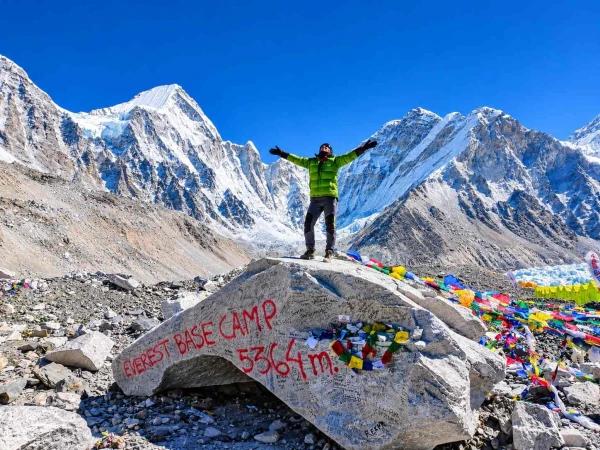
Everest Base Camp is a realistic first trek for many fit walkers. The trail needs no climbing skills. What it needs is time, two acclimatization days, and a willingness to turn back if your body says so. You sleep at around 5,160 m at Gorak Shep, which is where many people feel worst.
Lukla flights are the other variable. In busy seasons many depart from Manthali (Ramechhap), a 4 to 5 hour drive from Kathmandu, and weather delays are common. Plan two spare days.
Why Manaslu is usually a second trek, not a first
The Manaslu Circuit is a restricted area. You need a permit issued through a registered agency and a licensed guide the whole way. The trail is longer and more remote, lodges are simpler, and the Larkya La crossing at 5,106 m is a long, early-start day that can be cold and icy.
It can work for a determined first-timer with solid hiking experience at home. For most people, it is a better second Nepal trek, after you know how your body handles altitude.
How Much Does Trekking in Nepal Cost?
Your total cost has three parts: the package price, the extras outside it, and a contingency for delays. Most budgets go wrong on the second and third.
What our published package prices look like
These are per-person prices in US dollars, as shown on our trip pages on 15 October 2026. They cover the services listed on each page, not international flights, visa, insurance or tips.
|
Group size |
Annapurna Base Camp, 13 days |
Everest Base Camp, 14 days |
|
1 person (private) |
US$1,149 |
US$1,589 |
|
2 people |
US$987 |
US$1,379 |
|
3 to 6 people |
US$947 (4 to 6) |
US$1,349 |
|
7 to 10 people |
US$917 |
US$1,289 |
|
11 to 15 people |
US$847 |
US$1,239 |
The ABC price includes airport transfers, two hotel nights each in Kathmandu and Pokhara, tourist bus transport, ACAP and TIMS, a licensed guide, porter service, teahouse rooms and three meals a day on trek, plus a loaned sleeping bag, down jacket and duffel bag. The Everest price includes the Lukla flights (with shared transfer to Ramechhap in busy seasons), both Everest permits, guide, shared porter, two hotel nights in Kathmandu, teahouse rooms and trek meals.
Our Manaslu Circuit 14-day trip starts from US$911 per person for 2 to 6 people.
What is usually not included
- International flights and your Nepal visa
- Travel insurance with high-altitude evacuation cover
- Lunches and dinners in Kathmandu and Pokhara
- Hot showers, Wi-Fi and device charging in teahouses, which cost more the higher you go
- Drinks beyond those listed, including bottled water and alcohol
- Tips for your guide and porter
- Extra nights caused by weather, flight delays or a change of plan
On our ABC page we suggest about US$15 to 25 a day for personal extras on that route. Expect more on Everest, where everything is flown or carried higher.
Why two quotes for the same trek can differ by hundreds of dollars
The cheapest quote is a starting point, not a verdict. Compare the same trip, line by line:
- Hotel nights: how many, which category, and are they included at both ends?
- Transport: tourist bus, private jeep or flight? Who pays for the Ramechhap transfer?
- Meals: three a day on trek, or breakfast only?
- Guide and porter: licensed guide? How many trekkers per porter, and what weight limit per person?
- Permits: all of them, at today's fees?
- Equipment: sleeping bag and down jacket loaned, or extra?
- Group size: is the price based on a group you may not end up in?
- Cancellation and changes: what happens to your money if you cancel, or if weather changes the plan?
If a line is missing, ask. If the answer is vague, treat it as an extra cost.
Contingency money
Carry enough Nepali rupees in cash for the whole trek. Teahouses rarely take cards, and there are no reliable ATMs on most trails once you leave the road. Keep a separate reserve on a card for an unexpected hotel night or a rebooked flight.
When Should You Go Trekking in Nepal?
Autumn (late September to November) and spring (March to May) give most first-timers the best odds of dry trails and open views. They are also the busiest months, so book lodges and flights early. No season guarantees clear skies.
|
Season |
Months |
What to expect |
Trade-offs |
|
Autumn |
Late Sep to Nov |
Settled weather after the monsoon, clear mornings, cold nights up high |
Busiest trails and lodges; Lukla flights fill early |
|
Spring |
Mar to May |
Warmer days, rhododendron in bloom lower down |
Haze and afternoon cloud more common by May |
|
Winter |
Dec to Feb |
Quiet trails, often clear but very cold above 4,000 m |
Some high lodges close; snow can block passes and upper sections |
|
Monsoon |
Jun to Aug, often into early Sep |
Green valleys, few trekkers |
Daily rain, leeches, landslides on roads, cloud hides peaks, more flight cancellations |
How the season changes each route
- Poon Hill: works in every season except the wettest monsoon weeks. Winter mornings at the viewpoint are cold but often clear.
- Annapurna Base Camp: good in autumn and spring. In winter and after heavy spring snow, the narrow valley between Deurali and Machhapuchhre Base Camp can carry avalanche risk, and guides may hold groups until it is safe.
- Everest Base Camp: flights are the weak link. Fog and wind ground Lukla flights in any season, and monsoon cloud makes delays more likely. In winter, nights at Gorak Shep are severe.
- Manaslu: the Larkya La can hold deep snow from December onwards, and some high lodges close.
For a month-by-month view, read our guide to the best time to trek in Nepal.
Whatever month you pick, treat the itinerary as a plan, not a promise. Weather, roads and flights move the schedule more often than first-timers expect.
What Permits and Guide Arrangements Does Your Route Need?
Permits and guide rules differ by region, so check the rules for your exact route rather than for "Nepal". Here is what applies to the treks in this guide, as checked on 15 October 2026. Fees are per person for foreign (non-SAARC) nationals.
|
Route |
Permits and fees |
Guide rule |
How you get them |
|
Poon Hill, Annapurna Base Camp |
ACAP, NPR 3,000. TIMS card, NPR 2,000 |
Licensed guide required (NTB route list) |
Through a registered trekking agency |
|
Langtang Valley |
Langtang National Park entry, NPR 3,000. TIMS card, NPR 2,000 |
Licensed guide required (NTB route list) |
Through a registered trekking agency |
|
Everest Base Camp |
Sagarmatha National Park entry, NPR 3,000. Khumbu Pasang Lhamu Rural Municipality fee, NPR 3,000 |
Contested locally (see below) |
Park permit at Monjo or in Kathmandu; local fee in Lukla |
|
Manaslu Circuit |
Restricted Area Permit: US$100 for the first 7 days (Sep to Nov), US$15 a day after; US$75 and US$10 (Dec to Aug). Plus MCAP and ACAP. A local municipality fee is also collected |
Licensed guide always required |
Only through a registered agency, from the Department of Immigration |
Some counters add VAT to park and conservation fees. Your operator should show you the exact amount.
The guide rule, explained plainly
Under a revised TIMS rule in force since 31 March 2023, the Nepal Tourism Board lists the trekking routes where you must walk with a licensed guide and carry a TIMS card issued through an agency. The list includes the Poon Hill-ABC trek, Mardi Himal, the Annapurna Circuit, Langtang, the Manaslu routes and the Everest routes. NTB's page sets the TIMS fee at NPR 2,000 for most foreign trekkers and NPR 1,000 for SAARC nationals.
The Everest region is the exception in practice. The Khumbu Pasang Lhamu Rural Municipality runs its own entry permit, which rose to NPR 3,000 for most foreigners in 2024, and it has not applied TIMS. Published reports on whether the guide rule is enforced there disagree. Every Everest trek we run includes a licensed guide regardless, and we recommend one for any first-timer.
Restricted areas such as Manaslu
Restricted areas follow Department of Immigration rules, not the TIMS system. In March 2026 the department began issuing permits to individual trekkers, ending the old two-person minimum, but kept the conditions that matter: you book through a registered agency, you walk with a licensed guide, and one guide can lead at most seven trekkers (Kathmandu Post report via Asia News Network).
What to confirm before you pay
- Which permits the price includes, at which fee, and whether VAT is included
- That the guide is government-licensed, and their name before you arrive if possible
- What documents the agency needs (usually a passport copy and photos; restricted permits may need your original passport in Kathmandu)
- Who carries the permits on the trail. Checkpoints ask for them.
What Should You Pack for a Nepal Teahouse Trek?
Pack for warm afternoons in the valleys and freezing nights up high, then cut everything else. You walk with a daypack; a porter, if your package includes one, carries the main bag. Ask your operator for the weight limit per trekker before you pack.
Footwear
- Trekking boots with ankle support, already broken in on long walks at home
- Light shoes or sandals for the teahouse in the evening
- Four or five pairs of wool or synthetic hiking socks
Boots worn for the first time on day one are a common cause of blisters that slow down everyone in the group.
Clothing layers
- Two moisture-wicking base layers (top and bottom)
- A fleece or light insulated mid-layer
- A warm down jacket for evenings and early starts
- Two pairs of quick-dry trekking trousers
- Two or three trekking shirts
- Warm hat, sun hat, liner gloves and insulated gloves
Rain and cold protection
- Waterproof, windproof jacket
- Waterproof trousers (essential in spring and monsoon, useful in autumn)
- Pack cover or a liner bag inside your duffel
Daypack essentials
- 20 to 30 liter daypack
- Two water bottles or a bladder, plus purification tablets or a filter
- Sunglasses with strong UV protection, sunscreen and lip balm
- Headlamp with spare batteries
- Snacks, a small first-aid kit with blister plasters
- Power bank (charging costs extra and gets less reliable higher up)
- Toilet paper and hand sanitizer
Documents and money
- Passport, visa and copies
- Passport photos for permits
- Printed insurance policy with the emergency number
- Enough Nepali rupees in cash for the trek
Personal medication
Bring your regular medicines in their original packaging, plus anything your doctor prescribes for the trip. If you are considering acetazolamide for altitude, discuss it with your doctor before you travel.
Rent or buy?
Thamel in Kathmandu has many rental shops for sleeping bags and down jackets, which saves money and luggage space. On our Everest, Annapurna Base Camp and Manaslu packages we loan a sleeping bag and down jacket, so check what your own package includes before renting.
Boots are the one item to buy and break in at home.
What you can leave behind
- Heavy cotton clothes and jeans
- More than one warm jacket
- Full-size toiletries
- Laptops and spare electronics you will not use
- Large amounts of foreign cash you could leave in the Kathmandu hotel safe
Flying to Lukla? The baggage limit on that flight is usually 15 kg per person, including your hand luggage. Weigh your bag before you leave Kathmandu.
How Should You Prepare for Walking and Altitude?
Train for long, consecutive walking days, and plan your altitude around how high you sleep. Fitness makes the walking easier. It does not protect you from altitude illness, which can affect fit and unfit people alike.
This section is general education, not medical advice. Speak to a doctor or travel-health clinic about your own health before a high trek.
Train for the trek you chose
Start six to eight weeks before you fly if you can. Walk hills or stairs with a loaded daypack, and build up to two or three long days back to back. That second and third day matter more than speed. If your route has long descents, such as Annapurna Base Camp, train going downhill too.
Read the acclimatization plan, night by night
The CDC Yellow Book says any unacclimatized traveler sleeping at about 2,450 m or higher can get altitude illness. Its guidance, drawn from the Wilderness Medical Society, is:
- Avoid going from low altitude to a sleeping altitude above about 2,750 m in a single day
- Once above 3,000 m, raise your sleeping altitude by no more than about 500 m a night
- Add an extra night to acclimatize for every 1,000 m of sleeping altitude you gain
Most real itineraries break these rules on one or two nights because of where the villages sit. That is why the rest days, the walking pace and the willingness to stop matter so much. Ask your operator which nights exceed the guidance and what the plan is if you feel unwell.
Know the warning signs
Acute mountain sickness usually shows up as a headache with poor appetite, nausea, unusual tiredness, dizziness or bad sleep. Tell your guide early, even if it feels minor. Mild symptoms often settle with rest at the same altitude.
Some signs mean descend now, not tomorrow: confusion, stumbling or loss of coordination, breathlessness while resting, or a wet cough. These can point to the serious forms of altitude illness, HACE and HAPE.
Agree who makes the call
Before you start, agree with your guide how decisions are made. On our treks the guide checks how each trekker is doing every day, and our guides carry a pulse oximeter. The guide can stop an ascent or start a descent when symptoms call for it. A safe trek is one where turning back is a normal option, not a failure.
When to see a doctor before you go
See a doctor if you have a heart or lung condition, have had altitude illness before, are pregnant, take regular medication, or are considering preventive medicine such as acetazolamide. Bring their advice to your operator so the itinerary can reflect it.
What Is Daily Life on a Nepal Trek Actually Like?
A teahouse trek means walking from village to village and sleeping in simple family-run lodges. Comfort drops as you climb: lower villages can feel almost like guesthouses, while the highest lodges are basic, cold and busy in peak season.
A typical day
Breakfast is early, usually around 7. You walk through the morning, stop for lunch at a lodge on the trail, and arrive at the next village by mid-afternoon. Evenings center on the dining room, often the only heated room, where trekkers eat, play cards and go to bed early.
Rooms and bathrooms
- Rooms are usually twin share, with two beds, a pillow and a blanket
- Attached bathrooms exist in some lower villages and cost extra
- Higher up, expect shared toilets, sometimes squat style, and cold rooms
- Single rooms are often possible lower down, but not guaranteed at the highest lodges in peak season
Food
Dal bhat (rice, lentils and vegetable curry, usually with refills) is the staple and the most filling choice. Menus also offer noodles, fried rice, soups, momos, potatoes, porridge, eggs and pancakes. Menus shrink and prices rise with altitude, because everything is carried up. Vegetarian food is easy to find. Vegan is possible with clear communication, as many dishes use dairy or ghee, so tell your guide on day one.
Drinking water
Do not drink untreated tap or stream water. Treat refills with tablets, drops or a filter, or buy boiled water at the lodge. Refilling cuts plastic waste on the trail and usually costs less than bottled water.
Showers, charging and connectivity
Hot showers, device charging and Wi-Fi are normally paid extras. All three become less reliable and more expensive the higher you go, and hot water can disappear near the top in cold months. Mobile signal is patchy on every route. Treat connection as a bonus and tell family not to worry about a day or two of silence.
What Should Your Trekking Insurance Cover?
Your policy must cover trekking at the highest altitude on your itinerary, including helicopter evacuation, and you should confirm that in writing with the insurer. Many standard travel policies exclude trekking above a set height or leave out helicopter rescue.
Check these points against your exact route and dates:
- Activity: trekking is named as a covered activity, with no requirement for technical equipment
- Altitude limit: at least your highest point (4,130 m for ABC, 5,545 m for Kala Patthar, 5,106 m for the Larkya La)
- Evacuation: helicopter search, rescue and evacuation, and how much it pays
- Medical treatment: in Nepal, and repatriation home if needed
- Trip disruption: cancellation and curtailment, plus extra nights caused by flight delays
- Exclusions: pre-existing conditions, alcohol, and anything you do off the planned route
- Emergency process: the 24-hour assistance number, and whether the insurer must approve an evacuation before it happens
We ask every trekker for proof of insurance before departure. We cannot guarantee that a claim or an evacuation will be paid. Only your insurer can, so get the answers in writing before you fly.
Keep a printed copy of the policy and the emergency number in your daypack, and give a copy to your guide.
How Do You Choose a Trekking Company Without Guesswork?
Choose on evidence you can check, not on photos or the lowest price. A local agency or an overseas tour company can both run a good trek. What matters is how they answer the questions below, and whether the answers arrive in writing.
|
Check |
What to ask |
A good answer looks like |
|
Business identity |
Registration number, TAAN membership, office address |
Numbers you can quote back and verify, a real Kathmandu address |
|
Guide |
Is the guide government-licensed? Who will it be? |
A named, licensed guide, plus the guide-to-trekker ratio |
|
Quote |
Can I see every inclusion and exclusion? |
An itemized quote that matches the trip page |
|
Emergencies |
What happens if I get sick at altitude? |
A clear descent plan, evacuation contacts, and how insurance is used |
|
Changes |
What if a flight or the weather changes the plan? |
Who pays for extra nights, and how alternatives are chosen |
|
Cancellation |
What do I get back if I cancel? |
Written terms with dates and percentages |
|
Payment |
How much deposit, when is the balance due, any card fees? |
Stated amounts and dates, and a receipt for every payment |
Watch for quotes that leave out permits, use vague words like "full support", or change after you pay a deposit.
How we answer those questions
Thrill Himalaya Treks Pvt. Ltd. is a Kathmandu-based agency in Thamel, registered under NTB Reg. No. 3303/81/82 and a member of TAAN. Every trek we run uses a government-licensed guide. We send an itemized quote within 24 hours of your enquiry, and our full booking, payment and cancellation terms are on our Terms and Conditions page. We were named a TripAdvisor Travelers' Choice for 2026. You can read independent reviews on our TripAdvisor profile before you decide.
First-Time Trekking Mistakes Worth Avoiding
Most first-trek problems start at the planning stage, not on the trail. These six come up again and again.
- Choosing from a photograph. A view tells you nothing about the daily stages. Read the itinerary night by night before you fall for the picture.
- Comparing prices, not services. Two quotes for "Everest Base Camp, 14 days" can describe different hotels, transfers, porter ratios and meals. Compare line by line.
- Ignoring sleeping altitudes. The big jump is often in the middle of the itinerary, not on summit day. Find it and ask how it is handled.
- Buying gear you will rent cheaper. A heavy sleeping bag and expedition jacket bought for one trek often sit in a cupboard afterwards. Check what your package loans first.
- Leaving insurance and permits to the last week. Policies with high-altitude evacuation take time to compare, and permits need your documents.
- Treating the schedule as guaranteed. Weather, roads and flights move plans. Book your flight home with at least one spare day, two for Everest.
The route has to fit you. Not the other way around.
Your Nepal Trek Planning Checklist
Work through these in order. Each group should be complete before you move to the next.
Before you request a quote
- Fix your date window and total days in Nepal
- Pick two or three routes that fit your days and sleeping-altitude comfort
- Decide private or group
- Set a budget that includes flights, insurance, extras and tips
- Note any health conditions and talk to your doctor about high routes
Before you pay a deposit
- Get an itemized quote and compare it line by line
- Confirm which permits are included, and that the guide is licensed
- Read the cancellation, change and payment terms
- Ask how altitude problems and emergencies are handled
- Check the agency's registration and recent independent reviews
Before you travel
- Buy insurance that names trekking, your top altitude and helicopter evacuation
- Send passport copies and photos for permits
- Break in your boots on long walks
- Book your flight home with spare days
- Pack, weigh your bag, and check what your package loans
Before you start walking
- Attend the trek briefing and meet your guide
- Agree how decisions about turning back are made
- Withdraw enough Nepali rupees for the whole trek
- Keep your insurance details and emergency numbers in your daypack
Frequently Asked Questions
Can a beginner go trekking in Nepal?
Yes. Teahouse treks such as Ghorepani Poon Hill, Annapurna Base Camp and Everest Base Camp need no climbing skills. You need the fitness to walk 5 to 7 hours a day for several days in a row, and an itinerary with sensible acclimatization.
How do I choose my first trek in Nepal?
Start with your available days, then your comfort with sleeping altitude, then your budget. Poon Hill suits short trips and lower altitude. Annapurna Base Camp suits fit beginners who want high mountains without a mountain flight. Everest Base Camp suits fit beginners with spare days.
How many days should I allow for my first Nepal trek?
Allow about 8 days for Poon Hill, around 13 for Annapurna Base Camp from Kathmandu, and 14 for Everest Base Camp, plus at least one spare day. For Everest, add two spare days because Lukla flights are often delayed.
How much should I budget for trekking in Nepal?
Our guided packages currently range from about US$847 to US$1,149 per person for a 13-day Annapurna Base Camp trip and US$1,239 to US$1,589 for a 14-day Everest Base Camp trip, depending on group size. Add flights, visa, insurance, personal extras, tips and a contingency.
Do I need a guide for my Nepal trek?
On most popular routes outside Everest, yes. The Nepal Tourism Board requires a licensed guide and an agency-issued TIMS card on its listed routes, including Annapurna and Langtang. Restricted areas like Manaslu always require a guide. In the Everest region, local rules differ, but we still recommend a licensed guide for any first-timer.
Which permits do I need?
It depends on the region. Annapurna routes need ACAP and TIMS. Langtang needs a national park permit and TIMS. Everest needs the Sagarmatha National Park permit and the Khumbu municipality fee. Manaslu needs a restricted area permit, MCAP and ACAP.
Can I rent trekking equipment in Nepal?
Yes. Thamel in Kathmandu has many shops that rent sleeping bags and down jackets. Buy and break in your boots at home. Check whether your package already loans a sleeping bag and jacket, as ours do on the Everest, Annapurna Base Camp and Manaslu treks.
Can I combine trekking with sightseeing?
Yes. Many travelers add a day or two in Kathmandu for heritage sites such as Boudhanath and Pashupatinath, or extra nights in Pokhara. Tell us when you request a quote and we will build it into the itinerary.
Plan Your First Trek With a Local Team
Share your travel dates, the number of days you have, your recent walking experience and an approximate budget. We will reply within 24 hours with a suggested itinerary and an itemized quote you can compare with any other company's.
- WhatsApp +977 9851017941
- Email [email protected]
- Online Plan your trip
After you enquire, we confirm availability for your dates, answer your questions, and explain the deposit and booking steps in writing once you are happy with the plan.
Explore all Thrill Himalaya trekking packages
- Annapurna Base Camp with Mardi Himal Trek
- Annapurna Base Camp Trek - 10 Days
- Annapurna Base Camp Trek
- 6-Day Annapurna Base Camp Trek for Beginners
- Annapurna Base Camp Trek for Seniors
- Annapurna Base Camp Trek with Family and Kids
- Annapurna Circuit Trek
- Everest Base Camp Helicopter Tour
- Everest Base Camp Trek
- Everest Base Camp Trek via Salleri
- Everest Base Camp Trek with Heli Return
- Everest Base Camp Trek with Island Peak Climbing
- Everest Base Camp with Gokyo Lake Trek
- Everest Three Passes Trek
- Ghorepani Poon Hill Trek
- Gokyo Lake Trek
- Island Peak Climbing
- Manaslu Circuit Family Trek
- Manaslu Circuit Trek
- Manaslu Circuit Trek with Tsum Valley
- Mardi Himal Trek
- Mera Peak Climbing
- Pikey Peak Trek
- Short Annapurna Base Camp Trek -- 5 Days
- Short Annapurna Base Camp Trek -- 7 Days
- Short Manaslu Circuit Trek
- Tsum Valley Trek
Related travel and trekking blogs
- 7 Off-the-Beaten Treks in Nepal
- Annapurna Base Camp Trek Difficulty
- Best Time for Manaslu Circuit Trek
- Best Time to Trek in Nepal
- Best Treks in Nepal
- Manaslu Circuit Trek Complete Guide
- Dashain Tika Time 2026
- Everest Base Camp Trek in November
- How Difficult Is Manaslu Circuit Trek?
- How Do I Prepare for a Trek to Everest Base Camp?
- Manaslu Circuit Trek Duration
- Manaslu Circuit Trek Permits
- Is Nepal Safe After Flood?
- Langtang Valley Trek Distance
- Manaslu Circuit Trek: 14 Days Complete Itinerary from Kathmandu
- Manaslu Circuit Trek After Budhi Gandaki Flood
- Manaslu Circuit Trek Guide, Cost, Itinerary and Difficulty
- Manaslu Circuit Trek Nepal: Route, Highlights and Tips
- Manaslu Circuit Trek Guide
- Mount Everest Guide
- Nepal Premier League Cricket Travel Guide
- Nepal Travel Tips
- Tihar Festival in Nepal
- Mount Everest Guide