Group of trekkers walking along the scenic trail during a 10-day Annapurna Base Camp trek in Nepal
Breathtaking mountain view of the Annapurna massif from Annapurna Base Camp at 4,130 meters
Trekkers on a suspension bridge during the 10-day Annapurna Base Camp trekking adventure in Nepal

Annapurna Base Camp Trek 10 Days

40 reviews in TripAdvisor
Recommended by 99% of travelers
Duration10 Days
Trip GradeModerate
Maximum Altitude4,130 m / 13,549 ft
Group Size1 - 20 Persons
StartsKathmandu
EndsKathmandu
ActivitiesTrekking / Hiking
Best TimeSpring (March to May) & Autumn (September to December)

Is the 10-day ABC trek right for you? That is the question this page exists to answer, honestly and in full. This is the complete Annapurna Base Camp trek 10 days planning guide, from cost and itinerary to difficulty, permits, and the best time to trek, and it doubles as your Annapurna Base Camp trek 10 days booking page when you are ready to confirm dates. If you are choosing between the short Annapurna Base Camp trek 7 days, the 10 days Annapurna Base Camp trek, and the 12 to 13 days ABC trek, use this page as your decision hub.

The Annapurna Base Camp trek 10 days is the most balanced way to reach the heart of the Annapurna Sanctuary. In ten days you travel from Kathmandu to Pokhara, walk the classic tea house trek to 4,130 metres, sleep beneath Annapurna I and Machapuchare, soak in the Jhinu hot springs on the way down, and return to Kathmandu with time to spare before your flight home. Shorter versions rush the ascent. Longer versions suit slower travellers. Ten days is the sweet spot for most people, and among all Annapurna Base Camp trekking options, the 10-day ABC trek from Pokhara or Kathmandu is the most popular choice for first-time trekkers.

We are Thrill Himalaya Treks, a locally owned company based in Thamel, Kathmandu. Our government-certified guides walk this trail every season, so everything below comes from the trail, not from a brochure. Whether you want the Annapurna Base Camp trek from Kathmandu 10 days with full airport-to-airport service, or you are already lakeside and want the Annapurna Base Camp trek from Pokhara 10 days itinerary, we arrange both.

Why the 10-Day ABC Trek is the Best Option for Beginners

The logic behind Annapurna Base Camp trekking 10 days is simple: it gives your body time to adapt without wasting a single day of your holiday. Walking days average 4 to 7 hours. The altitude rises gradually along the classic route via Ghandruk and Chhomrong terrain. The schedule includes real recovery at the hot springs and buffer time on both ends, so a delayed flight or a snowy morning above Deurali does not wreck your plans.

For many people asking how many days for Annapurna Base Camp trek, the answer for beginners is 10 days. Seven-day versions demand back-to-back long days with no slack. Twelve and thirteen-day versions are lovely but need more leave than most working people have. Ten days means you reach base camp rested enough to actually enjoy standing there, which is the entire point of coming.

There is a second reason we recommend this length. Acclimatization on this route is naturally good because you sleep low and climb steadily, and the 10-day pacing preserves that advantage. Compress the schedule and you compress the safety margin. We would rather you summit smiling than summit exhausted.

Route Overview: Distance, Altitude & Elevation Profile

Trekkers often ask how many km is Annapurna Base Camp trek. This 10-day itinerary covers roughly 65 to 70 km in total on foot. The Annapurna Base Camp trek total distance in km and miles works out to about 40 to 43 miles across six walking days, four up and two down.

The highest altitude of the Annapurna Base Camp trek is 4,130 metres at base camp itself, with the overnight before at Deurali around 3,200 metres. The Annapurna Base Camp trek elevation profile with gradual ascent is one of this route's biggest advantages: elevation gain per day stays between roughly 400 and 800 metres on climbing days, which is exactly the range altitude medicine recommends. The entire trail is a well-supported tea house trek, with lodges, cooked meals, and hot drinks at every overnight stop, so you carry only a daypack while your porter handles the rest.

Annapurna Base Camp Trek Cost & Inclusions (2026 Price List)

How much does the Annapurna Base Camp trek cost? It is the first question everyone asks and the one most websites answer vaguely, so let us be direct about how pricing works instead of hiding behind a single number.

The average cost of Annapurna Base Camp trek for solo and group trekkers varies with three things: group size, season, and starting point. Annapurna Base Camp trek price ranges by season and group size are real, not a sales trick. Autumn departures in a group of four cost meaningfully less per head than a solo private trek in peak October. Here is our exact group-size pricing, so you never have to guess.

ABC Trek Price Per Person by Group Size

Group Size Price Per Person (USD)
1 person (solo) US$ 1,147
2 to 3 people US$ 997
4 to 6 people US$ 947
7 to 12 people US$ 897
13 to 20 people US$ 837

The bigger your group, the lower the ABC trek price per person. Bring three friends and everyone saves. Bring twelve and the trek costs US$ 837 each, all-inclusive as listed below.

What Is Included in the 10-Day Package

What matters more than the headline figure is what sits inside it. The total cost for Annapurna Base Camp trek 10 days including permits, guide and porter with us covers: all trekking permits, an experienced English-speaking licensed guide, porter service, tea house accommodation on the trail, hotel nights in Kathmandu and Pokhara as per itinerary, three meals a day while trekking, round-trip Kathmandu to Pokhara to Kathmandu flights, jeep transfers to and from the trailhead, airport pickups and drop-offs, a complimentary down jacket, sleeping bag and duffel bag for the trek, water purification tablets, a trekking certificate after you complete the route, and a farewell dinner in Kathmandu on your final evening. This is a transparent Annapurna Base Camp trek package cost with no hidden fees. The quote we send is the amount you pay.

Exclusions are the personal items every honest operator lists in writing: international flights, Nepal visa, travel insurance, drinks, hot showers on the trail, extra snacks, and tips for your crew. We put the full list in your booking documents before you pay anything.

Cost from Pokhara vs Kathmandu, and Rates for Nepali and Indian Trekkers

A few specifics people search for. The Annapurna Base Camp trek cost from Pokhara is lower than the Kathmandu version because you skip a full travel segment. The ABC trek price per person drops on a group trek and rises on a private trek, which runs entirely on your dates and pace. We offer a budget Annapurna Base Camp trek package for Nepali and Indian trekkers built around reduced domestic permit fees, so ask for your rate in NPR or INR. On the ABC trek budget vs luxury package question: our standard package uses good tea houses and reliable transport, while the luxury package adds single rooms, the best available lodges, and vehicle upgrades. And if you are hunting for a cheap Annapurna Base Camp trek cost without cutting safety or acclimatization, tell us your budget honestly. We will show you exactly what fits inside it, and we will never trim the guide, the insurance requirement, or the acclimatization pacing to hit a number. Some corners are not for cutting.

Why Should You Book the Annapurna Base Camp Trek 10 Days With Thrill Himalaya Treks?

Thrill Himalaya Treks is a registered local Nepali company (NTB Reg. No. 3303/81/82, TAAN member) operating from our own office in Thamel, Kathmandu. Here is exactly what you get with us that a booking platform or foreign reseller cannot give you.

Government-licensed local guides: Every guide is certified by Nepal's Ministry of Culture, Tourism and Civil Aviation and walks the ABC trail every season. Our lead guide Pemba Sherpa has spent decades on Annapurna routes.

5.0/5 rated, Travelers' Choice 2026: Travellers rate us 5.0 out of 5 across 98 TripAdvisor reviews. If you are comparing companies for the ABC trek, read those reviews before you read anyone's sales page, including this one.

Transparent pricing with no hidden fees: The quote we send is the amount you pay, with inclusions and exclusions listed in writing before any deposit. No surprise charges at any checkpoint or lodge.

Free trekking gear included: Every booking comes with a complimentary sleeping bag, down jacket and duffel bag, removing the most expensive purchases from your packing list. We also include water purification tablets and a trekking certificate.

24/7 WhatsApp support: You message people who have walked your exact route, before, during and after the trek, not a call centre abroad. Your family can reach our Kathmandu office at any hour while you are on the trail.

Honest advice, even when it costs us: If the honest answer is "do not trek that week," that is the answer you get. A company that answers to its reputation in its own city cannot afford anything less.

Small groups, beginner-friendly: We keep group sizes small and pace every departure to its slowest member. Complete ABC trek 10 days information for first-time trekkers is our specialty, because first-timers ask the best questions and we never get tired of answering them.

Responsible tourism and porter welfare: Our porters receive fair pay, proper gear, insurance and sensible loads, and the locally owned tea houses we use keep your money in the valley communities you walk through.

10 Days Annapurna Base Camp Trek Itinerary: Outline

Day 1: Arrival in Kathmandu, airport pickup, hotel transfer, trek briefing and gear check

Day 2: Kathmandu to Pokhara by flight or drive, jeep to Jhinu Danda, trek to Chhomrong

Day 3: Trek from Chhomrong to Dovan via Sinuwa (5 to 6 hours)

Day 4: Trek from Dovan to Deurali (3,200 m)

Day 5: Trek from Deurali to Annapurna Base Camp (4,130 m) via Machhapuchhre Base Camp, overnight at ABC

Day 6: Sunrise at base camp, descend to Bamboo via MBC and Deurali

Day 7: Trek from Bamboo to Jhinu Danda, evening at the hot springs

Day 8: Short walk to roadhead, jeep drive to Pokhara, free afternoon

Day 9: Fly Pokhara to Kathmandu, free time for shopping or sightseeing

Day 10: Airport transfer and final departure from Kathmandu
Itinerary
Trip PlanExpand all

Highlights: Arrival at Tribhuvan International Airport · Private transfer to your hotel · Full trek briefing and gear check with your guide · Evening free in Thamel

Your trip begins the moment you clear arrivals, where a Thrill Himalaya Treks representative meets you with a name board and a private vehicle for the short drive to your hotel. Once you have settled in, we sit down together for a full trek briefing: the route, the altitude profile, the daily rhythm, and what to expect from teahouse life. Then comes the gear check, item by item.

If anything is missing from your kit, Thamel's trekking shops are a five minute walk away, and we will point you to the honest ones. The evening is yours, and Thamel's restaurants make a good first taste of Nepal. Sleep well, because the mountains start tomorrow.

Good to know: Pack your broken-in boots, medications and one full trekking outfit in your hand luggage. If a checked bag arrives late, the trek can still start on time.

Max Altitude: 1,400m / 4,593ftAccommodation: 3 star Hotel, KathmanduMode of Transportation: Private Jepp / Van

Highlights: Morning mountain flight to Pokhara · Private jeep through the Annapurna foothills · ACAP permit check at Birethanti · Suspension bridge over the Modi Khola · Stone staircase through rhododendron forest · First views of Machhapuchhre from Chhomrong

An early transfer takes you to the domestic terminal for the 25 minute flight to Pokhara. Sit on the right side if you can, because the Himalaya runs along that window for most of the ride. In Pokhara your guide and a private jeep are waiting, and the road heads west through the foothills, stopping briefly at Birethanti so your guide can register your permits at the Annapurna Conservation Area checkpoint. The drive continues to Jhinu Danda (1,780m / 5,840ft), or the nearest driveable point if road conditions have shifted, which they do slightly by season.

From the road head, the trail crosses a long suspension bridge over the Modi Khola and climbs a stone staircase through rhododendron and bamboo forest to Chhomrong, the largest Gurung village on the route and your first real look at Machhapuchhre's fishtail summit. The trekking is deliberately short today. Between the flight, the drive and the climb, your body has done enough moving for one day.

Good to know: Chhomrong is the last village with proper shops on this route, so use the spare afternoon for a final gear check with your guide. Anything missing can still be dealt with here rather than further up.

Note: If you prefer to stay on the ground, the tourist highway drive from Kathmandu to Pokhara takes 6-8 hours and can replace the flight. It works best with adjusted timings or an extra night in Pokhara, so tell us at booking and we will build that version for you.

Max Altitude: 2,170m / 7,119ftMeals: Breakfast, Lunch, DinnerAccommodation: Teahouse, ChhomrongMode of Transportation: Flight, Private Jeep & On Foot

Highlights: The Chhomrong stone staircase · Suspension bridge over the Chhomrong Khola · Climb to Upper Sinuwa · Bamboo village and forest · Narrowing Modi Khola gorge

The day opens with the Chhomrong staircase, a long stone descent of well over two thousand steps to the suspension bridge across the Chhomrong Khola, followed immediately by a stiff climb to Upper Sinuwa (2,360m / 7,743ft). It is the most physically honest section of the trek, and it comes early, which is useful. You will know exactly what your legs are working with for the rest of the week.

Beyond Sinuwa the trail enters the sanctuary zone proper, where local custom keeps meat out of the teahouse kitchens from here up. The path runs through dense bamboo and rhododendron forest, where langur monkeys are a regular sighting, dropping to Bamboo village (2,310m / 7,579ft) before a steady climb along the river to Dovan. The valley narrows noticeably here, and the sky shrinks to a strip between the ridgelines.

Good to know: A slow, steady pace with trekking poles on the staircase will protect your knees far better than trying to power through it. You will meet these same steps again on Day 7, so make friends with them now.

Max Altitude: 2,600m / 8,530ftMeals: Breakfast, Lunch, DinnerAccommodation: Teahouse, DovanMode of Transportation: On Foot

Highlights: Himalaya village · Hinku Cave and its small shrine · Waterfalls across the gorge · Tree line thinning near Deurali · First routine oxygen saturation check

A shorter day by design, because you are crossing 3,000m and that is where altitude starts asking questions. There is no prize for reaching Deurali by lunchtime and then feeling terrible at dinner, so your guide keeps the pace measured and the water breaks frequent.

The forest thins past Himalaya village (2,920m / 9,580ft) and gives way to scrub and open rock, with the huge overhang of Hinku Cave, its small shrine tucked beneath, and waterfalls threading down the far wall of the gorge. Deurali sits at the mouth of the sanctuary, and its teahouses are a step up in comfort, generally with electricity and hot showers available. This is also the first night your guide checks oxygen saturation before dinner as routine practice. Not because we expect a problem, but because numbers caught early are easier to act on than symptoms caught late.

Good to know: Keep your water intake up through the day, since this altitude is where mild symptoms tend to show up first. The free afternoon at Deurali is not dead time either. Resting at 3,230m is exactly the acclimatization work a faster itinerary has to skip.

Max Altitude: 3,230m / 10,597ftMeals: Breakfast, Lunch, DinnerAccommodation: Teahouse, DeuraliMode of Transportation: On Foot

Highlights: Morning crossing of the gorge section · Machhapuchhre Base Camp · Crossing the tree line into alpine terrain · Overnight beneath Annapurna I, Annapurna South, Machhapuchhre, Hiunchuli and Gangapurna

This is the day you came for. The trail climbs through an avalanche-prone gorge section, which we time for morning when conditions are most stable, then opens out at Machhapuchhre Base Camp (3,700m / 12,139ft). Machhapuchhre itself, sacred to local Gurung communities, has never been climbed and remains off-limits to climbers, though you will walk directly beneath it for the rest of the day.

From MBC the last two hours to Annapurna Base Camp are gentler than the elevation suggests, and the sanctuary reveals itself gradually rather than all at once. Arriving with daylight still on the peaks, you get the full amphitheater in one sweep: Annapurna I, Annapurna South, Machhapuchhre, Hiunchuli and Gangapurna rising directly around camp. You sleep at 4,130m, ringed by peaks on every side, and reaching this point on the fifth day rather than racing up is the quiet safety advantage of this itinerary. Your sleeping altitude has risen in steps your body can actually keep up with.

Good to know: Afternoons here tend to cloud over, so an early start from Deurali gives you the best chance of a clear approach. Pack a warm layer for the evening, since temperatures at ABC drop fast after sunset even in good weather.

Note: In poor weather or during the busiest weeks of the season, your guide may adjust the overnight to Machhapuchhre Base Camp instead, with a day hike up to Annapurna Base Camp. Safety and teahouse availability take priority over the fixed plan.

Max Altitude: 4,130m / 13,549ftMeals: Breakfast, Lunch, DinnerAccommodation: Teahouse, Annapurna Base CampMode of Transportation: On Foot

Highlights: Sunrise over the Annapurna Sanctuary · Long descent via Machhapuchhre Base Camp and Deurali · Return through Himalaya and Dovan · The longest walking day of the trek

First light on Annapurna I is the reason people come, and it arrives early, so your guide will wake you before it. The peaks turn amber long before the sun reaches the basin floor, one of the finest mountain views in Nepal, and the temperature at that hour will make you glad of every layer you carried. Photograph it, drink your tea in the cold, then head back inside for breakfast.

From ABC, the trail retraces the route down through Machhapuchhre Base Camp, Deurali, Himalaya and Dovan, all the way to Bamboo. This is the longest day of the trek, and with close to 1,800m of elevation loss it is hard on knees rather than lungs. The consolation is that every hour of descent puts usefully thicker air back in your chest, so the effort gets easier as the day goes on.

Good to know: Trekking poles matter more today than on any other day, because sustained descent is harder on the knees than the climb up. Pack a rain layer too, as afternoon weather in the forest below Deurali can turn quickly.

Max Altitude: 2,310m / 7,579ftMeals: Breakfast, Lunch, DinnerAccommodation: Teahouse, BambooMode of Transportation: On Foot

Highlights: Final climb over the Chhomrong staircase · Descent to Jhinu Danda · Natural hot spring on the bank of the Modi Khola · Relaxed final evening in the hills

The last full trekking day climbs briefly to Sinuwa, drops to cross the Chhomrong Khola, then takes the Chhomrong staircase one final time. Uphill in this direction, it is best treated as a slow, steady toll rather than a race. From Chhomrong, familiar landmarks look different heading the other way, and the trail descends steadily to Jhinu Danda.

The natural hot spring sits a ten minute walk below the guesthouses, a set of stone pools beside the Modi Khola. Because this itinerary keeps the night at Jhinu rather than driving out the same day, most groups arrive early afternoon with plenty of time to use the spring properly rather than rushing it. After six days of stone steps, your legs will not need convincing, and dinner back at the lodge tends to be the loud one of the trip.

Good to know: Bring a swimsuit and a light towel for the hot spring. It is a small, informal spot with a modest entry fee, and exactly the reward you will want after the final staircase.

Max Altitude: 1,780m / 5,840ftMeals: Breakfast, Lunch, DinnerAccommodation: Teahouse, Jhinu DandaMode of Transportation: On Foot

Highlights: Breakfast in the hills · Short walk to the road head · Private vehicle back to Lakeside · Free afternoon by Phewa Lake

Breakfast at Jhinu, then a short walk brings you to the road head, where your private vehicle is waiting for the drive back down the Modi Khola valley. You are usually at your Lakeside hotel around midday, trading trail dust for hot water and a real mattress.

The afternoon is deliberately unscheduled. A slow walk along Phewa Lake, a cafe with a view of the mountains you have just stood beneath, an optional boat ride or massage: most trekkers settle for a long shower and an even longer dinner, and nobody argues with that choice.

Good to know: As on Day 2, the exact vehicle pickup point may shift slightly (Jhinu Danda vs. a nearby point) depending on current road conditions. Your guide will confirm the plan the evening before.

Max Altitude: 900m / 2,953ftMeals: BreakfastAccommodation: Hotel, Lakeside (Pokhara)Mode of Transportation: On Foot & Private Jeep/Van

Highlights: Morning flight along the Himalaya · Free afternoon in Thamel or optional valley sightseeing · Farewell dinner at a traditional Nepali restaurant · Certificate of Completion from Thrill Himalaya Treks

A morning flight returns you east to Kathmandu, and this time the mountains run along the left windows. The afternoon is free for last minute shopping in Thamel or extra sightseeing around the Kathmandu Valley. If you want a guided half-day tour of Boudhanath or Pashupatinath, tell us in advance and we will arrange it.

In the evening we host your farewell dinner at a traditional Nepali restaurant, with dal bhat and local dishes done properly and a cultural performance alongside. Over dinner, your guide presents you with a signed Thrill Himalaya Treks Certificate of Completion for the Annapurna Base Camp trek, a keepsake worth framing alongside your photos. It is the right way to close the loop: the whole group around one table, tired legs, full plates, and the past week already turning into stories.

Good to know: Keep the evening free of other plans. The farewell dinner usually starts around 6:30-7:00pm, and it is also the natural moment for thank-yous and goodbyes with your guide before tomorrow's departure.

Max Altitude: 1,400m / 4,593ftMeals: Breakfast, Farewell DinnerAccommodation: Hotel, KathmanduMode of Transportation: Flight & Private Jeep / Van

Highlights: Free morning depending on flight time · Private transfer to Tribhuvan International Airport · Trip ends where it began

Depending on your flight time, the morning is yours for a final coffee or one last wander through Thamel. Your private transfer collects you from the hotel with plenty of time, ideally three hours before an international departure, and the 10 days Annapurna Base Camp trek officially ends in Kathmandu, exactly where it began.

The final tally: two travel days, six trekking days, and two city days that quietly protected you from weather and flight delays. All that remains is the flight home and the slow business of explaining the photos.

Good to know: If your departure is late in the evening, ask us about a day room or luggage storage so the last day stays comfortable rather than improvised.

Max Altitude: 1,400m / 4,593ftMeals: BreakfastMode of Transportation: Private Jeep / Van
Start planning today.
Our travel experts are here to help. Our travel experts are here to help. Our travel experts are here to help.
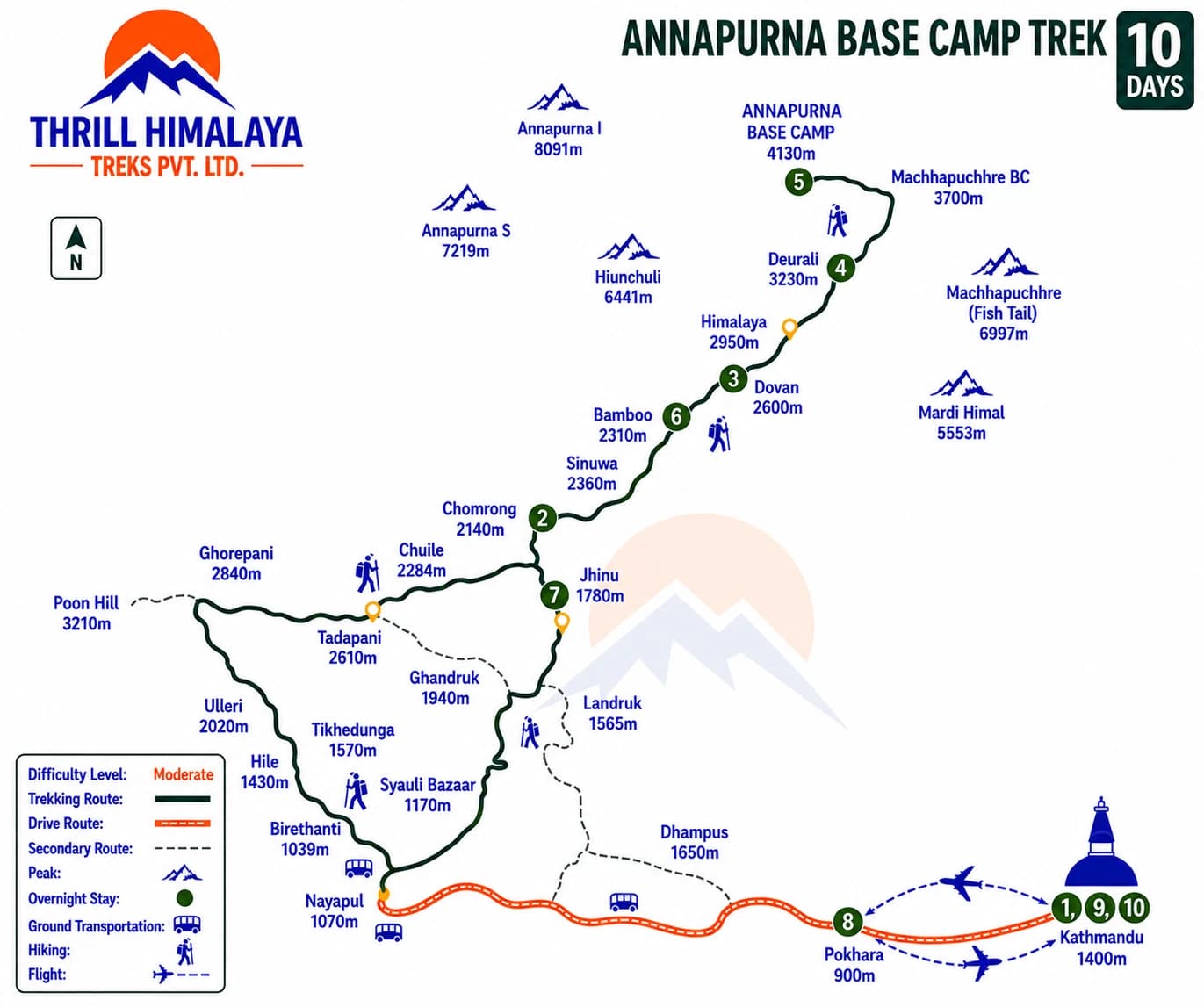
Route Map
Annapurna Base Camp Trek 10 Days route map showing Kathmandu, Pokhara, Chhomrong, Dovan, Deurali, Annapurna Base Camp, Bamboo, and Jhinu Danda itinerary by Thrill Himalaya Treks.
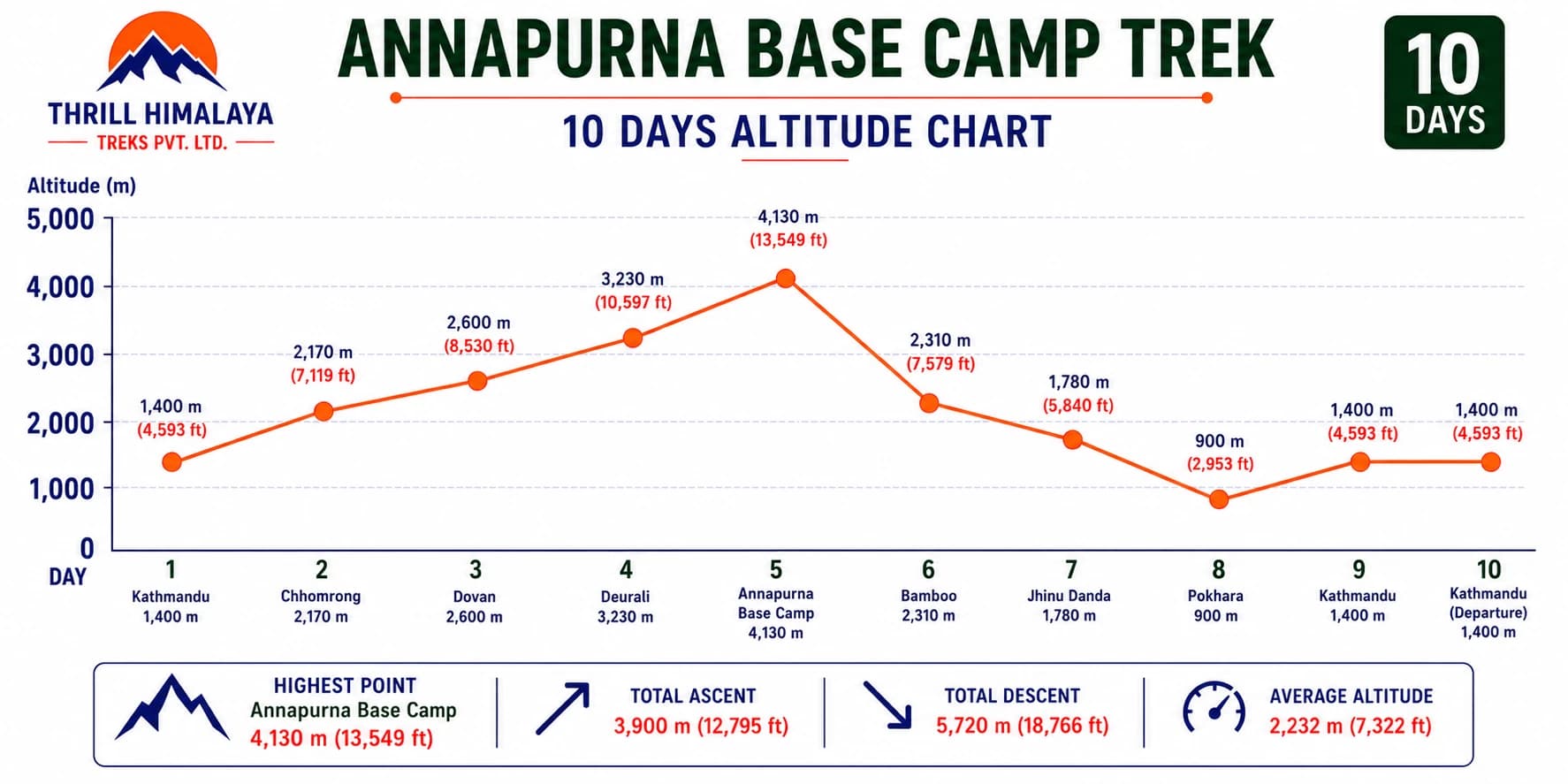
Altitude Chart
Annapurna Base Camp Trek 10 Days altitude chart showing daily overnight elevations from Kathmandu to Annapurna Base Camp (4,130 m) and return via Bamboo, Jhinu Danda, Pokhara, and Kathmandu by Thrill Himalaya Treks.
Cost Details
Includes

What Is Included in the Annapurna Base Camp Trek 10 Days Package

All trekking permits (ACAP and TIMS where applicable)

Experienced English-speaking licensed guide

Porter service (one porter for every two trekkers)

Round-trip Kathmandu to Pokhara to Kathmandu flights

Jeep transfers between Pokhara and the Jhinu trailhead

Airport pickups and drop-offs in Kathmandu

Hotel nights in Kathmandu and Pokhara as per itinerary

Tea house accommodation on the trail

Three meals a day while trekking (breakfast, lunch, dinner)

One cup of tea or coffee with breakfast each day

Complimentary down jacket, sleeping bag and duffel bag for the trek

Water purification tablets

Trekking certificate after you complete the route

Farewell dinner in Kathmandu on your final evening

Guide and porter wages, meals, accommodation and insurance

Excludes

What Is Not Included

International flights to and from Nepal

Nepal visa fees

Travel insurance (mandatory, covering trekking to 4,500 metres and helicopter evacuation)

Extra tea, coffee and soft drinks beyond the one cup with breakfast

Alcoholic drinks and bottled water

Hot showers and device charging on the trail

Extra snacks and personal expenses

Extra nights in Kathmandu or Pokhara outside the itinerary

Tips for your guide and porter

Any costs arising from events outside our control (flight delays, weather, early return)

Essential Information

Annapurna Base Camp Trek Difficulty & Fitness Requirements

Is the Annapurna Base Camp trek difficult? Moderately, and honestly no more than that. The difficulty level of the Annapurna Base Camp trek sits between Poon Hill, which is easier, and the Annapurna Circuit, which is harder and higher. Expect daily walking hours of 4 to 7 with plenty of breaks, long stone staircases around Chhomrong and Sinuwa, and cold nights above 3,000 metres. There is no technical climbing, no ropes, and no glacier travel anywhere on this route.

Is the 10-Day ABC Trek Suitable for First-Time Trekkers?

So how difficult is Annapurna Base Camp trek for beginners, specifically? Very manageable with preparation, and that is not marketing talk. If you are searching can a beginner do Annapurna Base Camp trek, this itinerary is built exactly for you. The stair sections are the hardest part, and they reward slow, steady walking rather than fitness heroics. Hundreds of our guests each year stand at base camp having never trekked in the Himalaya before.

Training Plan and Fitness Level Required

Is Annapurna Base Camp trek suitable for beginners in terms of fitness? Yes, provided you train a little. The minimum fitness level for Annapurna Base Camp trek is the ability to walk uphill for a few hours, sleep, and do it again the next day. A sensible training plan for Annapurna Base Camp trek 10 days looks like this: six to eight weeks of regular brisk walks, two stair or hill sessions per week, and two or three longer day hikes with a loaded daypack before you fly. That is how to prepare for the Annapurna Base Camp trek. You do not need a gym membership or mountaineering experience. You need consistency and decent knees.

Age Limit and Minimum Age

On age: the Annapurna Base Camp trek age limit we apply is a recommendation rather than a wall. Healthy trekkers aged 18 to 60 join without conditions. The minimum age for the Annapurna Base Camp trek with us is 15, accompanied by a parent, and trekkers over 60 are welcome with prior walking experience and medical clearance from their doctor. Our guides pace every group to its slowest member, every single day, without exception.

Altitude Sickness, Safety & Emergency Evacuation on the ABC Trail

Is the Annapurna Base Camp Trek Safe or Dangerous?

Is the Annapurna Base Camp trek safe, or is the Annapurna Base Camp trek dangerous? It is one of the safer high-altitude routes in Nepal, and here is why we can say that without flinching. The maximum sleeping altitude of 4,130 metres is significantly lower than treks that overnight above 5,000 metres, which keeps serious altitude illness less common. Is Annapurna Base Camp trek safe in 10 days when paced correctly? Yes, and the pacing is the operative phrase. Our itinerary climbs gradually, our guides carry oximeters and first aid kits, and we check on every trekker daily.

People also quietly search for the Annapurna Base Camp trek death rate, so let us address it plainly rather than pretend the question does not exist. Serious incidents on this trail are rare, and they cluster around two avoidable factors: crossing the avalanche-prone section between Deurali and base camp during or after heavy winter snowfall, and ascending too fast without acclimatization. Our route timing, weather monitoring, and 10-day pacing are designed around both risks. This is reassurance built on process, not on hope.

The altitude sickness risk on ABC trek and how we manage it deserves its own paragraph. Mild symptoms like headache and poor sleep can appear above 3,000 metres and usually settle with rest, hydration, and a slower pace. Our guides are trained to recognise the difference between normal adjustment and warning signs, and our rule is simple: if symptoms worsen, we descend, no negotiation, no summit fever. A written emergency evacuation plan backs every departure, with helicopter rescue coordination from Kathmandu if it is ever needed.

Travel Insurance Requirements

Travel insurance for the ABC trek covering trekking to 4,500 metres and helicopter evacuation is mandatory for all our guests. We will happily point you to insurers our past clients have used successfully. Do not trek this route uninsured with anyone, including us.

Guided vs Unguided ABC Trek

Finally, the guided Annapurna Base Camp trek vs unguided ABC trek pros and cons question. Rules on unguided trekking in Nepal have changed several times in recent years and enforcement varies by checkpoint, so we will not pretend the legal picture is fixed. The practical picture is fixed, though. Going guided means navigation handled, lodges secured in peak season when unguided trekkers get turned away from full tea houses, altitude monitored daily by someone trained to spot trouble, and a hundred small cultural doors that only open when a local knocks. Going unguided saves some money and costs you all of that. We think the trade is obvious, but we would rather you make it with clear eyes than with a slogan.

Best Time for the Annapurna Base Camp Trek: Month by Month

The best time for the Annapurna Base Camp trek is autumn and spring, and the best time to do Annapurna Base Camp trek for weather and views specifically is late September through November and March through May. Within those windows, the choices get more interesting.

Autumn (September to November)

We get many questions about the best month for Annapurna Base Camp trek; in practice October and April are the top choices. The Annapurna Base Camp trek in October and November delivers the most stable skies and the sharpest mountain views of the year. On the Annapurna Base Camp trek in September vs October question: late September is quieter and greener after the monsoon, but carries slightly more cloud risk, while October is busier and more reliable. Both are good; October is safer for photographers.

Spring (March to May) Rhododendron Season

Spring tells a different story. The Annapurna Base Camp trek in March and April rhododendron season wraps the lower forest in red and pink bloom, which turns the walk between Chhomrong and Dovan into something genuinely special. April is our personal favourite month on this trail, and March runs it close with fewer trekkers.

Winter and Monsoon: Should You Go?

Winter is possible with caveats. If you are planning an Annapurna Base Camp trek in December, January, or winter generally, talk to us first about snow and avalanche conditions above Deurali. Hardy trekkers who accept cold nights of minus 10 to minus 15 at base camp and possible route delays are rewarded with empty trails and crystalline air. Everyone else should pick autumn or spring. Monsoon, from June to August, means rain, leeches, and cloud-hidden peaks, and we only recommend it to trekkers who love solitude more than views.

Weather, Temperature and Packing List

Consider this your short Annapurna Base Camp trek weather forecast and temperature guide. Below 2,500 metres, trekking days are mild to warm in season, often 15 to 20 degrees in the sun. Above 3,000 metres, days cool quickly and the Annapurna Base Camp trek temperature at base camp drops below freezing at night in every month of the year, reaching minus 10 to minus 15 in deep winter. Mornings are cold, middays can be warm, evenings turn sharp within minutes of sunset. The answer to all of this is layering, not one heavy jacket.

What to Pack for the 10-Day ABC Trek

Your Annapurna Base Camp trek packing list starts with good trekking shoes, broken in properly before you fly, with ankle support for the stone staircases. Add warm base layers, a fleece mid-layer, a waterproof shell, warm hat and gloves, sunglasses, high-SPF sunscreen, a headlamp with spare batteries, a refillable water bottle with purification, blister care, and personal medication. Always carry rain protection, even in October, and pack layers for cold mornings at the top of your bag where you can reach them.

Here is the good news on trekking gear costs: we provide the sleeping bag and down jacket free with every booking, which removes the two most expensive purchases from your list. If you are wondering what to pack for short Annapurna Base Camp trek versions versus this 10-day itinerary, the core list barely changes; only quantities do. Send us your departure month and we will email a season-specific checklist, whether that is an Annapurna Base Camp trek packing list for October with heavier insulation or an April version with rain layers moved up the priority order.

Annapurna Trekking Permits: ACAP, TIMS Card & Regulations

This section answers the common question: what permits are required for Annapurna Base Camp trek, and do I need a guide?

The Annapurna Base Camp trek permit requirements start with the Annapurna Conservation Area Permit (ACAP), which every trekker on this route needs. The TIMS card for ABC trek and latest regulations are the moving part: TIMS remains standard paperwork for the region, but enforcement on the ABC trail has been inconsistent recently, so we confirm the current rule before every single departure and register whatever applies. You do not need to track Nepali regulatory updates from abroad. That is our job.

On the practical question of Annapurna Base Camp trek permit online or in Kathmandu/Pokhara: permits are issued through official counters in both cities, and as your operator we process them for you. Your side of the process is sending a passport copy and two photos. The Annapurna Base Camp trek permit cost is already included in your package price, so there is nothing extra to pay at any checkpoint.

Your Guide, Your Porter, and Responsible Tourism

local licensed guide for Annapurna Base Camp trekking changes the entire experience, and every guide we send is certified by Nepal's Ministry of Culture, Tourism and Civil Aviation. Our lead guide Pemba Sherpa has spent decades on Annapurna trails, and the team he has trained shares his habit of noticing things: the trekker who went quiet at lunch, the cloud bank building behind Machapuchare, the lodge with the best dal bhat in Dovan.

Porter welfare and responsible tourism on ABC trek routes are not footnotes for us. Our porters carry sensible loads, receive fair pay and proper gear, and are insured. The tea houses we use are locally owned, your money stays in the valley communities you walk through, and we follow leave-no-trace practice on every departure. Responsible tourism is not a badge on our website. It is how a local company behaves in its own mountains.

How Many Days Is the Annapurna Base Camp Trek? 7 vs 10 vs 12 to 13 Days

If you are still wondering how many days is Annapurna Base Camp trek, this section explains the difference between 7, 10 and 12 to 13 day itineraries, because the right answer depends on your fitness and your calendar, not on ours.

The Annapurna Base Camp trek 7 days itinerary is the short Annapurna Base Camp trek 7 days version, close to the minimum days for Annapurna Base Camp trek on foot. It compresses the route into long 7 to 8 hour walking days and suits fit, experienced hikers on tight leave. The short Annapurna Base Camp trek 7 days and short ABC 5 days from Pokhara are minimum-day options built for very fit trekkers, and we say that as a warning as much as a description. There is little slack for weather or tired legs.

The balanced 10 days Annapurna Base Camp trek, this page, is our most-booked option and the one we recommend to most first-timers. Sensible daily distances, hot springs recovery, city bookends in Kathmandu and Pokhara, and buffer built into the schedule.

The Annapurna Base Camp trek 12 days itinerary and its 13-day sibling are the slow and relaxed 12 to 13 days ABC itinerary choices, usually adding Poon Hill sunrise and extra acclimatization nights. Pick this pace for family groups, trekkers over 55, or anyone who wants more mornings in the mountains and fewer reasons to hurry. A short trek to Annapurna Base Camp for time-poor hikers exists at the other end of the scale, and we run both without judgment. Tell us your situation and we will tell you straight which one fits.

Explore Related Packages and Alternatives

If a different route or pace suits you better, one of these seven packages will fit.

ABC 13 Days Package: The slower classic with Poon Hill sunrise included and extra acclimatization nights. Ideal for trekkers who want gentler days and more mornings in the mountains.

Short ABC 5 Days from Pokhara: The fastest short trek to Annapurna Base Camp, built around road access for trekkers on a hard deadline. Best suited to fit hikers who can handle long walking days.

ABC 7 Days from Pokhara: The quick full route for strong hikers who want the whole trail without the city days. It skips Kathmandu entirely and packs the sanctuary into one focused week.

ABC for Beginners: A gentler pacing of the classic route with shorter walking days and extra rest built in. Designed for first-time trekkers who want base camp without pressure.

ABC for Senior Citizens: A relaxed itinerary with slow ascent, comfortable lodges, and close guide support throughout. Perfect for trekkers over 55 who want the sanctuary at their own pace.

ABC for Family and Kids: A family-friendly version with short daily stages, flexible rest days, and guides experienced with young trekkers. The safest way to share the Annapurna Sanctuary with your children.

Mardi Himal Trek: The quieter ridge-line alternative with dramatic close-up views of Machapuchare. If you have been weighing Mardi Himal vs Annapurna Base Camp, ask us about combining both in one itinerary.

Annapurna Base Camp Trek 10 Days FAQs

Thrill Himalaya Treks is a registered local Nepali company (NTB Reg. No. 3303/81/82, TAAN member) based in Thamel, Kathmandu, with government-licensed guides certified by Nepal's Ministry of Culture, Tourism and Civil Aviation. Travellers rate us 5.0 out of 5 across 98 TripAdvisor reviews, and we hold the Travelers' Choice 2026 award. You get transparent pricing with no hidden fees, fair porter welfare, a free sleeping bag, down jacket and duffel bag, and 24/7 WhatsApp support before, during and after your trek. We are locals guiding you in our own mountains, not a reseller.

The Annapurna Base Camp trek 10 days cost with Thrill Himalaya Treks starts at US$ 837 per person for groups of 13 to 20 and rises to US$ 1,147 for a solo trekker. Groups of 2 to 3 pay US$ 997 each, 4 to 6 pay US$ 947, and 7 to 12 pay US$ 897. The price includes round-trip Kathmandu to Pokhara flights, all permits, guide, porter, meals and accommodation. Season and starting point affect the final quote, so message us for your exact number.

Yes. The Annapurna Base Camp trek for beginners works best on the 10-day pacing, because it spreads the ascent across sensible daily stages with recovery built in. The minimum fitness level is the ability to walk uphill for a few hours, sleep, and repeat it the next day. Follow our 6 to 8 weeks training plan of regular walks, stair sessions and day hikes, and you will be ready. Beginners make up the majority of Thrill Himalaya guests on this route.

The difficulty level of the Annapurna Base Camp trek is moderate. It is harder than Ghorepani Poon Hill but easier and lower than Everest Base Camp or the full Annapurna Circuit. Expect 4 to 7 walking hours daily, long stone staircases around Chhomrong and Sinuwa, and cold nights above 3,000 metres, but no technical climbing, ropes or glacier travel anywhere on the route.

The minimum days for the Annapurna Base Camp trek on foot is about 5 to 7, but 10 days is the balanced choice for most trekkers. The short trek to Annapurna Base Camp in 7 days suits very fit hikers on tight leave. The 10 days Annapurna Base Camp trek adds acclimatization, hot springs recovery and buffer days, making it the best option for first-timers. The slow 12 to 13 days ABC itinerary with Poon Hill fits families, senior trekkers and anyone who prefers gentler days.

The Annapurna Base Camp trek itinerary 10 days runs: Day 1 arrival in Kathmandu; Day 2 fly to Pokhara, drive to Jhinu, trek to Chhomrong; Day 3 Chhomrong to Dovan; Day 4 Dovan to Deurali; Day 5 Deurali to Annapurna Base Camp at 4,130 metres, overnight at ABC; Day 6 sunrise at base camp, descend to Bamboo; Day 7 Bamboo to Jhinu Danda hot springs; Day 8 drive to Pokhara; Day 9 fly to Kathmandu; Day 10 final departure. Two travel days, six trekking days, two city buffer days.

The Annapurna Base Camp trek total distance on this 10-day itinerary is roughly 65 to 70 km, about 40 to 43 miles, across six walking days. Daily stages take 4 to 7 hours with breaks. Your Thrill Himalaya guide adjusts the pace to your group, and a porter carries your main bag so you walk with only a daypack.

The highest altitude of the Annapurna Base Camp trek is 4,130 metres at base camp itself. Mild symptoms like headache and poor sleep can appear above 3,000 metres and usually settle with rest, water and a slower pace. Our gradual elevation profile keeps daily gain between 400 and 800 metres, our guides carry oximeters and run daily checks, and serious altitude illness is rare on this route when paced correctly.

The Annapurna Base Camp trek is safe when paced correctly, and it ranks among the safer high-altitude routes in Nepal. Questions about the ABC trek death rate come up, so here is the honest picture: serious incidents are rare and cluster around two avoidable factors, the avalanche-prone section above Deurali in heavy winter snow, and climbing too fast. Thrill Himalaya's 10-day pacing, weather monitoring, daily health checks and written evacuation plan are built around both risks.

The best time to trek Annapurna Base Camp is autumn (late September to November) and spring (March to May). October delivers the most stable skies and sharpest views, while April adds rhododendron bloom on the lower trail. Winter treks are possible for hardy walkers who accept snow risk and cold nights, and monsoon suits only trekkers who prefer solitude over views.

Consider this the short Annapurna Base Camp trek weather and temperature guide: below 2,500 metres, trekking days are mild to warm in season, often 15 to 20 degrees in the sun. Above 3,000 metres the weather changes fast, and the temperature at base camp drops below freezing at night in every month, reaching minus 10 to minus 15 in winter. Layering beats one heavy jacket every time.

The Annapurna Base Camp trek permit requirements start with the Annapurna Conservation Area Permit (ACAP). A TIMS card for the ABC trek remains standard paperwork, though enforcement on this route has been inconsistent recently, so we confirm the current rule before every departure. Thrill Himalaya Treks arranges all permits from a passport copy and two photos, and permit costs sit inside your package price.

Rules on guided vs unguided trekking in Nepal have changed several times in recent years and enforcement varies by checkpoint. Our recommendation does not change: trek with a local licensed guide. A guide handles navigation, secures lodges in peak season when solo trekkers get turned away, monitors your altitude daily, and opens cultural doors that stay closed to strangers. The saving from going unguided is not worth what it costs you.

The Thrill Himalaya Annapurna Base Camp trek package includes all permits, a licensed English-speaking guide, porter service, tea house accommodation, hotels in Kathmandu and Pokhara, three meals a day while trekking, round-trip Kathmandu to Pokhara flights, jeep transfers, airport pickups, a free down jacket, sleeping bag and duffel bag, water purification tablets, a trekking certificate, and a farewell dinner in Kathmandu. Exclusions are international flights, Nepal visa, travel insurance, drinks, hot showers on the trail, and crew tips.

The ABC trek price per person drops as your group grows: US$ 1,147 solo, US$ 997 for 2 to 3, US$ 947 for 4 to 6, US$ 897 for 7 to 12, and US$ 837 for 13 to 20. A private trek costs more but runs entirely on your dates and pace. On budget vs luxury: our standard package uses good tea houses, while the luxury upgrade adds single rooms and the best available lodges.

Yes. The Annapurna Base Camp trek cost for Nepali and Indian trekkers is lower thanks to reduced domestic and SAARC permit fees, and Thrill Himalaya Treks quotes these rates directly in NPR or INR. The itinerary, guide, porter and inclusions stay identical; only the permit structure and price change. Message us on WhatsApp for your rate.

Your Annapurna Base Camp trek packing list starts with broken-in trekking shoes with ankle support, then warm base layers, a fleece, a waterproof shell, hat and gloves, sunglasses, sunscreen, a headlamp, a water bottle, blister care and personal medication. Thrill Himalaya provides the sleeping bag, down jacket and duffel bag free, which removes the most expensive gear from your list. Tell us your month, whether October or April, and we send a season-specific checklist.

The entire route is a tea house trek, with simple twin rooms, warm dining halls and locally owned lodges at every overnight stop. Meals cover Dal Bhat, noodles, soups, pasta and cooked breakfasts, and Dal Bhat remains the best value and the best fuel on the trail. Safe drinking water comes from boiled or filtered sources plus the purification tablets included in your package, so you never need to buy plastic bottles.

Yes, with limits. Tea houses offer charging, usually for a small fee that rises with altitude, and Wi-Fi is available at many lodges but gets patchy and slow above Dovan. We recommend a 10,000 to 20,000 mAh power bank, airplane mode during the day, and offline maps downloaded before you leave Pokhara. Your Thrill Himalaya guide stays reachable for your family through our Kathmandu office throughout.

The minimum age for the Annapurna Base Camp trek with Thrill Himalaya is 15, accompanied by a parent. Healthy trekkers aged 18 to 60 join without conditions, and trekkers over 60 are welcome with prior walking experience and medical clearance. Family groups are very welcome; for younger children or mixed-age families, our 12 to 13 days ABC itinerary with Poon Hill offers gentler pacing, and our dedicated ABC for Family and Kids package is built exactly for this.

A sensible training plan for the Annapurna Base Camp trek 10 days takes 6 to 8 weeks: regular brisk walks, two stair or hill sessions per week, and two or three longer day hikes with a loaded daypack before you fly. Add light squats and step-downs to protect your knees on the descents, since the stone staircases work your legs in both directions. No gym membership or mountaineering experience required.

Travel insurance for the ABC trek must cover trekking to 4,500 metres, helicopter evacuation and medical expenses, and it is mandatory for every Thrill Himalaya guest without exception. Helicopter rescue from the sanctuary costs thousands of dollars uninsured, which is why this is the one requirement we never flex on. We can suggest insurers our past clients have used successfully.

Completely. Add Poon Hill sunrise, extend in Pokhara, start from Pokhara instead of Kathmandu, or convert to a private departure on your dates. Popular combinations include the Mardi Himal and Annapurna Base Camp trek together in one itinerary, the Poon Hill and ABC combo in spring, and an Annapurna Circuit and ABC trek combination for walkers with three weeks. The 10-day frame is the starting point, not a cage.

The main risks are the winter avalanche zone between Deurali and base camp, altitude sickness from ascending too fast, and slippery trail sections after rain or snow. Thrill Himalaya manages them with route timing that avoids the avalanche window, a gradual elevation profile with daily oximeter checks, a descend-first rule when symptoms worsen, and guides who read trail and weather conditions every morning. Our best Annapurna Base Camp trek safety tip: walk slowly, drink constantly, and tell your guide everything.

Booking takes one message. Contact us on WhatsApp at +977 9851017941 or email [email protected] with your travel window and group size, and a trekking specialist replies within 24 hours with a personalised itinerary and exact quote. A 20% deposit confirms your departure, the balance is payable in Nepal, and we stay flexible on date changes if flights or weather shift. From there we arrange permits, hotels, transport and crew, and you show up in Kathmandu ready to walk.

Need Help?
Feel free to call or WhatsApp our expert.
Need Help? Call Us.+977 9851017941