Annapurna Base Camp Trek for Seniors - 15 Days

40 reviews in TripAdvisor
Recommended by 99% of travelers
Duration15 Days
Trip GradeModerate
Maximum Altitude4,130 m / 13,549 ft (Annapurna Base Camp)
Group Size1 to 12 persons (Private & Small Group)
StartsKathmandu, Nepal
EndsKathmandu, Nepal
ActivitiesTrekking, Cultural Sightseeing, Hot Spring Bathing
Best TimeAutumn (Sept–Nov) & Spring (March–May)

The Annapurna Base Camp trek for seniors is achievable for healthy trekkers aged 55 to 75 who walk regularly, pass a pre-trip medical check, and follow a slow itinerary. Our 15-day Kathmandu to Kathmandu route limits most trekking days to 3-5 hours, spreads the ascent over five gradual stages, includes guaranteed porter support, and gives guides full authority to shorten or adjust any day. Base camp sits at 4,130 m, notably lower and gentler than Everest Base Camp.

The Annapurna Base Camp trek for seniors brings us two kinds of enquiries. Seniors ask, "Can I still do Annapurna Base Camp after 60?" Their adult children ask, "Is this trek safe for my parents?" This page answers both honestly, because a senior trek sold with false confidence is a trek that goes wrong.

Here is the short version after 14 years of guiding in Nepal. Age is not the barrier most people assume. Every season I watch trekkers in their 60s, and occasionally their 70s, walk into the Annapurna Sanctuary and stand at base camp with tears in their eyes.

What decides success is not your birth year. It is three things: your walking habit, your health screening, and your itinerary. You control the first, your doctor confirms the second, and this 15-day slow-paced ABC trek is our answer to the third.

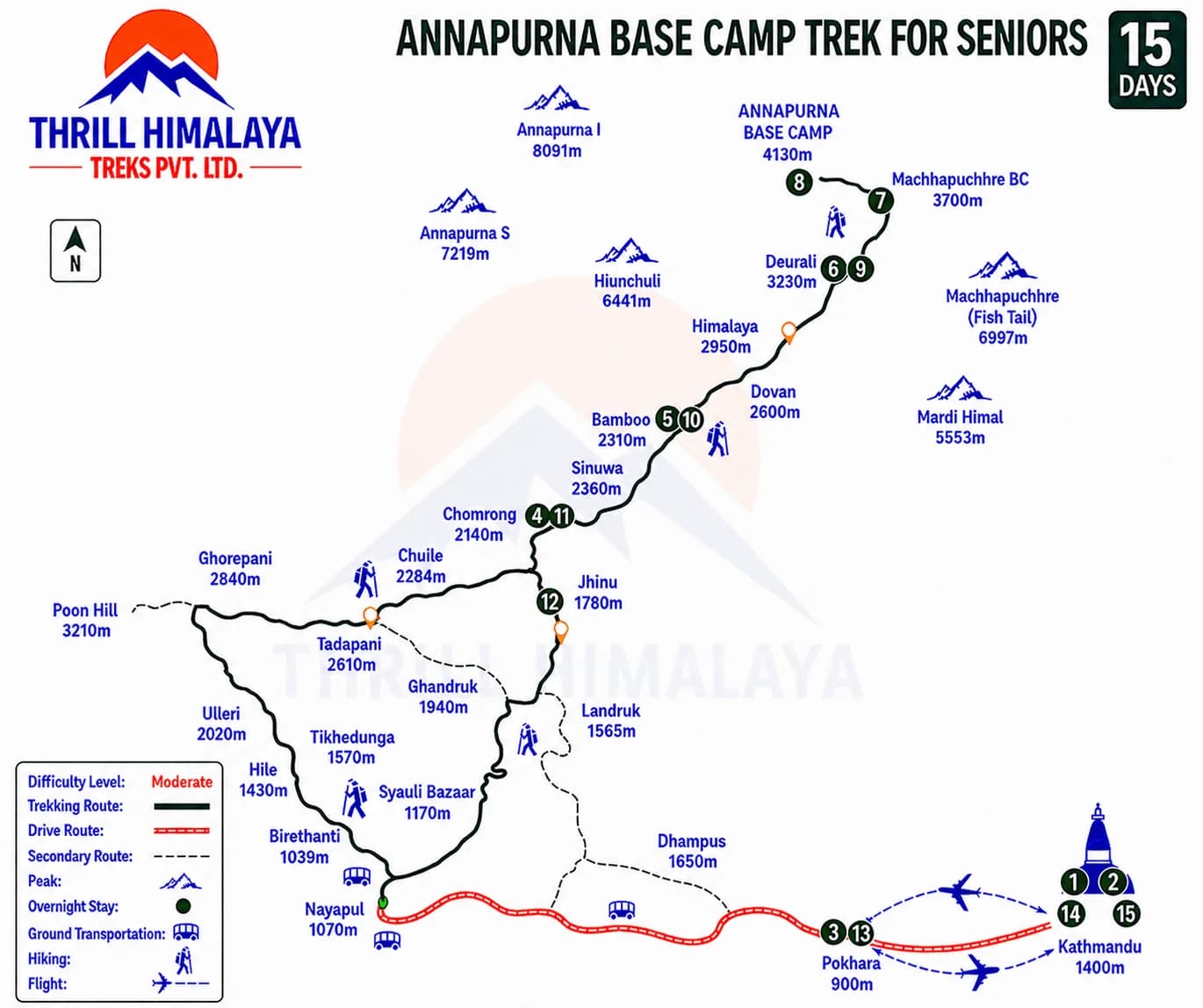
This is our slow-paced Annapurna Base Camp trek itinerary for seniors, 15 days from Kathmandu, designed around short walking hours and gradual ascent.

Compare it with the standard market offer. Most agencies sell seniors the same 10-12 day ABC package they sell everyone, with the same 6-7 hour walking days. We built this route differently: two acclimatization and sightseeing days before you take a single step on the trail, an ascent spread over five short stages, a descent spread over four, and buffer built in so nobody ever pushes through exhaustion to keep a schedule.

Highlights of the Annapurna Base Camp Trek for Senior Citizens

Highlights of the Annapurna Base Camp trek for senior citizens combine the mountains you dreamed about with the pacing your body deserves:

  • Standing at Annapurna Base Camp (4,130 m) inside a natural amphitheatre of peaks: Annapurna I (8,091 m), Annapurna South, Hiunchuli and the sacred fishtail summit of Machhapuchhre
  • five-stage gradual ascent (Chhomrong, Bamboo, Deurali, MBC, ABC) that no standard itinerary offers
  • Walking days of mostly 3-5 hours at a gentle pace, with the freedom to shorten or split any day
  • Guaranteed porter support so you carry nothing heavier than water, layers and a camera
  • joint-friendly four-day descent instead of the knee-punishing two-day rush most treks use
  • The natural Jhinu Danda hot spring on the way down, the perfect recovery soak for tired muscles
  • Two full days of Kathmandu heritage sightseeing and Pokhara lakeside relaxation before the trail begins
  • Government-certified guides selected for patience and experience with older travellers
  • Private or small-group departures only, never mixed with fast young trekking groups
  • trekking certificate at the end, and a story your grandchildren will retell for you

Can Senior Citizens Do the Annapurna Base Camp Trek?

Senior citizens can do the Annapurna Base Camp trek, with three honest conditions. Meet all three and this trek is realistically within reach for most people aged 55 to 75.

  1. You walk regularly. If you comfortably walk 2-3 hours at home, hike occasionally, or play a walking sport like golf, you have the base this itinerary needs. Marathon fitness is not required; consistency is.
  2. Your doctor agrees. We ask every trekker over 55 to complete a pre-trip medical consultation covering blood pressure, heart health, joint condition, and any medication that behaves differently at altitude. This is not bureaucracy; it is how we keep our safety record.
  3. You accept the slow philosophy. This trek has no prizes for speed. Guides set a deliberately gentle pace, and trekkers who want to race ahead frankly belong on a different package.

The oldest trekker we regularly plan for is around 75, always subject to health screening. Beyond that we recommend the Ghorepani Poon Hill route or a scenic Annapurna foothills walk, and we will say so plainly rather than take a booking that worries us.

One more honest point. The ABC trail has no road access, no shortcuts and no cable car. Once you commit to the upper valley, walking or helicopter are the only ways out. That is exactly why we screen carefully before booking, not after.

Why Is This 15-Day Itinerary Ideal for Older Trekkers?

This 15-day itinerary is ideal for older trekkers because every hard number in it was chosen for aging knees, hearts and recovery times. The comparison with a typical package tells the story faster than paragraphs can:

  Typical 10-12 Day ABC This 15-Day Senior ABC
Walking hours per day 5-7 hours Mostly 3-5 hours
Ascent stages to ABC 3-4 stages, one big final push 5 short stages: Chhomrong, Bamboo, Deurali, MBC, ABC
Descent 2-3 long days 4 relaxed days, joint-friendly
Pre-trek acclimatization None 2 days in Kathmandu and a Pokhara day before trekking
Porter support Optional extra Guaranteed, included
Flexibility Fixed schedule Guides shorten or extend any day based on your energy

Notice the Bamboo overnight on the way up. Standard itineraries skip it and walk Chhomrong to Dovan in one long day. Adding it cuts the two hardest ascent days almost in half. Small change, enormous difference for knees, hips, and heart rate.

If you are searching for the easiest Annapurna Base Camp trek for older travellers, this slow 15-day plan is the safest option: short days, five-stage ascent, four-stage descent, and guaranteed porter support.

How Much Does the Senior-Friendly Annapurna Base Camp Trek Cost?

The senior-friendly Annapurna Base Camp trek cost reflects a simple truth: a slower trek costs more than a rushed one. More nights, more staff days, more flexibility held in reserve. We believe the comfort and safety margin is worth every rupee, and our reviews from older trekkers agree.

Group Size Price Per Person (USD)
Solo trekker US$ 1,527
2-3 people US$ 1,377
Group of 4-6 US$ 1,347
Group of 7+ US$ 1,327

What Medical Preparation Do Seniors Need Before Trekking ABC?

Medical preparation seniors need before trekking ABC starts with one appointment: a consultation with your own doctor 4-8 weeks before departure. Bring this page. Complete this checklist together:

  • General fitness clearance for sustained walking at altitudes up to 4,130 m
  • Blood pressure review: stable, well-controlled BP is compatible with this trek; uncontrolled hypertension is not
  • Heart health: discuss any history of cardiac conditions; your doctor may advise a stress test
  • Medication check: confirm how your regular medication behaves at altitude, and whether preventive acetazolamide (Diamox) suits you; this is your doctor's call, not ours
  • Joint assessment: knees and hips take the descent load; poles and porter support offset most of it, but pre-existing severe joint conditions need honest discussion
  • Diabetes management: well-controlled diabetes is compatible with this trek; carry double medication supplies and discuss altitude effects on glucose with your doctor
  • Insurance: a policy covering trekking to 4,500 m with helicopter evacuation cover is mandatory, and we verify your policy wording with you before departure

On the trail, your guide carries a first aid kit and monitors you daily: pace, breathing, appetite, sleep, and symptoms. Guides on our senior departures are chosen specifically for experience with older clients and hold full authority to adjust the plan.

We do not push pace for seniors. Your health comes before our schedule, every time. That sentence is company policy, written down, and every guide who works our senior departures signs it.

How Should Seniors Train for the Annapurna Base Camp Trek?

Seniors should train for the Annapurna Base Camp trek for 8 to 10 weeks, gently and consistently. You are not training for speed. You are training joints, heart and lungs for consecutive short walking days on uneven ground and stone steps.

Weeks Before Focus What to Do
10-9 Daily walking habit Walk 45-60 minutes daily at conversational pace. Flat ground is fine at this stage.
8-7 Add gentle hills Two hill or incline walks per week. Introduce trekking poles now so they feel natural by departure.
6-5 Stairs and balance Two stair sessions weekly, 15-20 minutes, using the handrail freely. Simple balance exercises: standing on one leg while brushing teeth genuinely helps.
4-3 Longer outings One 3-4 hour walk each weekend in your trekking footwear, carrying a light daypack with water.
2 Back-to-back days Two consecutive 3-hour walks on one weekend. This is the single best predictor of trail comfort.
1 Taper Short easy walks only. Rest well, hydrate, finish packing.

Three senior-specific training truths from the trail. First, downhill strength matters more than uphill fitness at this age; practise descending stairs and slopes deliberately. Second, trekking poles reduce knee load by roughly a quarter on descents, which is why we call them non-negotiable. Third, consistency beats intensity every single time; a daily 45-minute walk prepares you better than a weekly exhausting hike.

How Many Hours Do Seniors Walk Each Day on This Trek?

Seniors walk mostly 3 to 5 hours each day on this trek, with the longest day around 5-6 hours on the descent. Every walking figure assumes a gentle pace with generous tea breaks, and your guide can split or shorten any stage. The full plan sits in the itinerary below.

What Support Do Seniors Get on the Annapurna Base Camp Trail?

Support seniors get on the Annapurna Base Camp trail is the deepest of any package we run, because support is what turns a hard trek into an achievable one:

  • Guaranteed porter support included: you carry only a light daypack with water, layers and camera
  • Small groups or private departures: senior departures never mix with fast young groups; most run privately
  • Optional assistant guide for couples or groups wanting one-to-one attention on harder sections
  • Lodge selection with seniors in mind: where the route allows, we book quieter lodges and request ground-floor or low-stair rooms
  • Daily flexibility: late starts, extra tea stops, shortened stages; the itinerary serves you, not the other way around
  • Daily health monitoring: your guide checks pace, breathing, appetite and sleep every day, quietly and without fuss
  • 24/7 WhatsApp line so family at home can reach our Kathmandu office at any point during the trek

Why Do Seniors and Their Families Trust Thrill Himalaya?

Seniors and their families trust Thrill Himalaya because our safety-first philosophy is written down, not just spoken:

  • Founder-led experience: I am Pravin Baniya, a trekking guide for 14 years before founding Thrill Himalaya Treks, and I personally review every senior departure plan
  • Safety-first philosophy in writing: pre-trek medical screening, insurance verification, written evacuation plans, and guides empowered to change plans without asking our office first
  • Licensed and established: NTB Reg. No. 3303/81/82, TAAN member, locally owned in Kathmandu, Nepal
  • TripAdvisor Travelers' Choice 2026, 5.0/5 across 98 reviews, top 3% of Kathmandu outdoor activities
  • Guides selected for seniors: patience and experience with clients over 55 are hiring criteria on these departures, not luck
  • Family communication: your adult children can message our 24/7 WhatsApp line for updates while you trek
  • Honest routing advice: if Poon Hill suits you better than ABC, we will say so and happily sell you the shorter trek

How Do I Book the Annapurna Base Camp Trek for Seniors?

Booking the Annapurna Base Camp trek for seniors takes four steps, whether you book for yourself or for your parents:

  1. Message us on WhatsApp (+977 9851017941) or email [email protected]; tell us age, walking habits, and any health conditions you are comfortable sharing
  2. Free suitability consultation: we reply within 24 hours with an honest assessment and, if needed, a suggestion for a gentler alternative
  3. Doctor's clearance and insurance check with our guidance
  4. Confirm with a 20% deposit; balance payable in Nepal (4% card surcharge applies)

Annapurna Base Camp Trek Itinerary for Seniors – 15 Days Kathmandu–Kathmandu

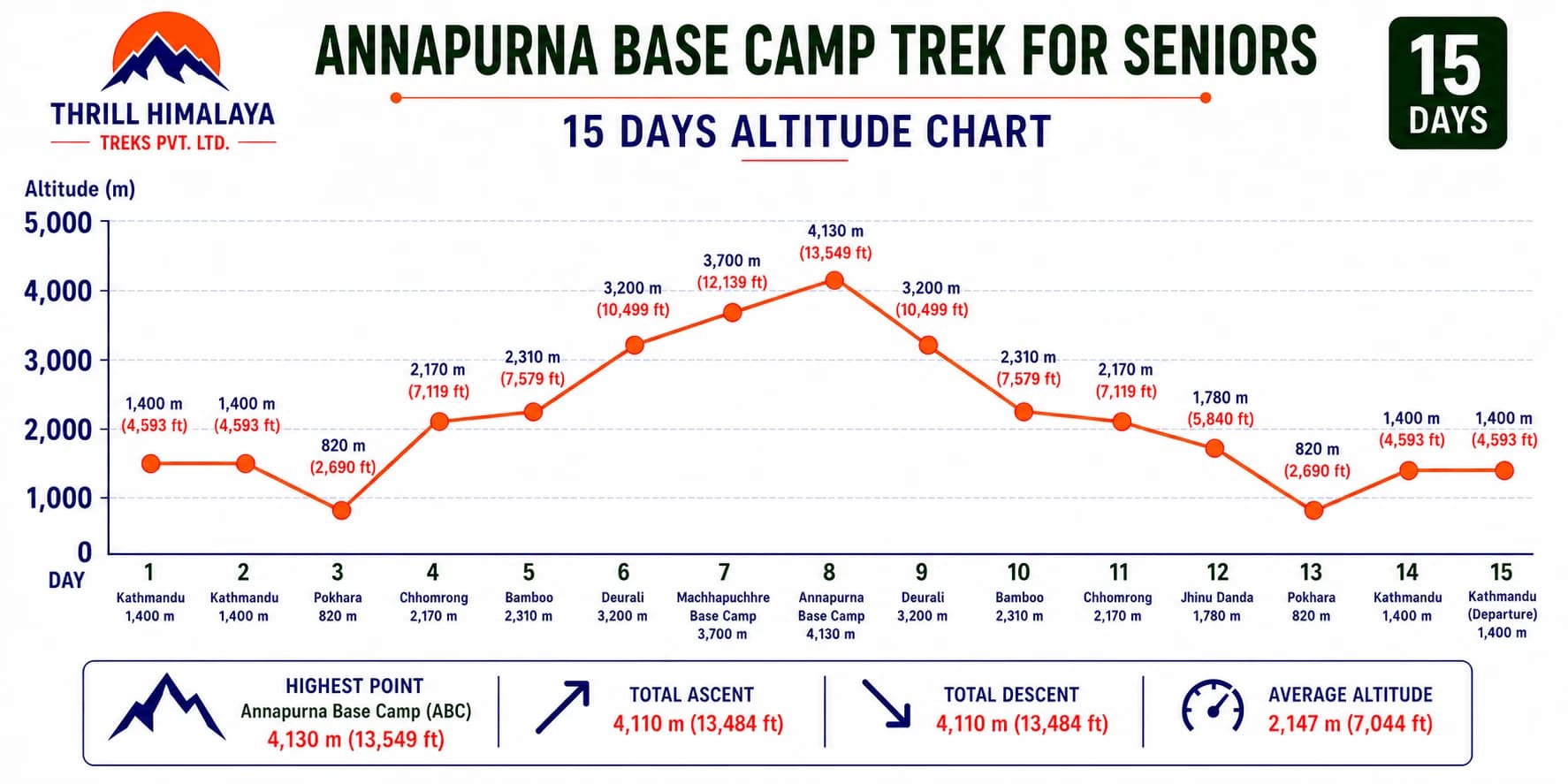
The Annapurna Base Camp trek itinerary for seniors runs 15 days from Kathmandu to Kathmandu. First the overview table, then a detailed description of every day so you and your family know exactly what each stage involves:

Day Plan Walking Sleep Altitude
1 Arrive Kathmandu, rest and briefing - 1,400 m
2 Kathmandu heritage sightseeing (4 sites, private vehicle) Gentle city walking 1,400 m
3 Fly to Pokhara, lakeside and viewpoint at leisure Optional strolls 820 m
4 Drive to Jhinu, trek to Chhomrong 3-4 hrs 2,170 m
5 Chhomrong to Bamboo 4-5 hrs 2,310 m
6 Bamboo to Deurali 4-5 hrs 3,200 m
7 Deurali to Machhapuchhre Base Camp 3-4 hrs 3,700 m
8 MBC to Annapurna Base Camp 2 hrs 4,130 m
9 Sunrise at ABC, descend to Deurali 3-4 hrs 3,200 m
10 Deurali to Bamboo 3-4 hrs 2,310 m
11 Bamboo to Chhomrong 4-5 hrs 2,170 m
12 Chhomrong to Jhinu, hot spring (Jhinu) 2-3 hrs 1,780 m
13 Drive to Pokhara, rest and celebrate - 820 m
14 Fly to Kathmandu, free afternoon - 1,400 m
15 Final departure, airport transfer - -
Itinerary
Trip PlanExpand all

Highlights: Tribhuvan International Airport pickup · hotel near Thamel · gear check · complimentary sleeping bag and down jacket fitting · trek briefing

Your guide meets you inside the arrivals hall at Tribhuvan International Airport, takes your trolley, and drives you to a comfortable hotel a short walk from Thamel. Depending on the Ring Road, the transfer is anywhere from thirty minutes to an hour. Nothing else is scheduled today, and that is intentional. Most of our senior trekkers arrive off long-haul flights through Doha, Istanbul or Delhi, and the single most useful thing you can do for the next two weeks is sleep tonight rather than sightsee.

Late in the afternoon, once you have showered and had tea, we sit down for the trek briefing. We walk the route day by day so you know exactly what each morning holds, then we go through your gear piece by piece on the bed. Your complimentary sleeping bag and down jacket are fitted here, not handed over in a bag at the trailhead, because a down jacket that does not close over your layers is no use at Machhapuchhre Base Camp. Bring any family members who are travelling with you into this conversation. We would far rather answer twenty questions now than have anyone worrying at 3,700 m.

This is also when we quietly go through the practical things: your regular medications and whether you have enough for sixteen days, any recent surgeries or joint replacements, your resting blood pressure, and whether you have trekked at altitude before. None of it changes whether you can do this trek. It changes how your guide paces you, and that is the whole design of this itinerary.

Good to know: Bring two passport photos and a photocopy of your passport page for the ACAP permit and TIMS card. Also bring your medications in original labelled packaging, split between your daypack and your duffel, so a delayed bag never separates you from them.

Max Altitude: 1,400 m / 4,593 ftAccommodation: three star hotel in KathmanduMode of Transportation: private Car

Highlights: Swayambhunath · Kathmandu Durbar Square · Pashupatinath · Boudhanath kora · unhurried lunch · back by late afternoon

A full day of Kathmandu heritage sightseeing with a private vehicle, a licensed city guide and, above all, no rush. You visit four UNESCO World Heritage sites: the hilltop stupa of Swayambhunath, the medieval palace courtyards of Kathmandu Durbar Square, the riverside temples and cremation ghats of Pashupatinath, and the great white dome of Boudhanath, where you can join elderly Tibetan pilgrims walking their daily kora circuit around the base. At Boudhanath in particular you will notice how many of the people circling the stupa are your own age or older. It is a good day to be reminded of that.

We schedule this day for two reasons beyond the temples themselves. First, it is a full day of easy walking on flat ground, which does more for jet lag than another day in the hotel. Second, your guide is watching. Not clinically, just attentively. How you handle the steps at Swayambhunath, whether you take the handrail, how you are moving after four hours on your feet: all of it tells us how to pace you on the trail, and it is far better to learn it here at 1,400 m than at Deurali.

Lunch is long and sitting down, in a garden restaurant rather than eaten on the move. We are back at the hotel by late afternoon so you can nap before dinner. If the group would rather cut a site and rest, say so. Nobody has ever regretted skipping the fourth temple.

Good to know: Swayambhunath has a long stone staircase from the eastern entrance, but there is a road that brings the vehicle to a car park close to the top with far fewer steps. Tell your guide at breakfast and we will take the upper approach as a matter of course.

Max Altitude: 1,400 m / 4,593 ftMeals: BreakfastAccommodation: three star hotel in KathmanduMode of Transportation: Private Car

Highlights: morning mountain flight · Phewa Lake · optional boat ride · World Peace Pagoda viewpoint · Machhapuchhre from the lakeside · early night

The flight to Pokhara takes twenty five minutes and, on a clear morning, delivers the entire Annapurna and Manaslu skyline through the left-hand windows. Ask for a seat on the left at check in. The alternative to flying is a seven hour drive on the Prithvi Highway, and for this particular group we consider the flight money well spent, both for your back and for the two extra hours of rest it buys.

The rest of the day is deliberately unscheduled, and we mean that literally. There is no guide waiting in the lobby. Stroll a stretch of the Phewa lakeside, take a rowing boat out for an hour, ride a taxi up to the World Peace Pagoda viewpoint if you feel like the view, or simply sit at a lakeside cafe with a pot of tea watching Machhapuchhre float above the water. Pokhara sits at 820 m and is warm, soft and slow, and it is the last easy day before the trail.

Dinner is early and so is bed. Tomorrow starts with a jeep at a reasonable hour and finishes with your first stone steps, and while it is a gentle beginning by trekking standards, it is still the beginning.

Good to know: This is your last reliable pharmacy, ATM and gear shop until you come back down. Buy anything you meant to buy in Kathmandu and did not, particularly blister plasters, and draw enough cash for the whole trek. Lodges on the ABC route are cash only and the mark-up on drinks and charging climbs with the altitude.

Note: Pokhara flights are occasionally delayed or cancelled by morning cloud, especially in late monsoon. If that happens, we switch to a private vehicle by mid-morning rather than sitting at the airport all day, and the trek schedule is unaffected because we absorb the time in the same afternoon at leisure.

Max Altitude: 820 m / 2,690 ftMeals: BreakfastAccommodation: lakeside hotel in PokharaMode of Transportation: Domestic flight, Private Car

Highlights: Nayapul and Birethanti · Modi Khola valley road · Jhinu Danda trailhead · stone staircase to Chhomrong · Gurung village · Annapurna South at sunset

The private jeep from Pokhara to Jhinu Danda takes around three hours, following the Modi Khola valley through Nayapul and Birethanti and onto the rough hill road above the river. It is bumpy in the last hour. We take the front seats for anyone who does not travel well and we stop whenever you want to stop.

From Jhinu the first walking day is short, honest and mostly uphill: stone steps climbing about 400 m to the large Gurung village of Chhomrong. Your guide sets the pace and it will feel slow to you. That is deliberate, and it is the most important habit of this entire trek. We stop for tea roughly every forty five minutes whether anyone has asked or not, because on the first day people push harder than they know and pay for it on day two. There is no time pressure at all. Even at a genuinely gentle pace you will be in Chhomrong by mid-afternoon.

Chhomrong is the most comfortable overnight on the whole route: solid stone lodges, good kitchens, hot showers, and a straight-on view of Annapurna South and Hiunchuli filling the valley head. Sitting on the terrace with tea while the last light comes off those faces is the moment the trip becomes real for most people. We book ahead here and request lower-floor rooms as standard, because Chhomrong lodges are built into a hillside and the internal staircases are steep.

Good to know: Get your trekking poles out at the jeep, not halfway up the first climb. Set them slightly longer for climbing and shorter for descending, and use the wrist straps properly, with your hand coming up through the loop so the strap takes your weight rather than your grip. Your guide will show you at the trailhead.

Max Altitude: 2,170 m / 7,119 ftMeals: Breakfast, Lunch, DinnerAccommodation: Tea House, ChhomrongMode of Transportation: Private Jeep/Van, then On Foot

Highlights: Chhomrong stone staircase · Chhomrong Khola suspension bridge · climb to Sinuwa · Kuldighar · bamboo and rhododendron forest · Bamboo lodges

This is the day that defines the whole senior itinerary, and it is worth understanding what we are doing differently. Standard ABC treks push from Chhomrong through to Dovan in one long stage of seven to eight hours. We stop at Bamboo instead, cutting the day's effort close to in half. You will arrive by early afternoon with energy still in reserve, which is precisely the point of paying for the longer package.

The morning begins with the famous Chhomrong staircase, several hundred stone steps dropping to the suspension bridge over the Chhomrong Khola. Down is harder on the joints than up, so poles are out from the lodge door and we take it in short segments with the handrail thinking that becomes second nature over the next week. From the bridge the trail climbs steadily through Sinuwa and Kuldighar, and then the character of the trek changes completely as you enter cool, damp bamboo and rhododendron forest with the river far below on your right.

The forest section into Bamboo is shaded, quiet and full of birdsong, and it is many trekkers' favourite hour of the lower route. Bamboo itself is a small cluster of lodges in a clearing rather than a village, simple but warm, and because we arrive early you get the afternoon to sit, read, do your stretches and let your legs recover properly before a day with real elevation gain.

Good to know: Descending stone steps is where knees complain most on this route. Shorten your stride, keep a slight bend in the knee rather than locking it out, and let the poles absorb the shock ahead of you. If you have a knee support or compression sleeve at home, this is the trek to bring it on and today is the day to put it on before breakfast.

Note: If the group is moving strongly and everyone is comfortable, your guide may propose continuing forty minutes past Bamboo toward Dovan. We only ever offer this as an option and never as a plan, and there is no cost or refund difference either way. The default is Bamboo.

Max Altitude: 2,310 m / 7,579 ftMeals: Breakfast, Lunch, DinnerAccommodation: Tea House, BambooMode of Transportation: On Foot

Highlights: Dovan · Himalaya Hotel · Hinku Cave · treeline · narrowing Modi Khola gorge · first cold night

Today is the biggest elevation day of the trek, close to 900 m of gain, and we spread it deliberately thin. The trail climbs gradually up the narrowing Modi Khola valley through Dovan and the Himalaya lodges, past the overhang at Hinku Cave, with the forest thinning around you as you go. By the time you reach Deurali the trees have given up entirely and you are walking between rock walls with the peaks growing above them. Four to five hours of walking, but we build in a long sitting lunch at Himalaya, so plan on being on the go for most of the day rather than racing it.

This is where most trekkers first notice thin air, usually as a slight breathlessness on the steps that was not there yesterday, or a headache that arrives with the late afternoon. Both are normal at this height and both are things your guide wants told rather than tolerated. We check oxygen saturation and pulse each evening from tonight onward, take the numbers down, and watch the trend rather than any single reading. Nine times out of ten a headache at Deurali is dehydration, and three litres of water and an early night resolves it.

Deurali is cold once the sun leaves the gorge, which happens early because of the walls on both sides. Your down jacket comes out this evening and stays within reach for the next four days. Dining rooms on the upper route are heated only in the evening, so the trick is to change into dry warm clothes the moment you arrive rather than sitting around in a damp base layer.

Good to know: Start drinking at breakfast rather than trying to catch up in the afternoon, and aim for three to four litres across the day. If plain water gets unappealing at altitude, and it usually does, bring electrolyte or rehydration sachets from home. They weigh nothing and they are the difference between drinking enough and drinking as much as you can face.

Max Altitude: 3,200 m / 10,499 ftMeals: Breakfast, Lunch, DinnerAccommodation: Tea House, DeuraliMode of Transportation: On Foot

Highlights: early start · avalanche-aware section in morning conditions · mouth of the Annapurna Sanctuary · Machhapuchhre north face · free afternoon · evening health check

A short day by design, and the design is medical rather than casual. We gain 500 m to sleep at 3,700 m, which is the ceiling altitude medicine recommends for a single night's increase in sleeping height. We could reach MBC by late morning and push on to Annapurna Base Camp the same afternoon, and plenty of itineraries do exactly that. We do not, because sleeping tonight at 3,700 m rather than 4,130 m is the reason our senior groups arrive at base camp feeling well instead of enduring it.

We start early for a second reason. The section between Deurali and MBC passes below slopes that carry avalanche risk in certain snow conditions, and morning is when those slopes are at their most stable and coldest. Your guide will check conditions with lodge owners and descending trekkers the evening before and set the departure time accordingly. If the assessment says wait, we wait, and the itinerary has the slack to absorb it.

The reward comes as the valley opens into the mouth of the Annapurna Sanctuary. The gorge you have been walking up for three days simply ends, and by lunch you are settled at MBC with the fishtail summit of Machhapuchhre filling the sky above you. The whole afternoon is free and it is active acclimatization rather than a rest: short strolls of ten or fifteen minutes around the lodges, hot drinks, and a proper sit down. Tonight's evening health check is the one that matters most on the trek, and it is the one that decides whether we go up in the morning.

Good to know: Sleep with tomorrow's socks, base layer and camera batteries inside your sleeping bag. Everything left out in an MBC room will be near freezing by morning, and batteries in particular lose most of their charge in the cold, which is a poor way to arrive at the finest viewpoint of the trip.

Max Altitude: 3,700 m / 12,139 ftMeals: Breakfast, Lunch, DinnerAccommodation: Tea House, Machhapuchhre Base CampMode of Transportation: On Foot

Highlights: post-sunrise start · gentle climb into the Sanctuary basin · Annapurna I · the base camp sign · full afternoon at 4,130 m · glacier moraine walk

Barely two hours of walking, and the finest short walk in Nepal. We leave after sunrise rather than before it, because the air is warmer, the light on the peaks is softer, and there is no reason at all to be cold and rushed on the best morning of the trip. The climb into the Sanctuary basin is genuinely gentle, a steady grassy incline rather than steps, and your guide will hold the pace to something you could hold a conversation at.

Then the trail crests, and you are inside. The full ring of peaks stands around you: Annapurna South, Hiunchuli, Gangapurna, Machhapuchhre now behind you, and at the head of the glacier Annapurna I, the tenth-highest mountain on Earth and the first eight thousand metre peak ever climbed. You walk the final stretch to the base camp sign at your own pace, alone if you want to, and your guide will take the photograph you have been training for at home. Take your time here. Nobody is waiting.

We overnight at base camp itself, which gives you the entire afternoon to absorb where you are. Most people do a slow half hour out onto the moraine, visit the memorial cairns for climbers lost on Annapurna, and then sit. It is cold once the cloud comes in, usually early afternoon, and the dining room becomes the social centre of a very small world. Drink more than you feel like, eat more than you feel like, and go to bed early. Sleep at 4,130 m is often broken, and that is normal rather than a warning sign.

Good to know: Sun at 4,130 m on snow is fierce even under cloud, and the reflected light burns the underside of your nose, ears and chin where you will not think to apply sunscreen. Factor 50, applied at MBC before you set off and again at base camp, plus proper category 3 or 4 sunglasses. This is the day people get burned.

Max Altitude: 4,130 m / 13,550 ftMeals: Breakfast, Lunch, DinnerAccommodation: Tea House, ABCMode of Transportation: On Foot

Highlights: sunrise on Annapurna I · unhurried breakfast at base camp · descent past MBC · thickening air · Deurali

Sunrise turns the whole cirque gold, starting on Annapurna I and working down the ring as the light drops. Unlike rushed itineraries that have people packed and walking by seven, we let you watch it properly and then eat breakfast indoors afterwards. You get one morning at Annapurna Base Camp in your life and it should not be spent worrying about a departure time.

The walk down retraces yesterday and the day before in reverse, and the pleasure of it is physical: every hour the air is noticeably richer, appetite comes back, headaches lift, and the effort of the climb turns into something you did rather than something you are doing. We stop at MBC for tea and keep going to Deurali, arriving comfortably in the afternoon at an altitude where everyone sleeps properly again.

Descending is where tired legs get careless, and the honest statistic is that more trekking injuries happen going down than going up. So poles stay out, the pace stays deliberate, and we take the loose sections one at a time rather than in a flow. Your guide walks behind rather than in front today. Short day, warmer night, and the hardest part of the trek now behind you.

Good to know: Loosen your bootlaces slightly at the ankle and tighten them across the top of the foot before a long descent. It stops your toes sliding forward into the toe box, which is what causes bruised toenails and the blisters that show up two days later.

Max Altitude: 3,200 m / 10,499 ftMeals: Breakfast, Lunch, DinnerAccommodation: Tea House, DeuraliMode of Transportation: On Foot

Highlights: Hinku Cave · Himalaya · Dovan · return of the treeline · waterfalls and birdsong · warm forest night

Another short day where faster treks would combine two stages into one, and the reasoning is the same as it was on the way up: joints, not lungs. You lose almost 900 m today, and 900 m of descent asks more of the knees and quadriceps than the same climb asked of the heart. Broken across three or four unhurried hours with proper stops, it stays comfortable.

What people notice most today is how much better everything feels. Appetite returns dramatically below about 3,000 m, sleep deepens, and the forest comes back around you with waterfalls and birdsong after four days of rock and snow. Many of our senior trekkers say this stretch of the descent, warm and unhurried and with nothing left to prove, is when the achievement finally lands.

There is time in the afternoon at Bamboo for the small things that make the last days pleasant: washing socks, charging batteries, sorting photographs, sitting outside with tea while the light comes down through the trees. Your guide will do a final health check tonight, mostly as a formality now, and then the trek is essentially in its comfortable phase.

Good to know: The forest between Deurali and Bamboo holds moisture and the stone steps stay slick well into the day, particularly in spring and monsoon. Plant the pole first, then the foot, on any section of wet rock. It costs you nothing in time and it is the single most effective thing you can do to stay upright.

Max Altitude: 2,310 m / 7,579 ftMeals: Breakfast, Lunch, DinnerAccommodation: Tea House, BambooMode of Transportation: On Foot

Highlights: Kuldighar · climb to Sinuwa · Chhomrong Khola bridge · the long staircase into Chhomrong · hot showers · celebration dinner

The one genuinely demanding day of the descent, and we say so plainly rather than letting it arrive as a surprise. The net elevation change is almost nothing, but between Bamboo and Chhomrong you climb back up to Sinuwa, drop to the suspension bridge, and then face the long stone staircase up into Chhomrong at the end of the day when your legs are already used. It is the same staircase you came down on day five and it is longer going up.

We take it in short segments, and by short we mean twenty or thirty steps at a time with a genuine pause between them, not a march with a rest at the top. Set off early so there is no clock on it. Your guide carries water and snacks for exactly this climb and will hand them to you without being asked. Everyone gets up it. Nobody gets up it quickly, and nobody needs to.

The reward is real. Chhomrong has the best lodge comfort on the route, proper hot showers, and the mountains you have just walked into and out of standing on the skyline where you first saw them a week ago. Tonight is the celebration dinner on the trail, with the crew, and it is usually the loudest evening of the trip.

Good to know: Have a full water bottle and something sweet in an outside pocket before you start the Chhomrong staircase, not buried in your pack. Stopping to dig for it is what breaks the rhythm on a climb like this.

Max Altitude: 2,170 m / 7,119 ftMeals: Breakfast, Lunch, DinnerAccommodation: Tea House, ChhomrongMode of Transportation: On Foot

Highlights: descent from Chhomrong · Jhinu Danda · natural hot spring pools on the Modi Khola · final teahouse night

The shortest walking day of the trek, and we finish it by early afternoon for the reason every trekker on this route looks forward to. The walk itself is a straightforward descent from Chhomrong back down to Jhinu Danda, done gently, with the last of the high country visible behind you.

Then the hot springs. Three stone-built pools on the bank of the Modi Khola, fed by natural mineral water, about twenty minutes on foot below the village down a steep path. Warm water, the sound of the river, and nine days of walking dissolving out of your legs. For older trekkers in particular this is not a novelty stop. Heat and buoyancy do genuine work on stiff joints and tired muscle, and people who soak here for an hour walk noticeably better the next morning.

Tonight is your last teahouse night, and there is a particular quality to it: the hard part is finished, the lodge is warm, everyone is clean for the first time in days, and the conversation turns to what everybody is going to eat when they get to Pokhara. Enjoy it. Tomorrow you are back in the world of hot showers on demand.

Good to know: Bring or borrow a swimsuit and a quick-dry towel for the springs, and go down in sandals or camp shoes rather than boots, since the path is steep and often wet. Do not stay in longer than about twenty minutes at a stretch, and drink water while you soak. Hot mineral pools dehydrate you faster than you would expect.

Note: In heavy rain the Modi Khola rises and the lower pools can be closed or submerged, and after a serious monsoon flood they occasionally stay closed for a season. Your guide will know the current state before you leave Chhomrong. If the springs are out, we finish at Jhinu early anyway and it becomes a long, well-earned afternoon of doing nothing.

Max Altitude: 1,780 m / 5,840 ftMeals: Breakfast, Lunch, DinnerAccommodation: Tea House, Jhinu DandaMode of Transportation: On Foot

Highlights: jeep from Jhinu to Pokhara · hotel and long shower · Phewa lakeside · optional International Mountain Museum · celebration dinner

A short walk down to the road head and then roughly three hours by private jeep back to Pokhara, the same rough hill road in reverse followed by smooth tarmac from Birethanti. You will be in the hotel by early afternoon, and the first order of business for everyone, without exception, is a long hot shower and a change into clothes that have not been in a duffel for ten days.

The rest of the day belongs to comfort. Pokhara after the trail is one of the most pleasant places in Nepal to be tired in: flat, warm, low, and full of cafes facing the water. Walk as much or as little of the lakeside as you feel like. The gentle optional extra we recommend is the International Mountain Museum, which is a fitting hour or two after your own Himalayan achievement and covers the history of Annapurna climbing including Maurice Herzog's 1950 first ascent of the mountain you just stood beneath.

Dinner tonight is the celebration meal in Pokhara, and it is usually the one where photographs get passed around the table. Your guide joins you. If anyone in the group has a birthday or an anniversary anywhere near these dates, tell us at booking and we will arrange the cake without being asked twice.

Good to know: Give your boots and any damp gear a full afternoon in the sun on the hotel balcony today. Ten days of trail leaves everything holding moisture, and packing it damp into a case for an international flight is how a trek follows you home.

Max Altitude: 820 m / 2,690 ftMeals: BreakfastAccommodation: Lakeside Hotel in PokharaMode of Transportation: Private Jeep/Van/Car

Highlights: morning flight to Kathmandu · free afternoon in Thamel · farewell dinner with Nepali cultural show · trekking certificate presentation

The morning flight back to Kathmandu takes twenty five minutes and leaves the whole afternoon free. Most people split between souvenir shopping in Thamel, which is far more productive now that you know what you actually want and how much room is in your bag, and a quiet return visit to Boudhanath to walk the kora circuit at a completely different pace than you did on day two. Or you rest at the hotel, which is an entirely respectable choice on the fourteenth day.

This day is also doing quiet structural work. It is a buffer. If mountain weather ever delays the Pokhara flight, this day absorbs it without touching your international departure, which is exactly why we build it in rather than flying you back on the last morning. The itineraries that skip it are the ones where people spend their final evening making anxious phone calls to airlines.

In the evening we take you out for the farewell dinner: a traditional Nepali restaurant, live Newari and Gurung folk music and dance, and far too much food. This is on us and it is the proper close to the trip. Your guide and the office team join you, we present your trekking certificate with your name and the date you stood at Annapurna Base Camp, and the week gets retold across the table with all the hard parts already turning funny. Tell your guide the day before about any dietary restrictions and we will choose the restaurant accordingly.

Good to know: Tipping for the guide and porters is customary and is best done as a group rather than individually, in an envelope, at the celebration dinner or the night before. Your guide will not raise it, so ask the office at any point and we will tell you honestly what the usual range is for a group your size.

Max Altitude: 1,400 m / 4,593 ftMeals: Breakfast, Farewell DinnerAccommodation: Three Star Hotel in KathmanduMode of Transportation: Domestic flight, Private Jeep/Car

Highlights: unhurried breakfast · packing assistance · private transfer to Tribhuvan International Airport

The last day is simple: breakfast, packing, and our private transfer to Tribhuvan International Airport, timed to have you there three hours before your flight. Departure formalities in Kathmandu are slower than most travellers expect, so the buffer is deliberate rather than optimistic. If your flight is late in the evening, tell us your flight number at booking and we will hold the room until the afternoon, usually at no extra cost.

If you would like to extend, both of the natural pairings are gentle rather than strenuous: a Chitwan wildlife safari, which is jeep and canoe rather than walking, or a Bhaktapur heritage day, which is the best-preserved medieval town in the valley and entirely flat. Either can be arranged at booking or, at a push, on the day you arrive.

Good to know: Keep 500 to 1,000 Nepali rupees in small notes for the airport. Card machines at Tribhuvan are frequently offline and the cafes past security take cash more often than not.


Max Altitude: 1,400 m / 4,593 ftMeals: BreakfastMode of Transportation: Private Jeep/Car/Van

Highlights: Tribhuvan International Airport pickup · hotel near Thamel · gear check · complimentary sleeping bag and down jacket fitting · trek briefing

Your guide meets you inside the arrivals hall at Tribhuvan International Airport, takes your trolley, and drives you to a comfortable hotel a short walk from Thamel. Depending on the Ring Road, the transfer is anywhere from thirty minutes to an hour. Nothing else is scheduled today, and that is intentional. Most of our senior trekkers arrive off long-haul flights through Doha, Istanbul or Delhi, and the single most useful thing you can do for the next two weeks is sleep tonight rather than sightsee.

Late in the afternoon, once you have showered and had tea, we sit down for the trek briefing. We walk the route day by day so you know exactly what each morning holds, then we go through your gear piece by piece on the bed. Your complimentary sleeping bag and down jacket are fitted here, not handed over in a bag at the trailhead, because a down jacket that does not close over your layers is no use at Machhapuchhre Base Camp. Bring any family members who are travelling with you into this conversation. We would far rather answer twenty questions now than have anyone worrying at 3,700 m.

This is also when we quietly go through the practical things: your regular medications and whether you have enough for sixteen days, any recent surgeries or joint replacements, your resting blood pressure, and whether you have trekked at altitude before. None of it changes whether you can do this trek. It changes how your guide paces you, and that is the whole design of this itinerary.

Good to know: Bring two passport photos and a photocopy of your passport page for the ACAP permit and TIMS card. Also bring your medications in original labelled packaging, split between your daypack and your duffel, so a delayed bag never separates you from them.

Max Altitude: 1,400 m / 4,593 ftAccommodation: three star hotel in KathmanduMode of Transportation: private Car

Highlights: Swayambhunath · Kathmandu Durbar Square · Pashupatinath · Boudhanath kora · unhurried lunch · back by late afternoon

A full day of Kathmandu heritage sightseeing with a private vehicle, a licensed city guide and, above all, no rush. You visit four UNESCO World Heritage sites: the hilltop stupa of Swayambhunath, the medieval palace courtyards of Kathmandu Durbar Square, the riverside temples and cremation ghats of Pashupatinath, and the great white dome of Boudhanath, where you can join elderly Tibetan pilgrims walking their daily kora circuit around the base. At Boudhanath in particular you will notice how many of the people circling the stupa are your own age or older. It is a good day to be reminded of that.

We schedule this day for two reasons beyond the temples themselves. First, it is a full day of easy walking on flat ground, which does more for jet lag than another day in the hotel. Second, your guide is watching. Not clinically, just attentively. How you handle the steps at Swayambhunath, whether you take the handrail, how you are moving after four hours on your feet: all of it tells us how to pace you on the trail, and it is far better to learn it here at 1,400 m than at Deurali.

Lunch is long and sitting down, in a garden restaurant rather than eaten on the move. We are back at the hotel by late afternoon so you can nap before dinner. If the group would rather cut a site and rest, say so. Nobody has ever regretted skipping the fourth temple.

Good to know: Swayambhunath has a long stone staircase from the eastern entrance, but there is a road that brings the vehicle to a car park close to the top with far fewer steps. Tell your guide at breakfast and we will take the upper approach as a matter of course.

Max Altitude: 1,400 m / 4,593 ftMeals: BreakfastAccommodation: three star hotel in KathmanduMode of Transportation: Private Car

Highlights: morning mountain flight · Phewa Lake · optional boat ride · World Peace Pagoda viewpoint · Machhapuchhre from the lakeside · early night

The flight to Pokhara takes twenty five minutes and, on a clear morning, delivers the entire Annapurna and Manaslu skyline through the left-hand windows. Ask for a seat on the left at check in. The alternative to flying is a seven hour drive on the Prithvi Highway, and for this particular group we consider the flight money well spent, both for your back and for the two extra hours of rest it buys.

The rest of the day is deliberately unscheduled, and we mean that literally. There is no guide waiting in the lobby. Stroll a stretch of the Phewa lakeside, take a rowing boat out for an hour, ride a taxi up to the World Peace Pagoda viewpoint if you feel like the view, or simply sit at a lakeside cafe with a pot of tea watching Machhapuchhre float above the water. Pokhara sits at 820 m and is warm, soft and slow, and it is the last easy day before the trail.

Dinner is early and so is bed. Tomorrow starts with a jeep at a reasonable hour and finishes with your first stone steps, and while it is a gentle beginning by trekking standards, it is still the beginning.

Good to know: This is your last reliable pharmacy, ATM and gear shop until you come back down. Buy anything you meant to buy in Kathmandu and did not, particularly blister plasters, and draw enough cash for the whole trek. Lodges on the ABC route are cash only and the mark-up on drinks and charging climbs with the altitude.

Note: Pokhara flights are occasionally delayed or cancelled by morning cloud, especially in late monsoon. If that happens, we switch to a private vehicle by mid-morning rather than sitting at the airport all day, and the trek schedule is unaffected because we absorb the time in the same afternoon at leisure.

Max Altitude: 820 m / 2,690 ftMeals: BreakfastAccommodation: lakeside hotel in PokharaMode of Transportation: Domestic flight, Private Car

Highlights: Nayapul and Birethanti · Modi Khola valley road · Jhinu Danda trailhead · stone staircase to Chhomrong · Gurung village · Annapurna South at sunset

The private jeep from Pokhara to Jhinu Danda takes around three hours, following the Modi Khola valley through Nayapul and Birethanti and onto the rough hill road above the river. It is bumpy in the last hour. We take the front seats for anyone who does not travel well and we stop whenever you want to stop.

From Jhinu the first walking day is short, honest and mostly uphill: stone steps climbing about 400 m to the large Gurung village of Chhomrong. Your guide sets the pace and it will feel slow to you. That is deliberate, and it is the most important habit of this entire trek. We stop for tea roughly every forty five minutes whether anyone has asked or not, because on the first day people push harder than they know and pay for it on day two. There is no time pressure at all. Even at a genuinely gentle pace you will be in Chhomrong by mid-afternoon.

Chhomrong is the most comfortable overnight on the whole route: solid stone lodges, good kitchens, hot showers, and a straight-on view of Annapurna South and Hiunchuli filling the valley head. Sitting on the terrace with tea while the last light comes off those faces is the moment the trip becomes real for most people. We book ahead here and request lower-floor rooms as standard, because Chhomrong lodges are built into a hillside and the internal staircases are steep.

Good to know: Get your trekking poles out at the jeep, not halfway up the first climb. Set them slightly longer for climbing and shorter for descending, and use the wrist straps properly, with your hand coming up through the loop so the strap takes your weight rather than your grip. Your guide will show you at the trailhead.

Max Altitude: 2,170 m / 7,119 ftMeals: Breakfast, Lunch, DinnerAccommodation: Tea House, ChhomrongMode of Transportation: Private Jeep/Van, then On Foot

Highlights: Chhomrong stone staircase · Chhomrong Khola suspension bridge · climb to Sinuwa · Kuldighar · bamboo and rhododendron forest · Bamboo lodges

This is the day that defines the whole senior itinerary, and it is worth understanding what we are doing differently. Standard ABC treks push from Chhomrong through to Dovan in one long stage of seven to eight hours. We stop at Bamboo instead, cutting the day's effort close to in half. You will arrive by early afternoon with energy still in reserve, which is precisely the point of paying for the longer package.

The morning begins with the famous Chhomrong staircase, several hundred stone steps dropping to the suspension bridge over the Chhomrong Khola. Down is harder on the joints than up, so poles are out from the lodge door and we take it in short segments with the handrail thinking that becomes second nature over the next week. From the bridge the trail climbs steadily through Sinuwa and Kuldighar, and then the character of the trek changes completely as you enter cool, damp bamboo and rhododendron forest with the river far below on your right.

The forest section into Bamboo is shaded, quiet and full of birdsong, and it is many trekkers' favourite hour of the lower route. Bamboo itself is a small cluster of lodges in a clearing rather than a village, simple but warm, and because we arrive early you get the afternoon to sit, read, do your stretches and let your legs recover properly before a day with real elevation gain.

Good to know: Descending stone steps is where knees complain most on this route. Shorten your stride, keep a slight bend in the knee rather than locking it out, and let the poles absorb the shock ahead of you. If you have a knee support or compression sleeve at home, this is the trek to bring it on and today is the day to put it on before breakfast.

Note: If the group is moving strongly and everyone is comfortable, your guide may propose continuing forty minutes past Bamboo toward Dovan. We only ever offer this as an option and never as a plan, and there is no cost or refund difference either way. The default is Bamboo.

Max Altitude: 2,310 m / 7,579 ftMeals: Breakfast, Lunch, DinnerAccommodation: Tea House, BambooMode of Transportation: On Foot

Highlights: Dovan · Himalaya Hotel · Hinku Cave · treeline · narrowing Modi Khola gorge · first cold night

Today is the biggest elevation day of the trek, close to 900 m of gain, and we spread it deliberately thin. The trail climbs gradually up the narrowing Modi Khola valley through Dovan and the Himalaya lodges, past the overhang at Hinku Cave, with the forest thinning around you as you go. By the time you reach Deurali the trees have given up entirely and you are walking between rock walls with the peaks growing above them. Four to five hours of walking, but we build in a long sitting lunch at Himalaya, so plan on being on the go for most of the day rather than racing it.

This is where most trekkers first notice thin air, usually as a slight breathlessness on the steps that was not there yesterday, or a headache that arrives with the late afternoon. Both are normal at this height and both are things your guide wants told rather than tolerated. We check oxygen saturation and pulse each evening from tonight onward, take the numbers down, and watch the trend rather than any single reading. Nine times out of ten a headache at Deurali is dehydration, and three litres of water and an early night resolves it.

Deurali is cold once the sun leaves the gorge, which happens early because of the walls on both sides. Your down jacket comes out this evening and stays within reach for the next four days. Dining rooms on the upper route are heated only in the evening, so the trick is to change into dry warm clothes the moment you arrive rather than sitting around in a damp base layer.

Good to know: Start drinking at breakfast rather than trying to catch up in the afternoon, and aim for three to four litres across the day. If plain water gets unappealing at altitude, and it usually does, bring electrolyte or rehydration sachets from home. They weigh nothing and they are the difference between drinking enough and drinking as much as you can face.

Max Altitude: 3,200 m / 10,499 ftMeals: Breakfast, Lunch, DinnerAccommodation: Tea House, DeuraliMode of Transportation: On Foot

Highlights: early start · avalanche-aware section in morning conditions · mouth of the Annapurna Sanctuary · Machhapuchhre north face · free afternoon · evening health check

A short day by design, and the design is medical rather than casual. We gain 500 m to sleep at 3,700 m, which is the ceiling altitude medicine recommends for a single night's increase in sleeping height. We could reach MBC by late morning and push on to Annapurna Base Camp the same afternoon, and plenty of itineraries do exactly that. We do not, because sleeping tonight at 3,700 m rather than 4,130 m is the reason our senior groups arrive at base camp feeling well instead of enduring it.

We start early for a second reason. The section between Deurali and MBC passes below slopes that carry avalanche risk in certain snow conditions, and morning is when those slopes are at their most stable and coldest. Your guide will check conditions with lodge owners and descending trekkers the evening before and set the departure time accordingly. If the assessment says wait, we wait, and the itinerary has the slack to absorb it.

The reward comes as the valley opens into the mouth of the Annapurna Sanctuary. The gorge you have been walking up for three days simply ends, and by lunch you are settled at MBC with the fishtail summit of Machhapuchhre filling the sky above you. The whole afternoon is free and it is active acclimatization rather than a rest: short strolls of ten or fifteen minutes around the lodges, hot drinks, and a proper sit down. Tonight's evening health check is the one that matters most on the trek, and it is the one that decides whether we go up in the morning.

Good to know: Sleep with tomorrow's socks, base layer and camera batteries inside your sleeping bag. Everything left out in an MBC room will be near freezing by morning, and batteries in particular lose most of their charge in the cold, which is a poor way to arrive at the finest viewpoint of the trip.

Max Altitude: 3,700 m / 12,139 ftMeals: Breakfast, Lunch, DinnerAccommodation: Tea House, Machhapuchhre Base CampMode of Transportation: On Foot

Highlights: post-sunrise start · gentle climb into the Sanctuary basin · Annapurna I · the base camp sign · full afternoon at 4,130 m · glacier moraine walk

Barely two hours of walking, and the finest short walk in Nepal. We leave after sunrise rather than before it, because the air is warmer, the light on the peaks is softer, and there is no reason at all to be cold and rushed on the best morning of the trip. The climb into the Sanctuary basin is genuinely gentle, a steady grassy incline rather than steps, and your guide will hold the pace to something you could hold a conversation at.

Then the trail crests, and you are inside. The full ring of peaks stands around you: Annapurna South, Hiunchuli, Gangapurna, Machhapuchhre now behind you, and at the head of the glacier Annapurna I, the tenth-highest mountain on Earth and the first eight thousand metre peak ever climbed. You walk the final stretch to the base camp sign at your own pace, alone if you want to, and your guide will take the photograph you have been training for at home. Take your time here. Nobody is waiting.

We overnight at base camp itself, which gives you the entire afternoon to absorb where you are. Most people do a slow half hour out onto the moraine, visit the memorial cairns for climbers lost on Annapurna, and then sit. It is cold once the cloud comes in, usually early afternoon, and the dining room becomes the social centre of a very small world. Drink more than you feel like, eat more than you feel like, and go to bed early. Sleep at 4,130 m is often broken, and that is normal rather than a warning sign.

Good to know: Sun at 4,130 m on snow is fierce even under cloud, and the reflected light burns the underside of your nose, ears and chin where you will not think to apply sunscreen. Factor 50, applied at MBC before you set off and again at base camp, plus proper category 3 or 4 sunglasses. This is the day people get burned.

Max Altitude: 4,130 m / 13,550 ftMeals: Breakfast, Lunch, DinnerAccommodation: Tea House, ABCMode of Transportation: On Foot

Highlights: sunrise on Annapurna I · unhurried breakfast at base camp · descent past MBC · thickening air · Deurali

Sunrise turns the whole cirque gold, starting on Annapurna I and working down the ring as the light drops. Unlike rushed itineraries that have people packed and walking by seven, we let you watch it properly and then eat breakfast indoors afterwards. You get one morning at Annapurna Base Camp in your life and it should not be spent worrying about a departure time.

The walk down retraces yesterday and the day before in reverse, and the pleasure of it is physical: every hour the air is noticeably richer, appetite comes back, headaches lift, and the effort of the climb turns into something you did rather than something you are doing. We stop at MBC for tea and keep going to Deurali, arriving comfortably in the afternoon at an altitude where everyone sleeps properly again.

Descending is where tired legs get careless, and the honest statistic is that more trekking injuries happen going down than going up. So poles stay out, the pace stays deliberate, and we take the loose sections one at a time rather than in a flow. Your guide walks behind rather than in front today. Short day, warmer night, and the hardest part of the trek now behind you.

Good to know: Loosen your bootlaces slightly at the ankle and tighten them across the top of the foot before a long descent. It stops your toes sliding forward into the toe box, which is what causes bruised toenails and the blisters that show up two days later.

Max Altitude: 3,200 m / 10,499 ftMeals: Breakfast, Lunch, DinnerAccommodation: Tea House, DeuraliMode of Transportation: On Foot

Highlights: Hinku Cave · Himalaya · Dovan · return of the treeline · waterfalls and birdsong · warm forest night

Another short day where faster treks would combine two stages into one, and the reasoning is the same as it was on the way up: joints, not lungs. You lose almost 900 m today, and 900 m of descent asks more of the knees and quadriceps than the same climb asked of the heart. Broken across three or four unhurried hours with proper stops, it stays comfortable.

What people notice most today is how much better everything feels. Appetite returns dramatically below about 3,000 m, sleep deepens, and the forest comes back around you with waterfalls and birdsong after four days of rock and snow. Many of our senior trekkers say this stretch of the descent, warm and unhurried and with nothing left to prove, is when the achievement finally lands.

There is time in the afternoon at Bamboo for the small things that make the last days pleasant: washing socks, charging batteries, sorting photographs, sitting outside with tea while the light comes down through the trees. Your guide will do a final health check tonight, mostly as a formality now, and then the trek is essentially in its comfortable phase.

Good to know: The forest between Deurali and Bamboo holds moisture and the stone steps stay slick well into the day, particularly in spring and monsoon. Plant the pole first, then the foot, on any section of wet rock. It costs you nothing in time and it is the single most effective thing you can do to stay upright.

Max Altitude: 2,310 m / 7,579 ftMeals: Breakfast, Lunch, DinnerAccommodation: Tea House, BambooMode of Transportation: On Foot

Highlights: Kuldighar · climb to Sinuwa · Chhomrong Khola bridge · the long staircase into Chhomrong · hot showers · celebration dinner

The one genuinely demanding day of the descent, and we say so plainly rather than letting it arrive as a surprise. The net elevation change is almost nothing, but between Bamboo and Chhomrong you climb back up to Sinuwa, drop to the suspension bridge, and then face the long stone staircase up into Chhomrong at the end of the day when your legs are already used. It is the same staircase you came down on day five and it is longer going up.

We take it in short segments, and by short we mean twenty or thirty steps at a time with a genuine pause between them, not a march with a rest at the top. Set off early so there is no clock on it. Your guide carries water and snacks for exactly this climb and will hand them to you without being asked. Everyone gets up it. Nobody gets up it quickly, and nobody needs to.

The reward is real. Chhomrong has the best lodge comfort on the route, proper hot showers, and the mountains you have just walked into and out of standing on the skyline where you first saw them a week ago. Tonight is the celebration dinner on the trail, with the crew, and it is usually the loudest evening of the trip.

Good to know: Have a full water bottle and something sweet in an outside pocket before you start the Chhomrong staircase, not buried in your pack. Stopping to dig for it is what breaks the rhythm on a climb like this.

Max Altitude: 2,170 m / 7,119 ftMeals: Breakfast, Lunch, DinnerAccommodation: Tea House, ChhomrongMode of Transportation: On Foot

Highlights: descent from Chhomrong · Jhinu Danda · natural hot spring pools on the Modi Khola · final teahouse night

The shortest walking day of the trek, and we finish it by early afternoon for the reason every trekker on this route looks forward to. The walk itself is a straightforward descent from Chhomrong back down to Jhinu Danda, done gently, with the last of the high country visible behind you.

Then the hot springs. Three stone-built pools on the bank of the Modi Khola, fed by natural mineral water, about twenty minutes on foot below the village down a steep path. Warm water, the sound of the river, and nine days of walking dissolving out of your legs. For older trekkers in particular this is not a novelty stop. Heat and buoyancy do genuine work on stiff joints and tired muscle, and people who soak here for an hour walk noticeably better the next morning.

Tonight is your last teahouse night, and there is a particular quality to it: the hard part is finished, the lodge is warm, everyone is clean for the first time in days, and the conversation turns to what everybody is going to eat when they get to Pokhara. Enjoy it. Tomorrow you are back in the world of hot showers on demand.

Good to know: Bring or borrow a swimsuit and a quick-dry towel for the springs, and go down in sandals or camp shoes rather than boots, since the path is steep and often wet. Do not stay in longer than about twenty minutes at a stretch, and drink water while you soak. Hot mineral pools dehydrate you faster than you would expect.

Note: In heavy rain the Modi Khola rises and the lower pools can be closed or submerged, and after a serious monsoon flood they occasionally stay closed for a season. Your guide will know the current state before you leave Chhomrong. If the springs are out, we finish at Jhinu early anyway and it becomes a long, well-earned afternoon of doing nothing.

Max Altitude: 1,780 m / 5,840 ftMeals: Breakfast, Lunch, DinnerAccommodation: Tea House, Jhinu DandaMode of Transportation: On Foot

Highlights: jeep from Jhinu to Pokhara · hotel and long shower · Phewa lakeside · optional International Mountain Museum · celebration dinner

A short walk down to the road head and then roughly three hours by private jeep back to Pokhara, the same rough hill road in reverse followed by smooth tarmac from Birethanti. You will be in the hotel by early afternoon, and the first order of business for everyone, without exception, is a long hot shower and a change into clothes that have not been in a duffel for ten days.

The rest of the day belongs to comfort. Pokhara after the trail is one of the most pleasant places in Nepal to be tired in: flat, warm, low, and full of cafes facing the water. Walk as much or as little of the lakeside as you feel like. The gentle optional extra we recommend is the International Mountain Museum, which is a fitting hour or two after your own Himalayan achievement and covers the history of Annapurna climbing including Maurice Herzog's 1950 first ascent of the mountain you just stood beneath.

Dinner tonight is the celebration meal in Pokhara, and it is usually the one where photographs get passed around the table. Your guide joins you. If anyone in the group has a birthday or an anniversary anywhere near these dates, tell us at booking and we will arrange the cake without being asked twice.

Good to know: Give your boots and any damp gear a full afternoon in the sun on the hotel balcony today. Ten days of trail leaves everything holding moisture, and packing it damp into a case for an international flight is how a trek follows you home.

Max Altitude: 820 m / 2,690 ftMeals: BreakfastAccommodation: Lakeside Hotel in PokharaMode of Transportation: Private Jeep/Van/Car

Highlights: morning flight to Kathmandu · free afternoon in Thamel · farewell dinner with Nepali cultural show · trekking certificate presentation

The morning flight back to Kathmandu takes twenty five minutes and leaves the whole afternoon free. Most people split between souvenir shopping in Thamel, which is far more productive now that you know what you actually want and how much room is in your bag, and a quiet return visit to Boudhanath to walk the kora circuit at a completely different pace than you did on day two. Or you rest at the hotel, which is an entirely respectable choice on the fourteenth day.

This day is also doing quiet structural work. It is a buffer. If mountain weather ever delays the Pokhara flight, this day absorbs it without touching your international departure, which is exactly why we build it in rather than flying you back on the last morning. The itineraries that skip it are the ones where people spend their final evening making anxious phone calls to airlines.

In the evening we take you out for the farewell dinner: a traditional Nepali restaurant, live Newari and Gurung folk music and dance, and far too much food. This is on us and it is the proper close to the trip. Your guide and the office team join you, we present your trekking certificate with your name and the date you stood at Annapurna Base Camp, and the week gets retold across the table with all the hard parts already turning funny. Tell your guide the day before about any dietary restrictions and we will choose the restaurant accordingly.

Good to know: Tipping for the guide and porters is customary and is best done as a group rather than individually, in an envelope, at the celebration dinner or the night before. Your guide will not raise it, so ask the office at any point and we will tell you honestly what the usual range is for a group your size.

Max Altitude: 1,400 m / 4,593 ftMeals: Breakfast, Farewell DinnerAccommodation: Three Star Hotel in KathmanduMode of Transportation: Domestic flight, Private Jeep/Car

Highlights: unhurried breakfast · packing assistance · private transfer to Tribhuvan International Airport

The last day is simple: breakfast, packing, and our private transfer to Tribhuvan International Airport, timed to have you there three hours before your flight. Departure formalities in Kathmandu are slower than most travellers expect, so the buffer is deliberate rather than optimistic. If your flight is late in the evening, tell us your flight number at booking and we will hold the room until the afternoon, usually at no extra cost.

If you would like to extend, both of the natural pairings are gentle rather than strenuous: a Chitwan wildlife safari, which is jeep and canoe rather than walking, or a Bhaktapur heritage day, which is the best-preserved medieval town in the valley and entirely flat. Either can be arranged at booking or, at a push, on the day you arrive.

Good to know: Keep 500 to 1,000 Nepali rupees in small notes for the airport. Card machines at Tribhuvan are frequently offline and the cafes past security take cash more often than not.


Max Altitude: 1,400 m / 4,593 ftMeals: BreakfastMode of Transportation: Private Jeep/Car/Van
Start planning today.
Our travel experts are here to help. Our travel experts are here to help. Our travel experts are here to help.
Cost Details
Includes
  • Kathmandu-Pokhara-Kathmandu flights, all private ground transport and airport transfer
  • Government-certified guide experienced with senior trekkers (certified by Nepal's Ministry of Culture, Tourism and Civil Aviation)
  • Guaranteed porter support (1 porter per 2 trekkers, 20 kg combined)
  • All hotels in Kathmandu and Pokhara plus teahouse accommodation on trek
  • Kathmandu heritage sightseeing with private vehicle and licensed city guide (monuments/heritage entrance fees extra)
  • ACAP permit and all trekking paperwork
  • Complimentary duffel bag, sleeping bag, down jacket and trekking poles for senior trekkers (gear returned after the trek)
  • Trekking certificate after you complete the trek
  • First aid kit carried by your guide, written emergency evacuation plan and 24/7 WhatsApp support
  • Guide and porter salaries, insurance, meals and accommodation
  • All government taxes and official company service charges
Excludes
  • Meals on trek (budget US$ 25-30 per day) and city lunches/dinners
  • Mandatory travel insurance with 4,500 m trekking and helicopter evacuation cover
  • Nepal visa fees and international flights
  • Heritage site entry fees in Kathmandu
  • Personal expenses: hot showers, battery charging, WiFi, drinks, snacks
  • Personal medication and any private helicopter arrangements
  • Pokhara sightseeing & entry fees (free/exploratory day for clients)
  • Tips for guide and porter (customary, at your discretion)
Essential Information

What Are the Teahouses and Food Like for Older Trekkers?

Teahouses and food for older trekkers on the ABC route are simple, warm and better than most seniors expect. Lodges are family-run: twin rooms with wooden beds, foam mattresses and blankets, shared bathrooms with a mix of Western and squat toilets, and a heated communal dining hall in the evenings. Rooms are unheated everywhere in the Nepali mountains, which is exactly why your complimentary four-season sleeping bag and down jacket matter.

Comfort decreases with altitude, honestly stated. Chhomrong and Jhinu offer the best rooms and hot gas showers. Deurali and above are basic, cold at night, and worth exactly two nights of mild hardship for what you get in return. We request Western toilets and low-stair rooms wherever they exist, and our long lodge relationships on this route mean those requests usually succeed.

Food is plentiful and suits older appetites well. Dal bhat, the Nepali staple of rice, lentil soup and vegetables with unlimited refills, is the most nutritious and hygienic choice on the mountain, and most seniors adopt it within days. Menus also carry porridge, eggs, pancakes, soups, pasta, momos and endless hot drinks. Ginger tea and garlic soup are trail traditions for altitude, and they genuinely help. We hold two firm rules above Chhomrong: no meat dishes (carried up unrefrigerated) and no alcohol at altitude. All drinking water is purified or boiled.

What Should Seniors Pack for the Annapurna Base Camp Trek?

Packing for seniors on the Annapurna Base Camp trek is lighter than you fear, because porters carry the main bag and we supply the two most expensive warm items free. The senior-specific list, refined over hundreds of departures:

Essentials

  • Trekking poles: non-negotiable for the stone steps; they cut knee load significantly on every descent
  • Well-broken-in, supportive footwear with ankle protection; the single most important item you own
  • Camp shoes or sandals for lodge evenings
  • Layering system: thermal base layers, fleece, waterproof shell jacket and trousers
  • Down jacket and four-season sleeping bag: provided free by us, returned after the trek
  • Warm hat, sun hat, gloves, buff, and 4-5 pairs of quality trekking socks

Senior-Specific Items

  • All regular medication in double supply, split between daypack and duffel, with a doctor's letter for prescriptions
  • Reading glasses plus a spare pair, and sunglasses category 3 or above
  • Knee supports or compression sleeves if you use them at home
  • Blister kit, joint-friendly pain relief approved by your doctor, and rehydration salts
  • A small pulse oximeter if you like data; your guide carries one regardless
  • Hot water bottle (lodges fill it at night for a small fee; the best US$1 of comfort on the trail)
  • Wet wipes, hand sanitiser, headlamp with spare batteries, power bank
  • Nepali rupees in cash; there are no ATMs beyond Pokhara

Everything above is available in Kathmandu if you prefer to buy on arrival, and your guide will take you to the honest shops during the day 1 briefing.

Permits Required for the Senior Annapurna Base Camp Trek

Permits required for the senior Annapurna Base Camp trek begin and end with the Annapurna Conservation Area Project (ACAP) permit, which every trekker on this route needs. We handle all permit paperwork in Kathmandu. TIMS enforcement on the ABC trail currently varies; we confirm the latest requirement at booking so you are never delayed at checkpoints.

What Extra Money Should Seniors Budget on the Trek?

Extra money seniors should budget on the trek is easy to estimate. Meals run US$ 25-30 per day on the trail. Hot showers cost US$ 2-4, device charging US$ 2-3, WiFi US$ 2-5 where available, and that blissful nightly hot water bottle about US$ 1. Prices rise with altitude because everything is carried up by porter or mule. Tipping is customary: as a guideline, US$ 8-10 per day for the guide and US$ 5-6 per day per porter. Carry rupees in cash from Pokhara onward.

When Is the Best Season for Older Trekkers on ABC?

The best season for older trekkers on ABC is October to mid-November, and here is the honest reasoning: dry trails mean safer footing on the stone steps, daytime temperatures are mild, and the mountain views are at their most dependable. Falls, not altitude, are the number one senior risk on this trail, and dry stone is the best fall prevention there is.

Season Months Senior Verdict
Autumn Oct to mid-Nov Best choice: dry steps, mild days, clear views, sociable lodges. Book early through us.
Spring Late Mar-Apr Excellent second: warmer at altitude, rhododendron forests in bloom. Our guides manage the early-spring avalanche awareness above Deurali.
Winter Dec-Feb Not advised for seniors: harsh cold at ABC and occasional ice on the steps.
Monsoon Jun-Sep Not advised: slippery trails are the single biggest fall risk for older trekkers.

Is Altitude Sickness More Dangerous for Seniors?

Altitude sickness is not more dangerous for seniors, and this surprises most families. Research on acute mountain sickness does not show higher AMS rates in older trekkers; some studies actually suggest slightly lower rates, possibly because seniors naturally walk at the steadier pace altitude demands.

The genuine senior-specific risks are different: cardiovascular strain and falls. This itinerary answers both directly. Short walking days and a five-stage ascent keep heart load moderate. Dry-season departures, mandatory poles, porter support and an unhurried pace on the steps address the fall risk. Your guide monitors daily and holds full turn-back authority.

Know the AMS basics anyway: mild symptoms are headache, poor sleep, reduced appetite and fatigue, managed with rest, fluids and no further ascent. Moderate symptoms, a persistent headache that ignores rest, vomiting or unsteadiness, mean descent immediately. The itinerary's slow profile makes moderate AMS genuinely uncommon on this departure, but the protocol exists in writing regardless.

What If I Cannot Complete the Full Route?

If you cannot complete the full route, you have still had a magnificent trek, and nothing bad happens. Seniors ask this question quietly, and it deserves a direct answer. Options your guide can activate at any point:

  • Rest and retry: an extra night at the current lodge, then reassess in the morning
  • Turn around comfortably: descend at your pace with the guide; even Deurali or MBC delivers spectacular Sanctuary scenery
  • Split the group: on private couple or group departures with an assistant guide, one person can descend while others continue
  • Helicopter options: for medical situations, evacuation through your insurance; for non-medical fatigue, a private helicopter pickup can be arranged at your own cost from several points on the route

No refund small print games, no guilt, no pressure. Roughly nine out of ten seniors on this itinerary reach base camp precisely because the schedule removes the pressure that causes failures on faster treks.

Why Is ABC Easier Than Everest Base Camp for Seniors?

ABC is easier than Everest Base Camp for seniors on every measure that matters to an older body, and this comparison is worth understanding before you choose your Himalayan goal. Annapurna Base Camp tops out at 4,130 m against Everest Base Camp's 5,364 m, a difference of more than 1,200 vertical metres that dramatically lowers altitude sickness risk. The ABC route needs no mountain flight into Lukla, one of the most weather-disrupted airports in the world; you fly to Pokhara on a reliable 25-minute hop and start the trail by road. Trekking days on ABC are shorter, the lodges sit closer together (which means more natural bail-out and rest options), and evacuation from any point on the Annapurna trail is faster and cheaper than from the upper Khumbu.

None of this makes ABC a lesser achievement. You still stand at a true Himalayan base camp beneath an 8,000-metre peak, inside one of the most dramatic mountain amphitheatres on Earth. For trekkers aged 55 to 75, ABC simply delivers that achievement with a far kinder risk profile, which is exactly why it is our first recommendation for older travellers and why this 15-day version is the itinerary we hand our own parents' generation.

Is ABC or Poon Hill Better for Senior Citizens?

Whether ABC or Poon Hill is better for senior citizens depends on your walking habit and your doctor's advice. The honest comparison:

  Ghorepani Poon Hill ABC (this 15-day trek)
Max altitude 3,210 m 4,130 m
Trekking days 4-5 9 within the 15-day package
Daily walking 4-6 hours Mostly 3-5 hours
Best for Seniors wanting a shorter commitment, or advised to stay lower Seniors who walk regularly and want the full Sanctuary experience
The payoff Sunrise panorama from a viewpoint Standing inside the Sanctuary at a true Himalayan base camp

Poon Hill suits seniors who want fewer days or whose doctor advises staying below 3,500 m. ABC suits seniors with a regular walking habit who want the deeper achievement. Tell us your situation on WhatsApp and we will recommend honestly, even when the honest answer is the cheaper trek.

Can My Adult Children Book This Trek ABC Trekking  for Me?

Adult children can book this trek for their parents, and it happens more often than you might guess; many enquiries for this package arrive from sons and daughters researching on behalf of a parent. We are used to their questions and we welcome them. The process works simply: we handle planning with whoever is organising, run a joint video call before booking so everyone meets the guide, collect the medical clearance directly and confidentially, and keep the family updated through our 24/7 WhatsApp line during the trek itself.

Three-generation trips also work beautifully from this page. Grandparents follow this 15-day pacing while the wider family walks matched dates on our 12-day family itinerary, meeting at the same lodges most evenings. Tell us everyone's ages and we will design one coordinated plan.

Which Other ABC Itineraries Should You Compare?

Other ABC itineraries worth comparing depend on your fitness and time. Active seniors with recent trekking experience sometimes choose our 7-day short Annapurna Base Camp trek instead. Three-generation families often combine this page with our 12-day Annapurna Base Camp trek with family and kids so grandparents and grandchildren walk the same trail on matched dates. If you simply want to see the opposite end of the pacing spectrum, our 5-day fast ABC trek from Pokhara shows what the rushed version looks like. We will tell you honestly which one fits.

Annapurna Base Camp Trek for Seniors - 15 Days FAQs

Yes, you can do the Annapurna Base Camp trek after 60 if you walk regularly and your doctor clears you for altitude. We guide trekkers in their 60s to base camp every season, and honestly, they often do better than younger clients who rush.

Age is not the deciding factor. Your everyday mobility, your walking habit, and your health are. If you can walk 2 to 3 hours comfortably at home, this slower itinerary is built for you.

Yes, the Annapurna Base Camp trek at 70 is possible, and we guide trekkers in their early 70s most seasons. We do a few things differently for guests around this age:

  • We assess your health and walking habit individually before confirming your booking
  • We often add an assistant guide so you get extra support and flexibility on the trail
  • We shorten the daily stages further and build in more rest

Past about 75, we usually suggest Poon Hill or another lower route instead, unless your doctor is fully confident and your fitness is excellent. We would rather tell you that honestly before you book than on the trail.

No, you do not need prior trekking experience for this senior-friendly ABC itinerary. A regular walking or day-hiking habit at home is enough for the pace we set.

High-altitude experience helps with confidence, but the itinerary itself does the acclimatization work for you. We climb gradually and sleep at staged overnights so your body adapts without you having to think about it.

We follow a written medical escalation plan on every departure, with extra attention on seniors. Here is how it works in practice:

  • Your guide carries a first aid kit and checks your symptoms, energy, and sleep every day
  • For mild issues like a headache or minor strain, we rest, slow down, and usually descend a little
  • For moderate issues, we arrange an assisted descent with porters or local transport and set up a clinic visit in Pokhara
  • For serious emergencies, we coordinate helicopter evacuation and hospital care directly with your insurance company

Most lodges on the ABC route have mobile coverage, and our Kathmandu office stays reachable 24/7 to back up the team on the trail.

No, current research does not show that altitude sickness is more dangerous simply because you are older. Some studies even suggest slightly lower AMS rates in older adults on gradual routes.

The real age-related risks at altitude are different:

  • Cardiovascular strain, because your heart and circulation work harder up high
  • Falls and balance on the steep stone steps and uneven trails

That is exactly why our senior ABC itinerary uses short walking days, dry-season departures, porter support for your main bag, trekking poles, and daily health checks.

You do not need to be an athlete to trek Annapurna Base Camp after 55. Our fitness baseline is simple:

  • You can walk 2 to 3 hours at home without pain or breathlessness
  • You manage stairs comfortably in daily life
  • You can complete an 8 to 10 weeks training plan of progressive walking and light strength work

If you meet that level and your doctor signs off, this slow itinerary was designed for trekkers exactly like you.

Not necessarily. Whether you take Diamox (acetazolamide) on the ABC trek is a decision between you and your doctor, not something we prescribe.

Many seniors complete this gradual itinerary comfortably without it, because the ascent is broken into stages. Others carry it preventively on medical advice or use it only if symptoms appear. Raise it at your pre-trek consultation, and ask specifically about dosage, timing, and interactions with your regular medications.

In autumn and spring, nights at Annapurna Base Camp typically drop to about -5°C to -10°C. Daytime temperatures at walking pace feel much milder.

The rooms are unheated, which surprises many first-time trekkers. That is why we provide four-season sleeping bags and warm down jackets on every departure. One tip from our guides: buy a simple hot water bottle at the lodge for about US$1. It is the best comfort upgrade a senior trekker can make.

Senior trekkers should adjust their packing in a few specific ways:

  • Trekking poles. Non-negotiable for the steep steps and long descents
  • Well-broken-in, supportive footwear, never brand-new boots
  • A double supply of your regular medications, split between your daypack and main bag
  • A doctor's letter listing your prescriptions and doses, for emergencies or customs questions
  • Reading glasses plus a spare pair, and any assistive devices you use at home

We supply the sleeping bag and down jacket, and your porter carries the main duffel. You walk with a light daypack only.

Sometimes, yes. Poon Hill is the better choice if you want a shorter trek, your doctor advises staying below roughly 3,500 m, or you want big Himalayan views without sleeping multiple nights at altitude.

Annapurna Base Camp suits seniors who walk regularly, want the full Sanctuary experience, and have medical clearance to sleep above 4,000 m.

We will tell you honestly which one fits your situation, even when the answer is the shorter, cheaper trek. That honesty is why families come back to us.

Yes, and it happens all the time. Adult children regularly book and manage a parent's ABC trek with us. Our standard process:

  • We handle all planning and questions with your son or daughter if you prefer
  • We arrange a joint video call before booking so everyone can ask questions together
  • We collect your medical details confidentially
  • We send the family brief daily check-ins by WhatsApp or email during the trek

You enjoy the mountains. The next generation handles the logistics.

The ABC trek can be done safely with well-managed chronic conditions like hypertension, stable heart disease, or diabetes, but only with strict medical clearance. We are firm on this. Our requirements:

  • A recent check-up and written approval from your doctor or specialist
  • Clear instructions on any limits: maximum altitude, daily walking hours, red-flag symptoms
  • Good control of your condition at home, with medications taken regularly and no recent major events

We then adapt the itinerary, pace, and monitoring to those instructions. If your doctor recommends staying lower, we will point you to a suitable alternative trek instead of pushing you toward ABC.

A senior-friendly Annapurna Base Camp itinerary runs 12 to 15 days, a few days longer than the standard trek, with 4 to 6 hours of walking per day and plenty of breaks.

The extra days go into:

  • Shorter opening stages so your body adapts early
  • One or more easy acclimatization days
  • An early start and a conservative pace on base camp day and the descent

We also build buffer into the schedule, so you never walk against the clock. Rushing is what gets trekkers into trouble, at any age.

If mountain weather delays your Pokhara flight, we protect your schedule in one of two ways: we switch you to private road transport on the improved highway, roughly 6 to 7 hours, or we rebook you on the next available flight, whichever suits conditions and your preference.

Your itinerary also includes a buffer day in Kathmandu to protect your international departure. We handle all the rearranging and phone calls. You just travel with your guide.

The best seasons for seniors on the ABC trek are autumn (October to November) and spring (March to April).

  • Autumn brings stable weather, the clearest views, and cool but manageable temperatures
  • Spring brings moderate temperatures and blooming rhododendrons, with slightly more humidity

We avoid mid-winter departures for most seniors because of the cold nights and snow or ice on the steps, and we plan around the monsoon to keep the trails dry and safe underfoot.

Need Help?
Feel free to call or WhatsApp our expert.
Need Help? Call Us.+977 9851017941