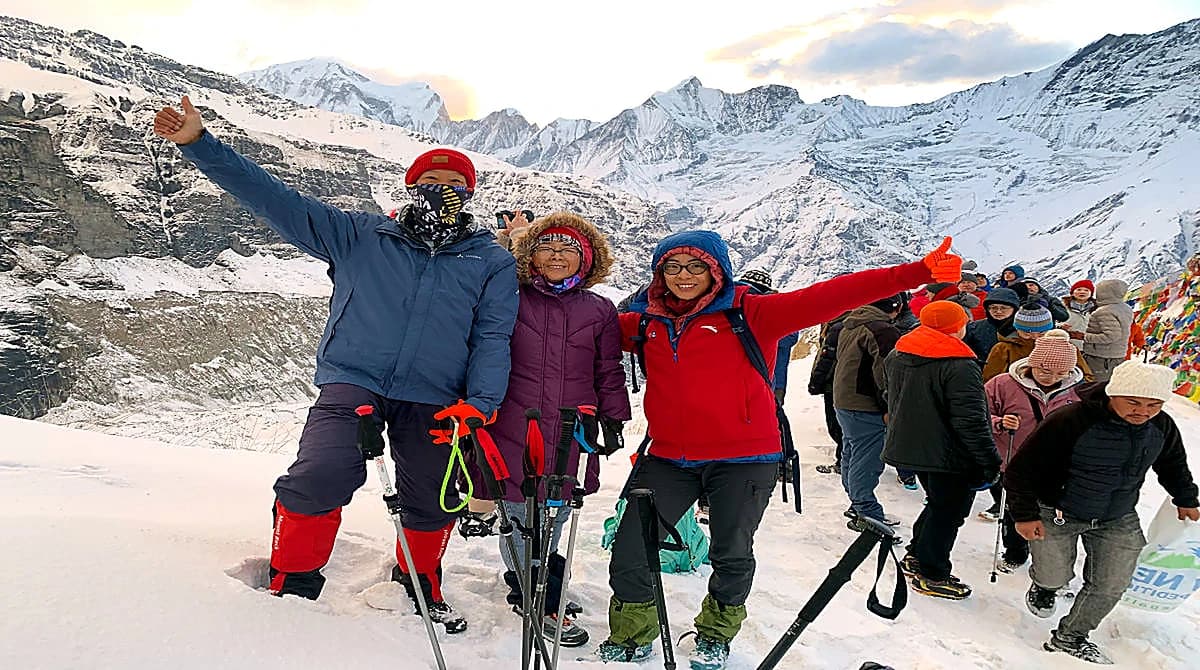
Family and children posing in snow at Annapurna Base Camp Nepal
Family with kids trekking along a mountain trail in Annapurna region
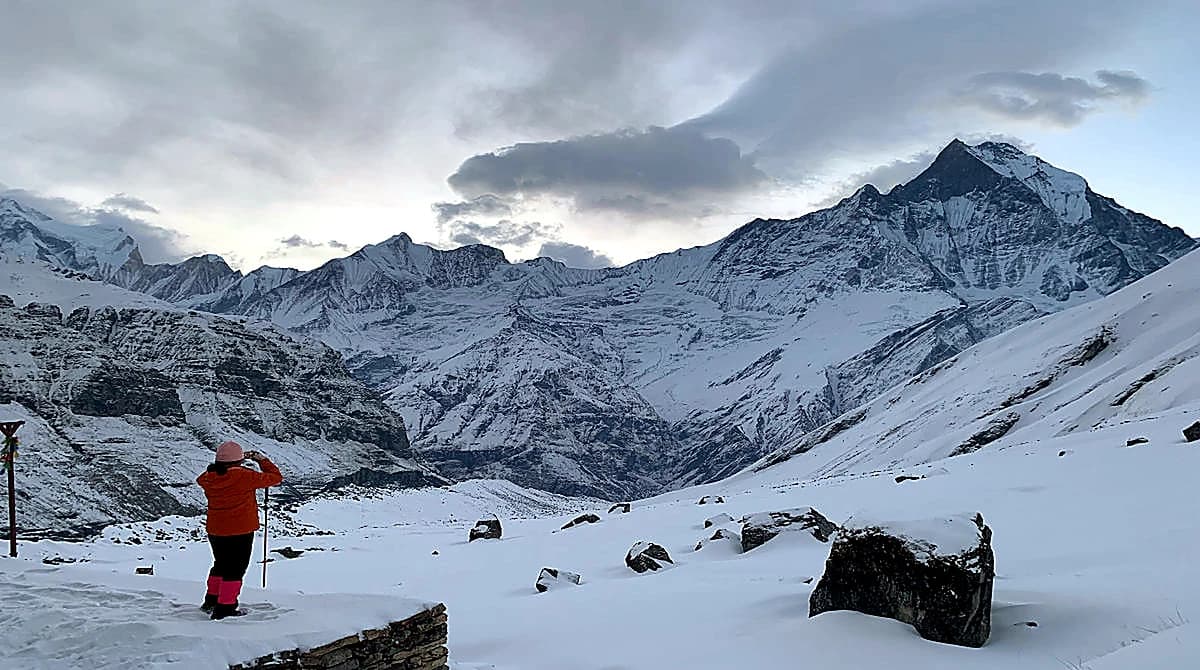
Panoramic view of snowy mountain peaks in the Annapurna Himalayas Nepal

Annapurna Base Camp Trek with Family & Kids - 12 Days

40 reviews in TripAdvisor
Recommended by 99% of travelers
Duration12 Day
Trip GradeModerate
Maximum Altitude4,130 m
Group Size1 – 8 Pax
StartsKathmandu
EndsKathmandu
ActivitiesTrekking, Sightseeing, Cultural Tour
Best TimeSpring (March to May) & Autumn (September to November)

The Annapurna Base Camp trek with family and kids is safe for children aged 10 and above when the ascent is split into short stages. Our 12-day Kathmandu to Kathmandu package breaks the high-altitude climb into three steps (Dovan, Deurali, MBC) before reaching ABC at 4,130 m, keeps walking days to 4-6 hours at a child's pace, and finishes with the Jhinu hot spring and Kathmandu heritage sightseeing. Guides experienced with children monitor altitude daily and hold clear turn-back authority.

The Annapurna Base Camp trek with family and kids raises two questions from every parent before anything else: "Is ABC safe for my children?" and "Will they actually enjoy it?" After 14 years of guiding families up this valley in Nepal, my answer to both is yes, provided you pick the right itinerary. That is exactly what this page is: the itinerary I would choose for my own children.

This 12-day ABC trek with kids from Kathmandu is deliberately slower than every standard package on the market. Where fast itineraries jump from Deurali straight to base camp in one push, we split the high-altitude section into three overnight stages: Dovan, Deurali, then Machhapuchhre Base Camp, before the short final walk to ABC. Kids sleep lower, climb less each day, and wake up at base camp with energy left to enjoy it.

You also get the full Nepal experience wrapped around the trek: the flight to Pokhara, the Jhinu Danda hot spring on the descent (universally the kids' favourite day), and a guided tour of four UNESCO World Heritage sites in Kathmandu before you fly home.

I have written this page to answer every question parents send us on WhatsApp, in one place: safety, minimum age, daily walking hours, altitude management, food, rooms, packing, training, cost, permits, best season, and what happens when things do not go to plan. Read it once and you will know more about the Annapurna Base Camp trek with children than most agencies will ever tell you.

Annapurna Base Camp Family Trek — Quick Facts

  • Duration: 12 Days (Kathmandu–Kathmandu)
  • Max Altitude: 4,130 m (ABC)
  • Target Age: Kids 10–16 years old
  • Daily Walking: 4–6 hours per day
  • Format: Private family trek (non-technical)
  • Key Highlights: Jhinu Danda hot spring, Phewa Lake boating, 4 UNESCO sites in Kathmandu

Highlights of the Annapurna Base Camp Trek with Family & Kids

Highlights of the Annapurna Base Camp trek with family and kids go far beyond the base camp photo, though that photo will hang on your wall for decades:

  • Standing together as a family at Annapurna Base Camp (4,130 m), inside a natural amphitheatre ringed by Annapurna I (8,091 m), Annapurna South, Hiunchuli and the sacred fishtail peak of Machhapuchhre
  • split three-stage ascent (Dovan, Deurali, MBC) designed specifically to protect children from altitude sickness
  • Walking days of only 4-6 hours at a child's pace, with long breaks, photo stops and snack stops built in
  • Soaking in the natural Jhinu Danda hot spring beside the Modi Khola river on the way down, the single most requested reward on the entire trail
  • Rhododendron and bamboo forests alive with langur monkeys, waterfalls and suspension bridges that children genuinely love
  • Gurung village culture in Chhomrong, where kids meet local children and see mountain life up close
  • A guided tour of four UNESCO World Heritage sites in Kathmandu, turning the trek into a full cultural education
  • A free afternoon on Phewa Lake in Pokhara: boating, lakeside cafes and the best ice cream in Nepal
  • Private family departures only: your family, your guide, your porters, your pace, your dates
  • trekking certificate for every family member at the end, including the kids

Is the Annapurna Base Camp Trek Safe for Family & Kids?

The Annapurna Base Camp trek is safe for family and kids aged roughly 10 to 16 who are healthy, on a properly paced itinerary with an experienced guide. I want to answer this question thoroughly, because it is the one that decides whether your family comes to Nepal at all. Here is the honest picture:

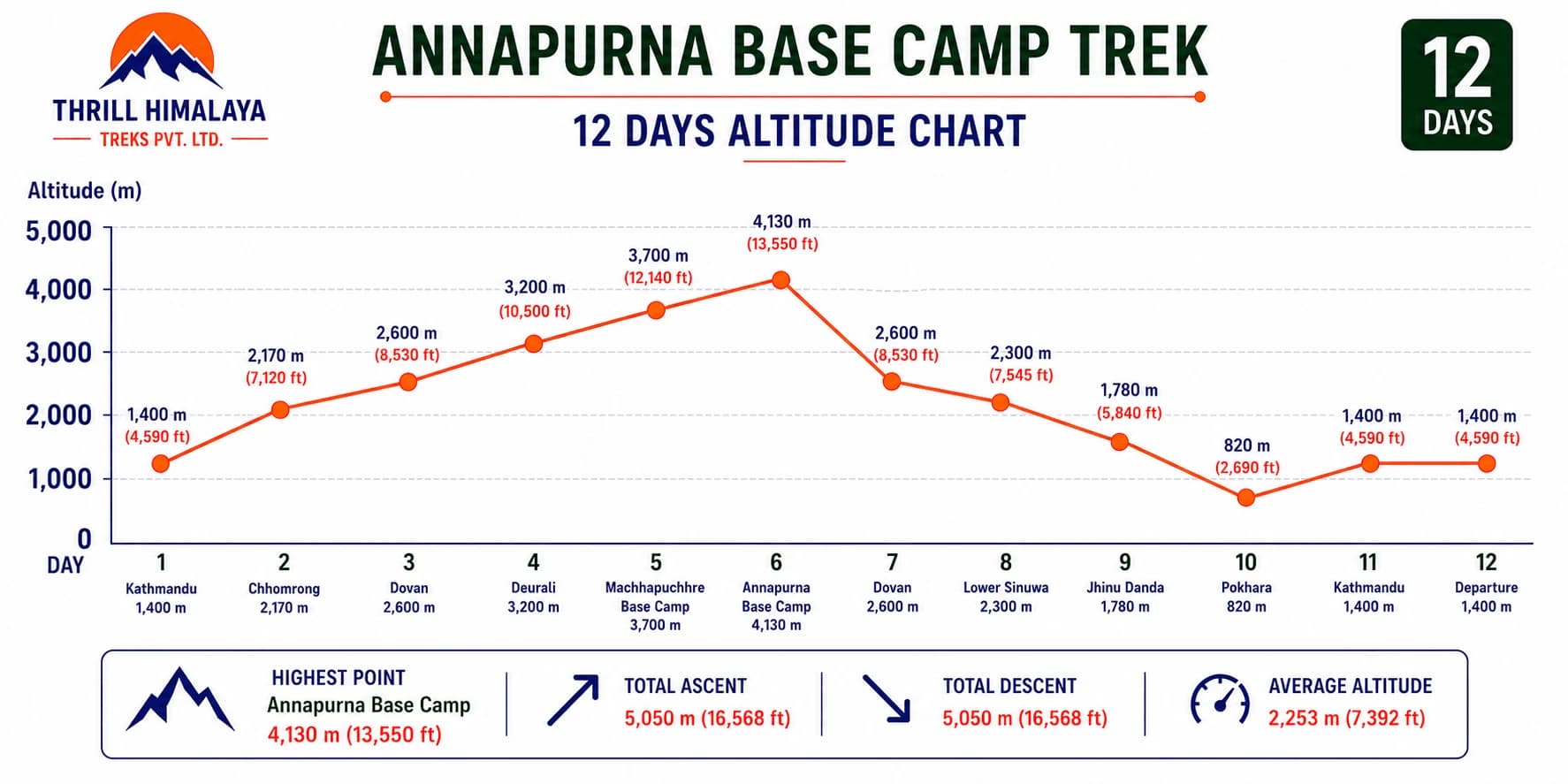
  • Altitude: ABC sits at 4,130 m. Children acclimatize much like adults but may not report symptoms clearly, so our guides check every child morning and evening using simple, kid-friendly questions and observation. Sleeping altitudes on this itinerary rise gradually: 2,170 m, 2,600 m, 3,200 m, 3,700 m, then base camp.
  • Trail: Non-technical, well-maintained, and busy with other trekkers. There is no climbing, no ropes, no glacier travel and no exposure that requires a head for heights. The main physical challenge is the stone staircase around Chhomrong, which kids usually handle better than their parents.
  • Weather: We run family departures in the stable spring and autumn windows and build in flexibility if conditions turn. The one section requiring judgement is the avalanche-aware stretch between Deurali and MBC in late winter and early spring; our guides know exactly when it is safe, when to cross early in the morning, and when to wait.
  • Emergencies: Every family departure has a written evacuation plan, mobile coverage exists at most lodges on this route, and helicopter rescue is available throughout the Annapurna Sanctuary via your insurance.
  • Track record: Families complete this route every season, and the biggest problems we actually deal with are blisters, sunburn and children who do not want to go home. Serious incidents on well-paced family itineraries are genuinely rare.

What makes the difference between a safe family trek and a risky one is not the mountain. It is the schedule. A 12-year-old on a 6-day adult itinerary is being asked to gain altitude faster than mountain medicine recommends. The same 12-year-old on this 12-day itinerary is inside every safety guideline with room to spare. That is the entire design philosophy of this package.

What Is the Minimum Age for Kids on This Trek?

The minimum age for kids on this trek is 10 years for the full ABC route, in our honest recommendation. Children of 8 or 9 are considered case by case after a conversation about their hiking experience and health. For younger children, we honestly recommend the Ghorepani Poon Hill route instead, which tops out at 3,210 m; we will tell you this directly rather than sell you the wrong trek.

Why 10? Two practical reasons. First, children of 10 and above can communicate symptoms reliably, which matters enormously for altitude monitoring. Second, they have the leg length and stamina to enjoy 4-6 hour walking days rather than endure them. A trek a child enjoys is a trek a child finishes.

How Much Does the Annapurna Base Camp Trek with Family & Kids Cost?

The Annapurna Base Camp trek with family and kids costs US$ 1,147 to US$ 1,197 per person for this 12-day package, depending on your family size. Larger families pay less per person, and children under 12 receive a reduced rate. Below is the full cost structure:

Family Size | Price Per Person (USD)
Family of 2 | US$ 1,197
Family of 3 to 4 | US$ 1,167
Family of 5+ | US$ 1,147
Child discount (under 12) | Ask us; children under 12 receive a reduced rate

Why Is This 12-Day Trek with Family & Kids Better Than a Standard ABC Itinerary?

This 12-day trek with family and kids is better than a standard ABC itinerary because every stage is redesigned around children, not squeezed from an adult schedule. The comparison below shows exactly where the differences lie:

  Standard 6-7 Day ABC This 12-Day Trek with Family & Kids
Biggest ascent day Deurali to ABC (930 m gain) Split into three stages, max ~500-600 m per sleeping night
Daily walking 5-7 hours at adult pace 4-6 hours at a child's pace with long breaks
Descent Two long, knee-heavy days Three relaxed days ending at the hot spring
Culture None included Four Kathmandu heritage sites plus Pokhara lakeside
Guide ratio Standard Higher support: guaranteed porters, assistant guide for larger families
Flexibility Fixed group schedule Private departure; the plan flexes around your children daily

The extra days are not padding. They are the safety mechanism. Splitting the Dovan to ABC section over three nights is the single biggest thing any family can do to reduce altitude risk for children, and almost no competitor itinerary does it. Most agencies simply relabel their standard adult trek as "family friendly" and change nothing else. Compare any competing family itinerary against the sleeping altitudes on this page and you will see the difference immediately.

How Many Hours Do We Walk Each Day on This Trek with Kids?

On this trek with kids you walk between 4 and 6 hours on trekking days, always at the pace of the slowest family member, with long breaks built in. Two days are deliberately much shorter: the day to Machhapuchhre Base Camp is only 3-4 hours, and the final morning walk into base camp itself takes about 2 hours. Non-trekking days (Kathmandu, Pokhara, flights) involve nothing more than gentle sightseeing on foot. The complete day-by-day plan follows below, with family notes for every stage.

Why Families Trust Thrill Himalaya for Annapurna Base Camp

Your child's first big trek should feel like an adventure story they tell for years — not a risk you spent the whole trip worrying about. That's the difference we're built around.

Led by someone who's actually done this for a living.
I'm Pravin Baniya. I spent 14 years guiding trails before founding Thrill Himalaya, and I still personally plan every family departure myself — not a booking agent, not a template itinerary. Just someone who knows exactly what a 9-year-old's legs feel like on hour four of a climb.

Guides who parent kids, not just lead them.
Every guide on a family trek is chosen partly because they're a parent or an uncle first. Patience on the trail isn't a nice bonus — it's part of the job interview.

Fully licensed, fully accountable.
NTB Reg. No. 3303/81/82. TAAN member. Government-certified guides. If something ever needs answering for, there's a real license and a real name behind it — ours.

Trusted by families who've already done this.
TripAdvisor Travelers' Choice 2026, 5.0/5 across 98 reviews, ranked in the top 3% of all Kathmandu outdoor activities. We didn't write that review — your fellow parents did.

Your family, your pace, your crew.
No joining a group of strangers. Small private family departures mean your own dates, your own rhythm, and a crew focused only on you.

Safety that doesn't bend for a schedule.
Written evacuation plans. Insurance verified before you even leave Kathmandu. And guides with full authority to change the plan on the spot — no head office, no commercial pressure, just what's right for your kids that day.

Advice you can actually trust.
If Poon Hill fits your children better than ABC, we'll say so — and happily book you the shorter, cheaper trek instead. We'd rather have your trust for the next ten years than your money for the next ten days.

Annapurna Base Camp Trek with Family & Kids: 12-Day Itinerary (Kathmandu–Kathmandu)

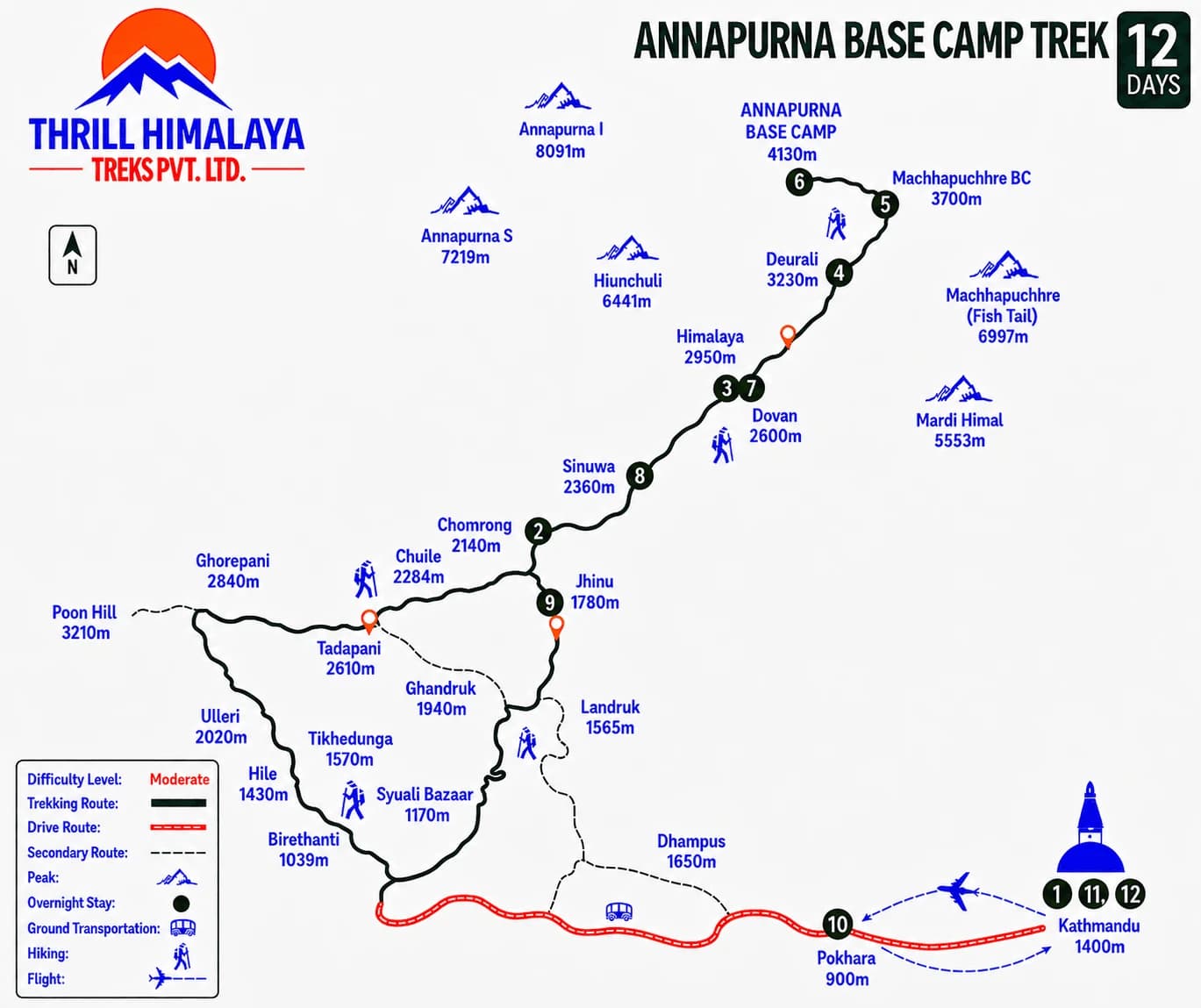
The Annapurna Base Camp trek with family and kids itinerary runs 12 days from Kathmandu to Kathmandu, with flights to and from Pokhara and every high-altitude day kept deliberately short. First the overview table, then a detailed description of every day so you know exactly what your family is signing up for:

Day Plan Walking Sleep Altitude Family Notes
1 Arrive Kathmandu, trek briefing - 1,400 m Gear check with your guide; we fit kids' rental gear here
2 Fly Pokhara, drive Jhinu, trek to Chhomrong 3-4 hrs 2,170 m Steps, but short day; mountain views from the lodge
3 Chhomrong to Dovan 5-6 hrs 2,600 m Bamboo forest, waterfalls, monkey spotting
4 Dovan to Deurali 4 hrs 3,200 m Short day on purpose; kids rest and play in the afternoon
5 Deurali to Machhapuchhre Base Camp 3-4 hrs 3,700 m Very short altitude day; symptom check for everyone
6 MBC to Annapurna Base Camp 2 hrs 4,130 m Early, easy walk into the Sanctuary; a morning kids never forget
7 ABC down to Dovan 5-6 hrs 2,600 m Big descent, big appetite; every step gets easier to breathe
8 Dovan to Lower Sinuwa 4-5 hrs 2,300 m Relaxed forest walking
9 Lower Sinuwa to Jhinu Danda hot spring 3-4 hrs 1,780 m The reward day: natural hot spring beside the river
10 Drive to Pokhara, free lakeside afternoon - 820 m Boating on Phewa Lake, ice cream, souvenir hunting
11 Morning flight to Kathmandu, heritage sightseeing - 1,400 m Four UNESCO World Heritage sites with a city guide
12 Final departure - - Airport transfer included
Itinerary
Trip PlanExpand all

Highlights: Tribhuvan International Airport pickup · transfer to your Thamel hotel · full family gear check · fitting of complimentary sleeping bags and down jackets in kid sizes · day-by-day route walkthrough · altitude rules and turn-back protocol agreed with parents

We meet you inside the arrivals area at Tribhuvan International with a name board and drive you to your hotel in or near Thamel, which on Kathmandu's roads takes anywhere from twenty minutes to an hour depending on the time of day. Rest, shower, and let the children run off the flight. Then, in the afternoon or evening depending on when you land, your trekking guide comes to the hotel to meet the whole family.

This briefing is not a formality and we do not rush it. We walk through the route one day at a time so everyone knows what tomorrow looks like, check every family member's gear piece by piece rather than asking whether you have packed properly, and fit the complimentary sleeping bags and down jackets, kid sizes included. Your guide answers the children's questions directly and at length, because a nine year old who understands why we stop at Machhapuchhre Base Camp is a nine year old who cooperates at 3,700 m. Then we agree the altitude rules and the turn-back protocol with the parents, out loud, before anyone starts walking.

If something is missing from your kit, Thamel's trekking shops are two minutes from the lobby and your guide will walk you to the honest ones rather than the ones that pay commissions. Most families end up buying a couple of pairs of thick socks, a spare pair of children's gloves, and a pack of cards.

Good to know: Bring the children's own broken-in walking shoes from home even if they look scruffy. Everything else on the list can be bought or rented in Thamel within an hour, but nobody wants to break in new boots on Chhomrong's stone steps on Day 2.

Note: If your flight arrives after 8 pm we move the briefing to breakfast on Day 2 rather than keeping tired children up. Nothing else in the itinerary shifts.

Max Altitude: 1,400 m / 4,590 ftAccommodation: Hotel in Thamel, KathmanduMode of Transportation: Private Vehicle

Highlights: 25-minute mountain flight to Pokhara · Annapurna and Manaslu ranges from the right-hand windows · private jeep up the Modi Khola valley · Jhinu Danda trailhead (1,780 m / 5,840 ft) · Chhomrong stone steps · Gurung village of Chhomrong · Annapurna South and Machhapuchhre from the lodge terrace

The flight to Pokhara takes 25 minutes and is worth booking a family trip around on its own. Ask for the right-hand side of the aircraft. On a clear morning the children will be pressed to the windows the entire way as Manaslu, Ganesh Himal, and then the Annapurnas slide past at eye level. From Pokhara airport our private jeep drives roughly three hours north up the Modi Khola valley to Jhinu Danda, where the road ends and the trek begins. Driving in like this is deliberate. Older itineraries spend a full day walking a dusty jeep road from Nayapul, which is nobody's idea of a good first day with kids.

The first afternoon on foot is short and honest: stone steps climb from Jhinu up to Chhomrong. It is steep in places and we say so in advance, because children handle a hard thing they were warned about far better than a hard thing that ambushes them. Roughly 400 vertical metres, three to four hours, and we take it in small pieces with proper stops, water, and snacks. Your guide walks at the pace of the slowest family member and that is the rule for the whole trek.

Chhomrong is the most comfortable overnight on the entire route, a large Gurung village stacked down a ridge with solid lodges, the best food you will eat above Pokhara, and a straight-on view of Annapurna South and Machhapuchhre from the terrace. It makes a genuinely memorable first evening. Children sleep well here, partly because 2,170 m is a gentle altitude and mostly because excitement beats jet lag by a wide margin at this age.

Good to know: Keep one small daypack per child with their own water bottle, a jacket, and their own snacks in it. Children who carry something they chose themselves complain measurably less than children who carry nothing.

Note: Pokhara flights depend on morning weather and occasionally cancel. If that happens we switch to a private vehicle for the Kathmandu to Pokhara leg, which takes 6 to 7 hours, and we absorb the day by driving through to Jhinu and starting the trek on Day 3. Your guide will have the flight status the evening before.

Max Altitude: 2,170 m / 7,120 ftMeals: Breakfast, Lunch, DinnerAccommodation: Teahouse in ChhomrongMode of Transportation: Domestic Flight, Private Jeep, then on Foot

Highlights: Chhomrong's stone staircase · Chhomrong Khola suspension bridge · climb to Sinuwa (2,360 m / 7,740 ft) · bamboo and rhododendron forest · grey langur monkeys · long lunch at Bamboo (2,310 m / 7,580 ft) · Dovan in the Modi Khola gorge

Chhomrong to Dovan is the longest walking day of the ascent, so we treat it like one: early breakfast, relaxed pace, and a long lunch at Bamboo rather than a hurried one. The morning begins by going down, which surprises every first-time trekker. You descend Chhomrong's famous stone staircase to the Chhomrong Khola and cross the suspension bridge at the bottom, which is a guaranteed highlight for children and usually requires a firm adult voice to move everyone along. Then you climb the same amount back up the far side to Sinuwa. Net gain across the whole day is only 430 m, but legs remember the stairs, not the arithmetic.

Above Sinuwa the trail changes completely. Terraced hillsides give way to cool, damp forest of bamboo, oak, and rhododendron, the crowds spread out, and the river stays audible below you all day. Grey langurs work the canopy through this section. Our guides are good at spotting them before the children do, though only just, and we build in the stops when it happens. In spring the rhododendron turns this whole stretch red and pink.

From Bamboo a gentler forest trail carries you the last hour or so to Dovan, a small cluster of lodges deep in the gorge. It sits in shade by late afternoon and gets cold quickly, so this is the first night the down jackets come out before dinner rather than after.

Good to know: Lengthen trekking poles by about 5 cm for the long descent to the Khola, then shorten them again for the climb to Sinuwa. If your children are using poles, do it for them at the bridge. It protects knees on the way down and shoulders on the way up.

Max Altitude: 2,600 m / 8,530 ftMeals: Breakfast, Lunch, DinnerAccommodation: Teahouse in DovanMode of Transportation: On Foot

Highlights: Modi Khola waterfalls · Hinku Cave · Himalaya lodges (2,920 m / 9,580 ft) · treeline · the gorge narrowing into the Sanctuary gate · Deurali by lunch · free acclimatization afternoon · first formal altitude check

Dovan to Deurali is deliberately short, and this is the day where our family itinerary starts to visibly differ from a standard trek. You cross 3,000 m today. Bodies give honest feedback at that altitude, and we would far rather arrive at Deurali by lunch with the whole afternoon spare than arrive at dusk with tired children and no margin. The trail climbs steadily beside the river past the Himalaya lodges, with waterfalls pouring off the cliffs directly above the path and the forest thinning as you go. You pass the overhang at Hinku Cave, and by the time the walls close in on both sides you are walking through the gate of the Annapurna Sanctuary itself.

The free afternoon at Deurali is not spare time, it is active acclimatization and it is doing real work. Children rest, play cards in the dining hall, and potter around the lodge while their bodies quietly adjust to 3,200 m. Your guide runs the first formal altitude check this evening: headache, appetite, sleep quality, energy, asked of each family member individually. The informal checks started days ago and the children will not have noticed them.

Nights are properly cold from here upward, which is where the complimentary down jackets and sleeping bags earn their place in the duffel. Keep everyone drinking through the afternoon, aim for 2 to 3 litres per adult and steady sips for the children, and eat a full dinner even if appetite has dipped slightly.

Good to know: Charge every device and dry socks over the stove tonight. Power above Deurali is limited, expensive, and often out when the weather closes in, and cold flattens phone and camera batteries faster than anyone expects.

Note: Our adult 6-day itinerary covers this same ground in half the days by climbing Deurali to ABC in a single 930 m push. That works for acclimatized adults on a tight schedule. With children we do not recommend it, and the two-day split in this itinerary is the main reason families reach base camp feeling well rather than feeling wrecked.

Max Altitude: 3,200 m / 10,500 ftMeals: Breakfast, Lunch, DinnerAccommodation: Teahouse in DeuraliMode of Transportation: On Foot

Highlights: early start through the avalanche-aware section · the young Modi Khola · Sanctuary walls rising on both sides · treeless high valley · Machhapuchhre Base Camp by lunch · fishtail summit directly overhead · full afternoon of acclimatization · the evening symptom check that matters most

Deurali to MBC is the most important safety decision built into this trek. Standard itineraries push straight through from Deurali to Annapurna Base Camp and gain 930 m in a day. We stop at Machhapuchhre Base Camp instead, keeping the walking to three or four hours and the gain to 500 m, and we sleep on it. There is no clever trick to altitude with children. There is only going up slowly and paying attention.

We start early, partly for the cool air and mostly because the section above Deurali crosses avalanche-aware ground that is in its safest condition in the morning before the day warms the slopes above. The walk itself is spectacular and short. The valley narrows to a corridor, the trail follows the young Modi Khola over rock and old moraine, the last trees disappear behind you, and the Sanctuary walls stand up on both sides. Children tend to go quiet through this section, which is the correct response.

Reaching MBC by lunch gives the family a full afternoon at 3,700 m with Machhapuchhre's fishtail summit filling the sky straight above the lodge. Rest, hot drinks, short flat wanders no more than a few minutes from the door, early dinner. The evening symptom check here is the one that counts. Anyone showing more than mild symptoms stays, rests, or goes down, and because this is a private trek that decision costs your family nothing except a schedule adjustment. No group is waiting on you and nobody loses money by turning around.

Good to know: Ask the kitchen for a bottle of boiled water when you order dinner. It doubles as a hot water bottle in a child's sleeping bag for the first hours of the night and as drinking water in the morning, and rooms at MBC drop below freezing.

Note: No alcohol from Deurali upward for the adults. It dehydrates you at altitude, wrecks the quality of your sleep, and blurs the exact symptoms your guide is watching for in the whole family. Save it for the trek completion dinner in Pokhara, where it will taste considerably better anyway.

Max Altitude: 3,700 m / 12,140 ftMeals: Breakfast, Lunch, DinnerAccommodation: Teahouse at Machhapuchhre Base CampMode of Transportation: On Foot

Highlights: post-sunrise start, no pre-dawn cold · gentle climb into the Sanctuary basin · the full ring of peaks appearing at once · Annapurna I (8,091 m / 26,545 ft) · Annapurna South, Hiunchuli, Gangapurna, Tent Peak · the base camp sign and prayer flags · glacier moraine walks · sunset over the entire cirque · night at base camp

MBC to Annapurna Base Camp takes barely two hours and it is the finest short walk in Nepal. We leave after sunrise rather than before it, because pre-dawn starts in freezing air belong to adult itineraries and a warm, well-fed, unhurried child walks better than a cold one. The trail climbs gently on moraine and grass, the corridor widens, and then it crests into the basin.

That is the moment. The full ring of peaks appears more or less at once and most families simply stop walking. Annapurna I, the tenth-highest mountain on Earth, stands at the head of the glacier with Annapurna South and Hiunchuli on one flank, Gangapurna and Tent Peak around the rim, and Machhapuchhre behind you, a summit nobody is permitted to climb. Your children walk the last stretch to the base camp sign themselves, on their own legs, and that photograph of tired faces, enormous grins, prayer flags, and an 8,000-metre backdrop is the one you came to Nepal for.

We spend the rest of the day and the night here. Short walks out along the moraine with your guide, hot lemon in the dining hall, layers on before the sun leaves the walls, and then sunset turning the whole cirque gold from the summits downward. Base camp is cold and basic and the rooms are plywood. It is also completely worth it, and your children will describe this night to people for the rest of their lives.

Good to know: Dress the children for the evening before the sun goes off the peaks, not after. Temperature at ABC falls very fast in the last half hour of daylight, and the trick is to add layers while everyone is still warm rather than trying to warm up a cold child at 4,130 m.

Note: Fresh snowfall changes this day. If conditions on the MBC to ABC section are not right we stay at Machhapuchhre Base Camp and try again at first light the next morning when the snow is firm, using the spare capacity in the descent days. Your guide has the final call and will explain the reasoning to the children as well as the parents. The views from MBC are extraordinary in their own right.

Max Altitude: 4,130 m / 13,550 ftMeals: Breakfast, Lunch, DinnerAccommodation: Teahouse at ABCMode of Transportation: On Foot

Highlights: sunrise on Annapurna I · unhurried breakfast at base camp · descent past MBC · lunch at Deurali or the Himalaya lodges · Hinku Cave · return to the treeline · forest walk to Dovan · 1,530 m of altitude loss

Mornings at Annapurna Base Camp begin with first light hitting the summit of Annapurna I while you are still standing in blue shadow, and we let the family watch it properly before breakfast instead of hurrying anyone down. It takes about twenty minutes for the light to work its way down the sanctuary walls, and it happens in near silence. Take the photographs, then put the cameras away for the last few minutes and simply look at it.

After a full breakfast we turn around. The descent to Dovan gives back 1,530 m, which sounds dramatic on paper and feels liberating in practice. Every hour the air thickens, appetites come back, and the children speed up so noticeably that the usual problem on this day is holding them back rather than encouraging them along. We keep a careful pace on the steeper stone sections regardless, because descending on tired legs is where slips happen and where the only real injury risk on this trek lives.

Lunch is at Deurali or the Himalaya lodges depending on how the morning has gone, then the trail drops back below the treeline and into the forest to Dovan. Warm, green, loud with the river, and low enough that everyone sleeps deeply for the first time in three nights.

Good to know: Keep a spare camera or phone battery inside a sleeping bag overnight and in an inside jacket pocket at sunrise. Cold flattens batteries at 4,130 m and a dead battery ten minutes before first light on Annapurna I is an avoidable heartbreak.

Max Altitude: 2,600 m / 8,530 ftMeals: Breakfast, Lunch, DinnerAccommodation: Teahouse in DovanMode of Transportation: On Foot

Highlights: relaxed forest walking · Bamboo village with downhill legs · waterfall stops · langur spotting, second attempt · Upper Sinuwa · short comfortable day into Lower Sinuwa

Dovan to Lower Sinuwa is the easiest walking day of the trek and we designed it that way on purpose. The ascent is behind you, the achievement is banked, nobody is watching the altimeter, and the trail retraces the bamboo and rhododendron forest with fresh eyes and downhill legs. This is the day families actually talk to each other. Four hours of conversation punctuated by waterfalls, with a second and usually more successful attempt at photographing the langurs.

We stop at Lower Sinuwa rather than pushing on to Chhomrong or beyond. It would be possible to compress Days 8 and 9 into one long day and finish the trek twenty-four hours earlier. We do not, for two reasons: it turns a joyful last stretch into a slog, and it means arriving at the Jhinu hot springs tired and late rather than with a whole afternoon to enjoy them. Short days at the end of a trek are a kindness, not padding.

Lower Sinuwa is a small, quiet stop with good evening light and views back up the valley you have just walked out of. Worth pointing out to the children exactly where they were two days ago, because from here it looks impossibly far away.

Good to know: Sort your duffel tonight rather than tomorrow morning. Put swimwear, a quick-dry towel, and a clean change of clothes into your daypacks, because tomorrow the duffels go ahead with the porters and the hot spring is a twenty-minute walk below the village.

Note: If your family wants a longer route out, we can finish through Ghandruk instead, adding a day and a night in one of the most attractive Gurung villages in Nepal with its own museum and a fine sunrise view. It replaces the hot spring afternoon, so families with children usually keep the hot spring. Ask us at booking and we will price both.

Max Altitude: 2,300 m / 7,545 ftMeals: Breakfast, Lunch, DinnerAccommodation: Teahouse in Lower SinuwaMode of Transportation: On Foot

Highlights: Chhomrong Khola bridge · the last meaningful climb of the trek · Chhomrong steps in reverse · descent to Jhinu Danda · 20-minute walk to the natural hot pools on the Modi Khola · final teahouse night · celebration dinner in Jhinu

Lower Sinuwa to Jhinu Danda is short because the afternoon belongs to the hot spring. You cross back over the Chhomrong Khola, take on the last meaningful climb of the trek up to Chhomrong, and then descend the famous stone staircase in the direction gravity is on your side for. From Chhomrong the trail drops steadily to Jhinu Danda, and you are in the lodge with the whole afternoon ahead of you.

Then you walk twenty minutes down to the natural hot pools on the bank of the Modi Khola. Three stone pools fed by thermal water with the river running cold and very loud right beside them. Ask any child at the end of this trek to name their favourite moment and the hot spring competes seriously with base camp itself. Eight days of stone steps come out of everyone's legs in that water, and the difference in how the family feels on tomorrow's drive is real rather than imagined.

Tonight is the last teahouse night, and the lodges in Jhinu do a good celebration dinner. Your guide and porters eat with you, which is the point of the evening. The children have spent nine days with these people and this is the night the trek gets talked through from the beginning, usually with a good deal of exaggeration about the Chhomrong steps.

Good to know: The pools have basic changing shelters and no towels, so carry your own and a plastic bag for wet swimwear. Keep young children in the lower, cooler pool. The upper pool sits hotter than most kids will happily tolerate, especially after a walking day.

Max Altitude: 1,780 m / 5,840 ftMeals: Breakfast, Lunch, DinnerAccommodation: Teahouse in Jhinu DandaMode of Transportation: On Foot

Highlights: private jeep down the Modi Khola valley · hot showers · Phewa Lake boating with the Annapurnas on the horizon · lakeside ice cream · optional World Peace Pagoda, Gurkha Museum, or paragliding · trek completion dinner with certificate presentation for every family member

The drive from Jhinu to Pokhara takes about three hours and the afternoon is entirely yours. Most families do the same three things in the same order: long hot showers, boating on Phewa Lake with the mountains you were standing under two days ago sitting on the horizon, and ice cream on the lakeside. Pokhara is warm, easy, and cheerful, and it is the right place to decompress after nine days of teahouses.

If your family still has energy there are good optional extras. The World Peace Pagoda viewpoint across the lake is a short boat ride and a twenty-minute climb, the Gurkha Memorial Museum is genuinely interesting for older children, and paragliding from Sarangkot is available for teenagers with a parent along. Tell us in advance for the paragliding, since it books out in high season and has weight and age minimums.

In the evening we host your trek completion dinner at a lakeside restaurant, with your guide and, where they have travelled down with us, your porters. This is where we present the certificates of trek completion, one for every family member, named and signed, with the route and the altitude reached on them. Small children take these very seriously indeed, which is exactly right. They walked to 4,130 m and back on their own legs, and the certificate is proof they can put on a bedroom wall.

Good to know: Hand your laundry in at the hotel the moment you check in. Pokhara turns it around same day for very little money, and it means you fly to Kathmandu tomorrow with a clean bag instead of carrying nine days of teahouse clothing into your final hotel.

Max Altitude: 820 m / 2,690 ftMeals: BreakfastAccommodation: Hotel in Pokhara, lakesideMode of Transportation: Private jeep

Highlights: early morning flight to Kathmandu · Swayambhunath, the hilltop Monkey Temple · Kathmandu Durbar Square and the living goddess tradition · Pashupatinath on the Bagmati river · Boudhanath Stupa and its prayer wheels · farewell dinner in Thamel

The early flight to Kathmandu leaves the entire day for culture, with a dedicated city guide and a private vehicle so the pace stays yours. Four UNESCO World Heritage sites, arranged so that the walking comes in manageable pieces with breaks between them.

We start at Swayambhunath, the hilltop stupa known as the Monkey Temple, whose resident macaques make it every child's favourite site in Nepal and where the view back over the whole Kathmandu valley puts the trip in context. Then Kathmandu Durbar Square, with its medieval palace complex, earthquake reconstruction still visible in places, and the Kumari house where Nepal's living goddess tradition continues. After lunch, Pashupatinath, the holiest Hindu temple complex in Nepal, on the banks of the Bagmati. Your guide will tell you honestly what is visible there, including open-air cremations, so parents can decide how much of it younger children see and we can shape the visit around that. We finish at Boudhanath, the great white dome ringed with prayer wheels that children can spin the whole way around, which is the calmest and most pleasant place in Kathmandu to end a day.

For children this day quietly reframes the entire trip. They came to Nepal for a mountain and they leave having seen a civilization, and that is often the part they write about at school. Tonight we take the family out for a farewell dinner in Thamel, traditional Nepali food with music, to close out the trip properly.

Good to know: Carry small change in 10 and 20 rupee notes for shoe removal fees, prayer candles, and the inevitable souvenir negotiation, and keep bags zipped and closed at Swayambhunath. The monkeys are quick, entirely unafraid, and interested in anything that looks like food.

Max Altitude: 1,400 m / 4,590 ftMeals: Breakfast, Farewell DinnerAccommodation: 3 star Hotel in Thamel, KathmanduMode of Transportation: Domestic flight, Private Vehicle

Highlights: unhurried breakfast · packing time · private transfer to Tribhuvan International Airport three hours before departure

Departure day is simple. Breakfast, packing, and our private transfer to Tribhuvan International Airport three hours before your flight, which sounds excessive until you have queued at Kathmandu's international terminal with children and luggage. Your guide or a company representative sees you to the terminal door.

If your schedule has room for more, tell us at booking rather than at the end. A Chitwan jungle safari extends beautifully from this itinerary and is superb with children, with jeep safaris, elephant breeding centre visits, and canoe trips on the Rapti. A Bhaktapur day trip is the other easy addition, a half hour from your hotel and the best-preserved medieval city in the valley, with pottery square and the famous king curd for the kids.

Good to know: Keep the trekking certificates flat in your hand luggage rather than rolled in a duffel. They arrive home creased otherwise, and after nine days of walking they deserve better.

Max Altitude: 1,400 m / 4,590 ftMeals: BreakfastMode of Transportation: Private Vehicle
Start planning today.
Our travel experts are here to help. Our travel experts are here to help. Our travel experts are here to help.
Cost Details
Includes
  • Kathmandu-Pokhara-Kathmandu flights and all private ground transport, including airport transfers
  • Government-certified lead guide experienced with children (certified by Nepal's Ministry of Culture, Tourism and Civil Aviation), plus assistant guide for families of 5+
  • Guaranteed porter support (1 porter per 2 trekkers, 20 kg combined)
  • All accommodation: Kathmandu and Pokhara hotels plus teahouse accommodation on trek (twin sharing, family rooms where available)
  • ACAP permit and paperwork for every family member
  • Four-site Kathmandu heritage sightseeing with city guide and private vehicle
  • Complimentary sleeping bags, duffel bags and down jackets, kid sizes included (returned after the trek)
  • Trekking certificate for every family member, including the kids, after completing the trek
  • First aid kit carried by your guide, 24/7 WhatsApp support and a written family emergency evacuation plan
  • Guide and porter salaries, insurance, meals and accommodation
  • All government taxes and official company service charges
Excludes
  • Meals on trek (budget US$ 25-30 per adult per day, less for children) and city lunches/dinners
  • Travel insurance with 4,500 m trekking and helicopter evacuation cover (mandatory for all family members)
  • Nepal visa fees and international flights
  • Heritage site entry fees in Kathmandu
  • Personal expenses: hot showers, battery charging, WiFi, snacks, drinks
  • Tips for guide and porter (customary, at your discretion)
Essential Information

How Do You Manage Altitude Risk for Kids on the Annapurna Base Camp Trek?

Managing altitude risk for kids on the Annapurna Base Camp trek comes down to five rules we apply on every family departure, in plain language:

  • Gradual sleeping altitude: no jump bigger than roughly 600 m per night above 2,600 m, achieved by the Dovan-Deurali-MBC split
  • Twice-daily checks: the guide talks with each child morning and evening, watching for headache, appetite loss, unusual tiredness, or mood change (often a child's first symptom)
  • Clear turn-back rules agreed with parents before the trek: moderate symptoms in any family member means the whole plan flexes; we never split parents from children on the mountain
  • Hydration and food games: our guides are genuinely good at getting kids to drink enough water without a battle
  • Insurance requirement: every family member needs cover for trekking to 4,500 m including helicopter evacuation; we help you verify your policy wording before departure

How Do I Recognise Altitude Sickness in My Child?

Recognising altitude sickness in a child is a skill we teach every parent at the day 1 briefing, because you know your child's normal better than anyone. The early signs of mild AMS are headache, nausea or loss of appetite, unusual tiredness, dizziness and poor sleep. In children specifically, watch for the indirect signals: a normally chatty kid going quiet, a good eater pushing food around the plate, irritability that does not match the situation. Mild symptoms are managed with rest, fluids and no further ascent that day. Moderate symptoms (persistent headache that does not respond to rest, vomiting, unsteadiness) mean descent, immediately and without debate. Our guides carry a first aid kit, know these thresholds cold, and hold the authority to act on them. In 14 years of guiding, the families who told us about symptoms early are the families who still reached base camp a day later; the pattern is that consistent.

How Should a Family with Kids Prepare and Train for the Annapurna Base Camp Trek?

A family with kids should prepare and train for the Annapurna Base Camp trek for 6 to 8 weeks, and the good news is that the training is genuinely fun when done together. You are not preparing for a race; you are preparing legs and lungs for consecutive 4-6 hour walking days with some steep steps. Here is the family training plan we send to every booking:

Weeks Before Focus Family Activities
8-7 Build the habit Two 1-hour family walks per week, plus normal school sport. Make it routine, not an event.
6-5 Extend the distance One longer weekend walk of 2-3 hours on hilly ground or trails. Kids carry a small daypack with their own water.
4-3 Stairs and legs Stair sessions twice a week (15-20 minutes), because Chhomrong is stairs. Turn it into a game or a race count for the kids.
2 Back-to-back days Two consecutive walking days on a weekend, 3-4 hours each, in the exact shoes everyone will trek in.
1 Taper and pack Light walks only. Pack together as a family so the kids know their own gear.

Two preparation rules matter more than any training session. First, every family member's footwear must be broken in; new boots are the number one cause of ruined family treks. Second, involve the children in the planning: kids who helped choose the route, packed their own daypack and can name the mountains walk further and complain less. Show them this page. Let them read the day-by-day. Ownership is the best trekking fuel there is.

What Are the Rooms, Bathrooms and Food Like on a Family Trek?

Rooms, bathrooms and food on a family trek along the ABC trail are simple but warm-hearted, and knowing exactly what to expect prevents every disappointment. Teahouses are family-run mountain lodges: twin rooms with wooden beds, foam mattresses, pillows and blankets, and a communal dining hall with a heater or stove in the evenings. For families we book adjacent rooms, plus family rooms where lodges offer them (Chhomrong and Jhinu have the best options). Rooms are unheated, which is normal on every trekking route in Nepal and precisely why we provide proper four-season sleeping bags.

Bathrooms are shared at most lodges, a mix of Western and squat toilets, and cleanliness is generally decent on this well-run route. Attached bathrooms exist at lower elevations, subject to availability, and we request them for families wherever possible. Hot showers (gas or solar) are available for a small fee up to Deurali; above that, expect a basin of hot water or a wet-wipe evening, which children treat as an adventure and adults endure for exactly two nights.

Electricity and charging are available at every lodge, usually for a small per-device fee, and WiFi exists at most lodges up to Deurali (slow, but enough to message home). Mobile data works intermittently along the route; your guide's phone always has the numbers that matter. We give every family our 24/7 WhatsApp line so relatives at home can reach our Kathmandu office at any point during the trek.

What Food Do Kids Actually Eat on the ABC Trek?

Food kids actually eat on the ABC trek is a happy surprise for most parents. Teahouse menus on this route are long and genuinely child-friendly. A typical day looks like this:

Meal Typical Options Kids Choose
Breakfast Pancakes with honey, porridge, eggs any style, Tibetan bread, toast, hot chocolate
Lunch Fried rice, chowmein noodles, momos (Nepali dumplings, the universal kid favourite), vegetable soup, chips
Dinner Dal bhat with unlimited refills, pasta, pizza at larger lodges, spring rolls, more momos
Snacks Popcorn, chocolate bars, biscuits, seasonal fruit at lower villages

Dal bhat deserves a special mention: rice, lentil soup, vegetables and pickle, refilled until you surrender. It is the most nutritious, most hygienic and best-value meal on the mountain, which is why every guide and porter in Nepal eats it twice a day. Most trekking kids convert to it by day three.

Hygiene is where our guides earn their keep quietly: they know which kitchens on this route are the cleanest and steer the family's orders accordingly. All drinking water is purified or boiled; we teach kids the water routine on day one and it becomes part of the adventure. Vegetarian, vegan and allergy-aware ordering is straightforward; tell us at booking and your guide manages it at every lodge. One rule we hold firmly for everyone above Chhomrong: no meat dishes high on the trail (it is carried up unrefrigerated) and no alcohol at altitude for the adults. Boring advice that keeps families healthy.

What Should We Pack for the Annapurna Base Camp Trek with Kids?

Packing for the Annapurna Base Camp trek with kids is lighter than most parents expect, because porters carry the main bags (up to 20 kg per porter, shared between two trekkers) and we supply the expensive warm gear free. Here is the complete family packing list we send with every booking confirmation:

Clothing (per child and per adult)

  • Broken-in hiking shoes or boots plus camp sandals for the lodge
  • 2-3 quick-dry trekking shirts and 2 pairs of trekking trousers (zip-offs are ideal for kids)
  • Thermal base layer top and bottom for the nights above Deurali
  • Warm fleece or midlayer
  • Waterproof shell jacket and rain trousers
  • Warm hat, sun hat, buff, and gloves
  • 4-5 pairs of trekking socks plus one sacred pair of sleeping socks
  • Down jacket and sleeping bag: provided free by us, kid sizes included, returned after the trek

Gear and Extras

  • A small daypack per child (their water, snacks, and one treasured item; porters carry everything else)
  • Trekking poles for the parents at minimum; kid-sized poles help on the Chhomrong steps
  • Headlamp each (kids love them, and they make night toilet trips simple)
  • 1-litre water bottles x2 per person, plus purification tablets or a filter
  • High-SPF sunscreen and lip balm; UV at altitude is fierce on young skin
  • Sunglasses for every family member, category 3 or above
  • Favourite trail snacks from home; familiar treats work wonders at 3,700 m
  • Cards or one small game for teahouse evenings
  • Basic family first aid: child paracetamol, plasters, blister tape, rehydration salts, any personal medication with a doctor's note
  • Wet wipes and hand sanitiser (the honest heroes of family trekking)
  • Power bank, passport copies, and Nepali rupees in cash for the trail

Everything on this list is available in Kathmandu or Pokhara if you prefer to buy on arrival, and your guide will happily take the family shopping at the honest shops during the day 1 briefing.

Permits Required for the Annapurna Base Camp Trek with Family & Kids

Permits required for the Annapurna Base Camp trek with family and kids start with the Annapurna Conservation Area Project (ACAP) permit, which your whole family needs for this route. We arrange all permit paperwork in Kathmandu for adults and children, and the cost is included in your package price. TIMS enforcement currently varies; we confirm the latest requirement at booking so there are no surprises at checkpoints.

What Extra Money Should a Family Budget on the Trek?

Extra money a family should budget on the trek is straightforward to estimate. Meals on trek run US$ 25-30 per adult per day and noticeably less for children. Hot showers cost roughly US$ 2-4, device charging US$ 2-3, and WiFi US$ 2-5 where available. Soft drinks, chocolate and snacks climb in price with altitude, because everything is carried up on someone's back; a chocolate bar that costs US$ 1 in Pokhara costs US$ 3-4 at MBC, and explaining why to your children is a small economics lesson in itself. Tipping is customary and appreciated: as a guideline, US$ 8-10 per day for the guide and US$ 5-6 per day for each porter, contributed jointly by the family. Carry Nepali rupees in cash for the trail; there are no ATMs beyond Pokhara.

When Is the Best Time for the Annapurna Base Camp Trek with Kids?

The best time for the Annapurna Base Camp trek with kids is autumn (October-November): dry trails, warm days, crisp mountain views, and lively teahouses where kids meet trekkers from around the world. Spring (March-April) comes a close second, with rhododendron forests in full bloom, a genuine highlight for children. Here is the honest month-by-month picture:

Season Months Family Verdict
Autumn Oct-Nov Best overall: stable weather, clearest views, comfortable temperatures, busy social trail. Book lodges early through us.
Spring Mar-Apr Excellent: warmer, rhododendrons blooming, slightly hazier views low down. Early spring needs avalanche awareness above Deurali, which our guides manage.
Winter Dec-Feb Possible for hardy families with teens: quiet trails and sharp views, but very cold nights at ABC and occasional snow closures. Ask us before committing.
Monsoon Jun-Sep Not recommended for families: rain, leeches in the forest, slippery steps and clouded views. If your dates are fixed here, talk to us about alternatives.

Both prime windows align reasonably with many school holiday calendars; message us your school dates and we will build the departure around them, including Easter, October half-term, and Dashain-Tihar for Nepali families.

Is ABC Better Than Poon Hill for a Trek with Family & Kids?

Whether ABC is better than Poon Hill for a trek with family and kids depends on your children. Poon Hill (3,210 m, 4-5 days) is the right choice for kids under 10, families with no hiking background, or very tight schedules. ABC is the right choice for families with kids 10+ who want a real base camp, a genuine sense of achievement, and the amphitheatre of the Annapurna Sanctuary rather than a viewpoint. Mardi Himal sits between the two: quieter, higher than Poon Hill, but with more basic lodges and fewer family facilities than the ABC trail.

  Poon Hill Mardi Himal ABC (this trek)
Max altitude 3,210 m ~4,200 m viewpoint 4,130 m
Duration 4-5 days 5-7 days 9 trekking days in this 12-day package
Best for ages 6+ 12+ 10+
Lodge comfort Best on any route Basic Good low, basic high
The payoff Sunrise viewpoint Ridge-line views Standing inside the Sanctuary at a true base camp

Many families do Poon Hill one year and return for ABC two years later; we are happy to plan either, and our honest advice costs nothing on WhatsApp.

What Will Kids Learn on the Annapurna Base Camp Trek?

Kids learn more on the Annapurna Base Camp trek than any classroom fortnight could teach, and parents tell us this is the benefit they underestimated most. Over 12 days your children will cross living geography (glacial valleys, moraines, altitude zones from subtropical forest to alpine desert), meet Gurung mountain culture in villages that predate every guidebook, watch how porters, guides and lodge families cooperate to make life work at 4,000 m, and practise real resilience: walking on tired legs, sleeping somewhere cold, and discovering that they can. Add the Kathmandu heritage day at the end, with living Hindu and Buddhist traditions at four World Heritage sites, and the trek becomes the richest kind of education: the kind children do not realise is education until years later. Several families have used our trek documentation for school project credit; ask us and we will happily help your kids put their journey into a presentation for their class.

How Do We Keep the Trek Responsible and Kind to the Mountains?

Keeping the trek responsible and kind to the mountains is something we take seriously and teach lightly. Our family departures follow simple rules the kids adopt fast: refill and purify water instead of buying plastic bottles, carry all wrappers down, greet locals with "Namaste" (children who learn this get grinned at the whole way up the valley), photograph people only with permission, and buy snacks and crafts in the villages so trekking money stays in the valley. Our porters carry within legal weight limits, are insured, and are equipped properly for the altitude; ask them about their villages, most love talking with trekking kids. Responsible trekking is not a lecture on this trip. It is just how we walk.

Explore Our Related Annapurna Region Trek Packages

  • Short Annapurna Base Camp Trek 5 Days – Fastest route to ABC for fit trekkers short on time.
  • Annapurna Base Camp Trek for Beginners 6 Days – Easy-paced first Himalayan trek, no experience needed.
  • Short Annapurna Base Camp Trek 7 Days – Our most popular ABC itinerary, the perfect balance of pace and comfort.
  • Annapurna Base Camp Trek 10 Days – Relaxed pace with Poon Hill sunrise added to the classic route.
  • Annapurna Base Camp Trek with Family and Kids 12 Days – Child-friendly stages and family rooms, built for trekking with kids.
  • Annapurna Base Camp Trek 13 Days – The complete route: Poon Hill, base camp, and hot springs, no rushing.
  • Annapurna Base Camp Trek for Seniors 15 Days – Slow-ascent itinerary for trekkers 55 plus, with rest days and close support.
  • Mardi Himal Trek 5 Days – Short, quiet ridge trek with close-up Machhapuchhre views.
  • Ghorepani Poon Hill Trek 4 Days – Nepal's easiest classic trek, famous for the Poon Hill sunrise.
  • Annapurna Circuit Trek 12 Days – The legendary full circuit crossing Thorong La Pass at 5,416 m.
Annapurna Base Camp Trek with Family & Kids - 12 Days FAQs

Yes, the Annapurna Base Camp trek is safe for families and kids when you trek with a licensed guide, follow a slow itinerary, and choose the right season. The trail uses well-maintained stone paths and teahouse villages, so you are never far from food, shelter, or help. At Thrill Himalaya Treks, our government-certified guides carry first aid kits and oximeters, check your children daily, and adjust the pace whenever needed. We designed this 12-day family itinerary specifically with shorter walking days and an extra acclimatization buffer so kids stay safe and enjoy the journey.

The minimum age we recommend for the Annapurna Base Camp trek is 8 years old. Children younger than 8 usually struggle with the daily walking hours and the 4,130-meter altitude at base camp. For families with children aged 5 to 7, we suggest the Ghorepani Poon Hill trek instead, which reaches a gentler 3,210 meters. There is no legal minimum age in Nepal, but our 14 years of guiding experience shows that kids aged 8 and above complete the ABC trek comfortably when the itinerary allows enough rest days.

You walk 4 to 6 hours each day on this 12-day family ABC trek, which is shorter than the 6 to 8 hours on standard adult itineraries. We break the classic long stages into gentler days so children walk at their own pace with plenty of snack stops, photo breaks, and rest. The longest day is the walk to Annapurna Base Camp itself, and even that stays under 6 hours because we sleep at Machhapuchhre Base Camp the night before. Slow days keep kids happy and reduce altitude risk at the same time.

We manage altitude sickness for children through slow ascent, daily health checks, and a strict turn-back policy. Our guides monitor every child with a pulse oximeter each evening above 2,500 meters and watch for headaches, poor appetite, or unusual tiredness. The 12-day itinerary gains altitude gradually, and we sleep low whenever possible. Children cannot always explain their symptoms clearly, so our guides are trained to spot early warning signs. If any symptom appears, we stop, rest, or descend immediately. Your child's safety always comes before reaching base camp.

The best seasons for the Annapurna Base Camp trek with family and kids are spring (March to May) and autumn (October to November). Spring brings warm days, blooming rhododendron forests, and stable weather that children love. Autumn offers the clearest mountain views and dry trails. We advise families to avoid the monsoon months (June to September) because of slippery trails and leeches, and mid-winter (December to February) because of heavy snow near base camp. For school-age children, the October and April school holiday windows work perfectly.

Yes, a 10-year-old or 12-year-old can complete the Annapurna Base Camp trek safely on a family-paced itinerary. Children in this age group have trekked with us to base camp many times, and they often adapt to walking better than their parents. The keys are shorter daily stages, proper acclimatization, warm gear, and a guide who keeps them motivated. Kids this age should be reasonably active, able to walk 3 to 4 hours on hilly ground at home, and excited about the adventure. With those basics in place, success rates are very high.

The fitness level required for this family ABC trek is moderate. Parents and kids should manage 4 to 6 hours of walking with breaks, including long stone staircases like the famous Ulleri and Chhomrong steps. You do not need mountaineering experience or gym-level fitness. If your family enjoys weekend hikes, cycling, or regular sports, you are ready. We recommend 6 to 8 weeks of simple preparation before arrival: weekly walks of 2 to 3 hours, stair climbing, and a few practice hikes with a light daypack. Porters carry your main luggage, so you only carry water and snacks.

Our 12-day Annapurna Base Camp family package, priced from US$ 1,147 per person, includes all trekking permits (ACAP and TIMS), a government-certified English-speaking guide, porters, teahouse accommodation for the full trek, three meals a day on the trail, ground transport between Kathmandu, Pokhara, and the trailhead, and first aid support with oximeter checks. The package excludes international flights, Nepal visa fees, travel insurance, drinks, hot showers, WiFi, and tips. Children under 12 receive a reduced rate, and we list every inclusion and exclusion clearly before you book, so your family faces no hidden costs on the trail.

Children need the same two permits as adults for the Annapurna Base Camp trek: the Annapurna Conservation Area Permit (ACAP) and the TIMS card. Children under 10 receive the ACAP free of charge, which saves families a useful amount. Indian nationals pay a reduced SAARC rate for the ACAP. TIMS enforcement is currently inconsistent on some routes, but we arrange it for every trekker to keep your family fully compliant. Thrill Himalaya Treks handles all permit paperwork before your trek starts. You only need to send us passport copies and photos.

Families on the ABC trail stay in teahouses, which are simple mountain lodges run by local families. You get private twin rooms in the lower villages, and we book family rooms or adjoining rooms wherever available so parents stay close to their children. Bathrooms are shared in most teahouses, with Western-style toilets common up to Chhomrong and squat toilets more usual higher up. Hot showers are available for a small fee in most villages. We pre-book the teahouses with the cleanest rooms and best food, which matters a lot when you travel with kids.

Food options for kids on the Annapurna Base Camp trek are wider than most parents expect. Teahouse menus include pasta, fried rice, noodles, pancakes, porridge, eggs, potatoes, pizza, and momos (Nepali dumplings that most children love). Dal bhat, the local rice and lentil meal, comes with free refills and gives kids steady energy. Boiled and filtered water is available everywhere. If your child has allergies or is a picky eater, tell us in advance. Our guides speak with the kitchen at every stop and make sure your children eat well each day.

A family should budget around USD 8 to 12 per person per day for extras on the trek, since meals are already included in our package. This covers hot showers (USD 2 to 5 per shower), WiFi (USD 2 to 5 per device), battery charging, soft drinks, chocolate bars, and snacks that kids ask for along the way. Prices rise with altitude because everything is carried up by porter or mule. For a family of four on this 12-day trek, USD 300 to 400, carried in Nepali rupees, covers extras comfortably, plus tips for your guide and porters at the end.

Our day-by-day Annapurna Base Camp family itinerary spreads the trek over 12 days with short stages built for children. You start with arrival in Kathmandu and a scenic drive to Pokhara, then trek gradually through Ghandruk, Chhomrong, Bamboo, and Deurali with walking days of 4 to 6 hours. We sleep at Machhapuchhre Base Camp before the short morning walk to Annapurna Base Camp at 4,130 meters, so kids arrive fresh for sunrise over the Annapurna Sanctuary. The return follows the same valley with a relaxing final night in Pokhara. See the full itinerary section above for village names, altitudes, and walking times.

We keep children entertained and motivated on the ABC trek through games, storytelling, and small daily goals. Our guides teach kids Nepali words, point out langur monkeys and Himalayan birds, and turn suspension bridges and stone steps into fun challenges. Many families use a trail journal or a photo mission for each day, and our guides happily join in. Reaching a village bakery, spotting Machhapuchhre for the first time, or earning a hot chocolate at the next teahouse gives kids something to look forward to. Motivated kids walk further than parents ever expect.

Yes, Ghorepani Poon Hill is better than Annapurna Base Camp for younger children, especially those under 8 years old. Poon Hill reaches only 3,210 meters, takes 4 to 5 days, and still delivers a world-class sunrise over Annapurna and Dhaulagiri. Annapurna Base Camp climbs to 4,130 meters and needs 10 to 12 days, which suits kids aged 8 and above. Many families combine both goals: younger kids trek to Poon Hill first, then return for ABC a few years later. Talk to a trekking specialist on WhatsApp and we will help you choose the right trek for your children's ages.

The family-friendly training plan we recommend before the ABC trek starts 6 to 8 weeks before your flight. Walk together as a family twice a week, building from 1 hour to 3 hours per walk. Add stair climbing or hill walking once a week, because the ABC trail includes thousands of stone steps. Let kids carry a small daypack on practice hikes so they get used to it. Swimming and cycling build stamina without strain. Keep training fun rather than strict. A family that hikes together at home walks confidently together in the Himalayas.

The gear families need for Annapurna Base Camp with kids includes broken-in hiking shoes, warm layers, a down jacket, a rainproof shell, a warm hat, gloves, sunglasses, sunscreen, and a sleeping bag rated to minus 10 degrees Celsius for the nights near base camp. For children, pack extra socks, a favorite snack supply, a small comfort item for teahouse nights, and a kid-sized daypack. Water bottles with purification tablets keep everyone hydrated safely. We send every family a complete printable packing checklist after booking, so nothing important gets left at home.

Yes, we help families arrange kid-sized rental gear for this trek, including down jackets and sleeping bags in children's sizes. Rental shops in Kathmandu and Pokhara stock smaller sizes, and our team checks the fit with your children before the trek begins so nothing is too loose or too heavy. Renting saves you from buying expensive winter gear your kids will outgrow in a year. Typical rental costs run USD 1 to 2 per item per day. Tell us your children's ages and heights when you book, and Thrill Himalaya Treks will have suitable gear ready on arrival.

If weather or health issues force a change to your Annapurna Base Camp plan, our guides adjust the itinerary on the spot with your family's safety as the only priority. We build a spare day into the 12-day schedule, so a rest day or slow day does not cost you the base camp experience. If a child shows altitude symptoms, we descend immediately and never push higher. In serious cases, we arrange helicopter evacuation through your travel insurance, which is why insurance covering trekking up to 4,500 meters is mandatory for every family member. You lose nothing by being careful in the mountains.

Yes, we customize the Annapurna Base Camp family trekking itinerary for your children's pace on every booking. This 12-day plan is our recommended structure, but we happily add rest days, shorten walking stages, include a Poon Hill sunrise detour, or start with an extra night in Pokhara. Every family trek runs as a private trip with your own guide, so no other group ever sets your pace. Tell us your children's ages, fitness, and interests, and we will send a personalised itinerary and quote within 24 hours. Message us on WhatsApp or email [email protected] to start planning.

Need Help?
Feel free to call or WhatsApp our expert.
Need Help? Call Us.+977 9851017941