Manaslu Circuit Family Trekking route scenery Nepal
Manaslu Circuit Trek family adventure Nepal

Manaslu Circuit Family Trek - 16 Days

40 reviews in TripAdvisor
Recommended by 99% of travelers
Duration16 Days
Trip GradeStrenuous
Maximum Altitude5,106m Larkya La Pass
Group Size2- 15 People
StartsKathmandu:Private Jeep to Machha Khola
EndsKathmandu:Private Jeep to Machha Khola
ActivitiesTrekking & Culture
Best TimeOctober-November & March-May

The Manaslu Circuit Family Trek is a 16-day itinerary designed for teenagers aged 13 and above trekking with their parents. It crosses Larkya La Pass at 5,106m using two acclimatization days, daily health checks for under-18s, and shorter walking stages. Prices start at USD [899] per person with teen discounts, and a licensed guide is mandatory.

Why Is the Manaslu Circuit a Great Family Trek?

Because it gives teenagers what Everest and Annapurna no longer can: a real adventure. The Manaslu trail has no crowds, no souvenir stalls every hour, and no road cutting through the route. Your family walks through Tibetan Buddhist villages where kids watch yak caravans instead of jeep traffic, and earns a genuine 5,000m pass together.

We have guided families on this route since our early years, and our guide Pemba Sherpa has a theory about why it works: "Teenagers do not complain on Manaslu. There is too much to look at." He is mostly right.

One honest note before anything else. This is a challenging high-altitude trek, not a walking holiday. It suits active families with fit teenagers, and we will tell you plainly in your first WhatsApp chat if it does not suit yours. Younger children belong on our lower treks, and we say so on this page rather than after you have paid a deposit.

Manaslu Circuit Family Trek Highlights

  • Crossing Larkya La Pass (5,106m) as a family, an achievement your teenager will talk about for years
  • Two full acclimatization days at Samagaon and Samdo, built for growing bodies, not squeezed out for speed
  • Close-up views of Manaslu (8,163m), the world's eighth highest mountain, from the trail and from Birendra Lake
  • screen-free week: no reliable WiFi from Deng to Bimthang, and teenagers who arrive glued to phones leave playing cards with porters
  • Monasteries, mani walls, and village schools where local kids are as curious about your teens as your teens are about them
  • Daily health monitoring for under-18s with pulse oximeter checks above Samagaon

What Is the Age Limit for the Manaslu Circuit Trek?

There is no official government age limit for the Manaslu Circuit. The age policy is ours, and we keep it strict because Larkya La sits at 5,106m and altitude affects children differently than adults.

Our policy: teenagers aged 13 and above, accompanied by a parent or legal guardian, with at least one previous multi-day hike behind them. We do not take children under 13 on the full circuit, even if other agencies will. Younger kids acclimatize less predictably, cannot always describe their symptoms clearly, and the trail has no bailout road once you pass Deng.

If your children are under 13, we would rather send your family on a trek they will finish smiling. Ask us about lower-altitude family options, or consider the Manaslu Circuit Trek 14 Days for the adults while a relative explores Kathmandu with the younger ones.

Trekkers over 60 joining a family group are welcome with a doctor's letter confirming fitness for high-altitude trekking. Age matters far less than honesty about fitness, and we check both at your briefing.

How Much Does the Manaslu Circuit Family Trek Cost?

Our Manaslu Circuit Family Trek cost starts at USD [899] per adult, and every trekker aged 13 to 17 gets a teen discount of [10]%. Families always travel as private groups at no extra charge, so your pace is your own.

Family size Adults (per person) Teens 13 to 17 (per person)
2 people (1 adult + 1 teen)             $999                $899
3 to 4 people            $949                $855
5 or more            $899                $809

What the price includes

  • All permits: Manaslu RAP, MCAP, and ACAP, including paperwork for minors
  • Nepal government-certified guide with wilderness first aid training, experienced with teen trekkers, plus porters (one per two trekkers)
  • All teahouse accommodation and three meals a day, with flexible portions for hungry teenagers
  • Private jeep Kathmandu to Machha Khola and Dharapani to Kathmandu
  • Complimentary sleeping bag and down jacket for every family member
  • Pulse oximeter monitoring and a family-specific safety briefing in Kathmandu
  • 24/7 WhatsApp support so relatives at home can reach us any time

How Do We Keep Teenagers Safe at 5,106m?

This is the section that matters most, so here is our teen safety protocol in full, not a vague promise of "experienced guides."

  • Daily oximeter checks. From Samagaon onward, your guide records every under-18's oxygen saturation and resting heart rate each evening. Falling numbers trigger a rest day before symptoms appear, because teenagers often hide how they feel
  • The Dharamsala turnaround rule. If any family member shows moderate AMS symptoms at Dharamsala, the whole group descends or waits. No summit fever, no exceptions, no pass crossing with a sick teenager. We state this before you book so nobody argues at 4,460m
  • Climb high, sleep low. Both acclimatization days include a higher day-hike with a return to the same sleeping altitude, the pattern altitude medicine recommends
  • Guide-to-family ratio. One guide per family, plus an assistant guide for families of four or more, so an adult stays with the group even if one member needs to descend
  • Evacuation readiness. Your guide carries the insurance details of every family member and knows the helicopter landing points along the route. Evacuating a minor requires parental consent paperwork, which we prepare in advance, not during an emergency

We also brief teenagers directly, not just parents. A 15-year-old who understands why headaches matter reports them. One who has been lectured at hides them.

Have a specific safety question about your child? Ask a trekking specialist directly on WhatsApp at +977 9851017941. Honest answers within hours, not sales talk.

What Do Teenagers Actually Think of This Trek?

Parents research this trek. Teenagers get taken on it. So here is the teen-eye view, from feedback our guides collect on the trail.

The first two days get mixed reviews. The jeep ride is long and the lower gorge is hot. Then Manaslu appears above Lho on day 6 and, in Pemba's words, "the phones come out for photos and stay out for photos only." There is no reliable WiFi between Deng and Bimthang, roughly a week, and every parent we ask privately calls this the best feature of the trek. Evenings become card games with porters, dal bhat cooking lessons in teahouse kitchens, and actual conversations.

Teens consistently rate three moments highest: sunrise at Larkya La after the hard 3 am start, meeting local kids at the Samagaon school, and spotting blue sheep on the Samdo hillsides. The pass day is genuinely hard, and finishing it changes how teenagers see themselves. More than one parent has told us their teen came home and joined a hiking club.

[Add here: 3 to 4 short verbatim quotes from real teen trekkers with first name and age, and a photo of a family at the Larkya La prayer flags. This block is the strongest trust element on the page]

Which Permits Do You Need for a Family Trek in Manaslu?

The same three permits every Manaslu trekker needs, and we arrange all of them: the Manaslu Restricted Area Permit (RAP), the MCAP, and the ACAP for the exit through the Annapurna region. A TIMS card is not required. The Chumnubri Rural Municipality collects a local fee of NPR 1,000 to 2,000 at Jagat.

For minors, immigration requires each child's passport (valid six months beyond travel), passport photos, and a parent or legal guardian on the same permit. Since March 22, 2026, the old two-person minimum for the RAP is gone, but the licensed guide requirement remains mandatory for everyone, adult or teen. Send us passport scans after booking and every permit is ready before your family lands.

When Is the Best Time for a Family Trek on the Manaslu Circuit?

Late September to November is the best window, with stable weather, clear views, and a normally snow-free Larkya La. For families tied to school calendars, the autumn half-term and Dashain-Tihar season in October lines up perfectly with the best conditions of the year.

March to May works well too, with warmer valley days and rhododendron forests in bloom, though spring haze can soften afternoon views. We do not run family departures in monsoon or deep winter. Landslide-prone roads and a snowbound pass are adult risks we will not extend to teenagers.

How Fit Does Your Family Need to Be?

Every family member, teen and adult, should comfortably walk 5 to 6 hours with a daypack before departure. Here is the 8-week preparation plan we send booked families:

  • Weeks 1 to 3: two 1-hour brisk walks midweek, one 3-hour hike at the weekend, together as a family so pace habits form early
  • Weeks 4 to 6: add hills or stairs, extend the weekend hike to 4 to 5 hours, teens carry a 5kg daypack
  • Weeks 7 to 8: two back-to-back weekend hike days, because trekking tiredness is cumulative and this is what surprises most families

Teenagers who play school sports usually adapt fastest of anyone in the group. The family member who most often needs the training plan, honestly, is a desk-working parent. Plan accordingly and nobody holds anybody up.

Why Book Your Family Trek with Thrill Himalaya?

We are a local, Nepali-owned agency in Kathmandu, registered with the Nepal Tourism Board (Reg. No. 3303/81/82) and a TAAN member, running Manaslu region treks since 2012. Families are different from trekking groups, and we run them differently:

  • Private departures only for families, at group prices. Your teenager's pace sets the day, not a stranger's
  • Guides chosen for teens. We assign guides who are patient teachers, not just strong walkers, and several are parents themselves
  • A written safety protocol, published on this page, that you can hold us to
  • Personal Kathmandu briefing where your teens meet their guide, check gear together, and hear the altitude talk from someone other than their parents, which lands better
  • Fair porter treatment, with proper loads, insurance, and equipment, because your kids notice how crew are treated

[Add here: TripAdvisor rating and review count, Google Reviews stars, 2 to 3 testimonials from past family departures, NTB and TAAN badge images]

How Do You Book the Manaslu Circuit Family Trek?

  1. Send an enquiry on WhatsApp or email with your dates, family size, and the ages of your teens
  2. Have a fit check conversation. We ask about hiking experience honestly, and we will recommend a different trek if this one does not fit
  3. Get your personalised family quote within 24 hours, with the teen discount applied
  4. Confirm with a deposit, then send passport scans for all members so permits and minor-consent paperwork are ready before arrival
  5. Land in Kathmandu for airport pickup, gear check, and your family safety briefing, then start walking

Itinerary
Trip PlanExpand all

Highlights: Trishuli and Budhi Gandaki river valleys · Terraced hillsides of Dhading · Arughat Bazaar · First look at the Manaslu region's mountains

Your family safety briefing and gear check happen the evening before, so Day 1 begins with an early pickup and a drive that trades Kathmandu's traffic for the Trishuli River valley within the first hour. The road is paved and easy as far as Dhading Besi, then narrows and roughens after Arughat Bazaar, a lively roadside town that makes a good stop for tea and a last proper coffee for parents. From there the route follows the Budhi Gandaki River into increasingly rural Gorkha district, with terraced hillsides giving way to your first real glimpses of the mountains you are about to spend two weeks among. Machha Khola, a small riverside village, is your first teahouse night.

Good to know: The last stretch of road past Arughat is noticeably bumpier than the first half. This is completely normal for the route, not a wrong turn, and most families find it turns into part of the adventure rather than a complaint.

Max Altitude: 930m / 3,051ftMeals: Lunch, DinnerAccommodation: Teahouse, Machha KholaMode of Transportation: Private Jeep

Highlights: Suspension bridges over the Budhi Gandaki · Tharo Bhir cliffside trail · Local checkpoint at Jagat · First proper day on foot

This is the day the trek actually begins, and it shows your family what the next two weeks will feel like. The trail follows the Budhi Gandaki River closely, crossing it several times on swaying suspension bridges that teenagers usually love and parents usually end up photographing. Past Khorlabesi and the hot spring at Tatopani, the trail climbs briefly over the exposed rock face at Tharo Bhir before dropping back to river level. Jagat, a stone-paved village and one of the region's permit checkpoints, marks a satisfying end to a first day that eases the whole family into trekking rhythm without overreaching.

Good to know: Trekking poles make the biggest difference on exactly this kind of day, with its mix of river-level flats and short rocky climbs. If anyone in your family is trying poles for the first time, today is a forgiving place to get used to them.

Max Altitude: 1,340m / 4,396ftMeals: Breakfast, Lunch, DinnerAccommodation: Teahouse, JagatMode of Transportation: On Foot Trekking

Highlights: Dense forest trail · Gurung village architecture · Local school and farms at Philim · An easy afternoon to settle in

Day 3 is deliberately short, and that is not an accident. After a checkpoint stop right in Jagat, the trail winds through forest and past small farming terraces to Philim, a well-kept Gurung village of stone houses with a school and fields of corn and millet. With only three and a half hours of walking, your family reaches the teahouse by early afternoon, leaving time to wander the village, watch daily life carry on around you, and let legs that are still adjusting get a proper rest before the trail lengthens again tomorrow.

Good to know: This is a good afternoon for teenagers to strike up a conversation with local kids around their own age. Philim's school often has children out and about by the time you arrive, and curiosity tends to run in both directions.

Max Altitude: 1,570m / 5,151ftMeals: Breakfast, Lunch, DinnerAccommodation: Teahouse, PhilimMode of Transportation: On Foot Trekking

Highlights: Deepening Budhi Gandaki gorge · Waterfalls along the trail · Ekle Bhatti wire bridge crossing · Entering the Nubri region

The gorge narrows and deepens today, and the trail responds with more climbing and a couple of genuinely exciting wire bridge crossings high above the river. Waterfalls drop from the cliffs on both sides in several places, and the forest thickens with rhododendron and oak. Deng, a small settlement tucked between the cliffs and the riverbank, is your stop for the night and marks a real threshold, since it is the last point on this trek reachable by any kind of vehicle. Everything from here happens on foot.

Good to know: Deng also marks the start of the trek's quietest phase for phones and WiFi. Coverage has already been patchy for a day or two, and from here it disappears almost entirely until Bimthang, so this is a good evening to let the family know that cards, conversation, and an eOn Foot Trekkingarly night are the entertainment options for the week ahead.

Max Altitude: 1,860m / 6,102ftMeals: Breakfast, Lunch, DinnerAccommodation: Teahouse, DengMode of Transportation: On Foot Trekking

Highlights: Ghap village and its painted kani gateway · Mani walls and prayer stones · Shift toward Tibetan Buddhist culture · Namrung's stone entrance gate

The trail's character shifts noticeably today. Past the villages of Rana and Bihi, you reach Ghap, where you pass through your first kani, a painted archway chorten that marks the entrance to a village, and walk alongside mani walls carved with Buddhist prayers, which local custom asks you to pass on your left. Forest gives way to increasingly alpine terrain as you climb toward Namrung, marked by a stone gateway and a small checkpoint that feels like a genuine entrance into the upper Nubri region.

Good to know: Namrung has some of the better teahouses on the whole circuit, several with attached bathrooms and a bakery. A slightly more comfortable night here is a welcome reward before the trail opens up into higher, starker country.

Max Altitude: 2,630m / 8,629ftMeals: Breakfast, Lunch, DinnerAccommodation: Teahouse, NamrungMode of Transportation: On Foot Trekking

Highlights: Ganesh Himal and early Manaslu viewpoints · Lho's hillside monastery · Prok village across the valley · The first full view of Manaslu

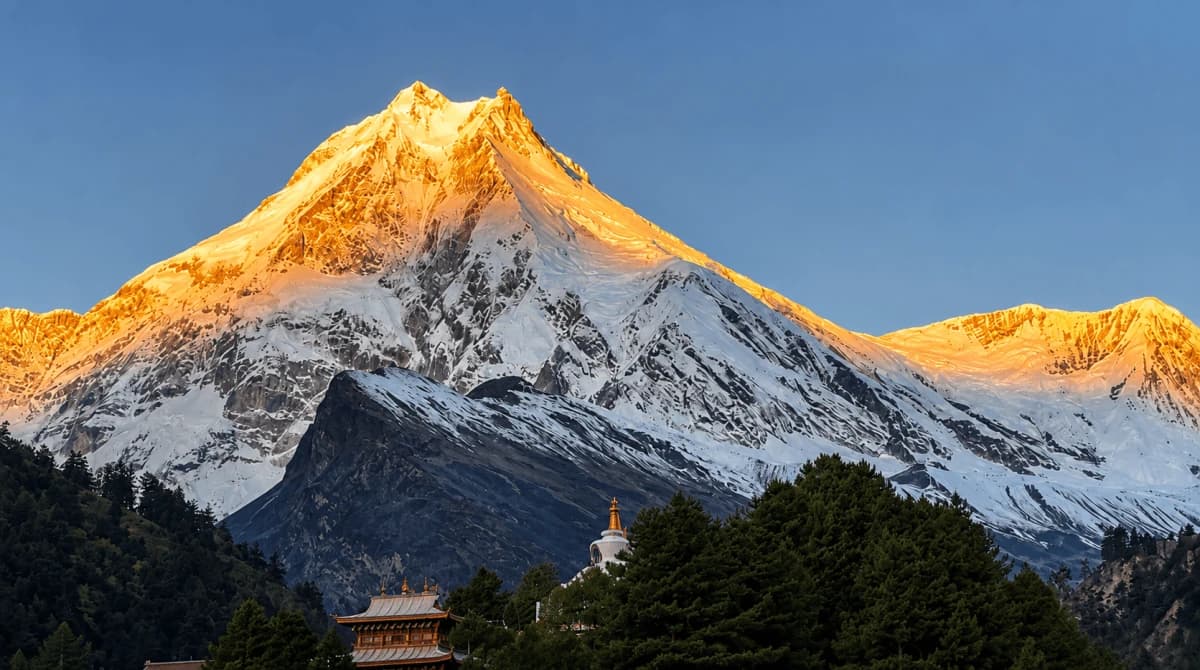
This is the day Manaslu itself finally appears, and it changes the mood of the whole trek. The trail climbs gently through forest and past the village of Prok, visible across the valley, before reaching Lho, where the trail rounds a bend and Manaslu's summit fills the sky for the first time. Our guide Pemba Sherpa, who has walked this route with families for years, puts it simply: the phones come out for photos here, and mostly stay out for photos only after that. Lho's hillside monastery is worth the short extra walk above the village if energy allows.

Good to know: Late afternoon light on Manaslu from Lho is some of the best on the entire trek. If your family has a photographer among them, keep the camera or phone handy for the hour before sunset.

Max Altitude: 3,180m / 10,433ftMeals: Breakfast, Lunch, DinnerAccommodation: Teahouse, LhoMode of Transportation: On Foot Trekking

Highlights: Shyala's meadow views of Manaslu · Pungyen Gompa side trail · Arrival in Samagaon · Start of daily health monitoring

A short, steady climb through juniper and birch brings you to Shyala, a scattering of stone houses set in an open meadow directly beneath Manaslu's south face, arguably the single best mountain view of the entire circuit. From here the trail eases into Samagaon, a large Tibetan Buddhist village that will be your base for the next two nights. From this evening onward, your guide begins daily oximeter checks for every trekker under 18, a quiet, routine part of the evening rather than anything to worry about.

Good to know: Samagaon has real character to explore once you arrive, with an active monastery, mill houses, and yak pastures on its outskirts. Arriving by early afternoon leaves plenty of daylight to wander before the two rest days begin.

Max Altitude: 3,530m / 11,581ftMeals: Breakfast, Lunch, DinnerAccommodation: Teahouse, SamagaonMode of Transportation: On Foot Trekking

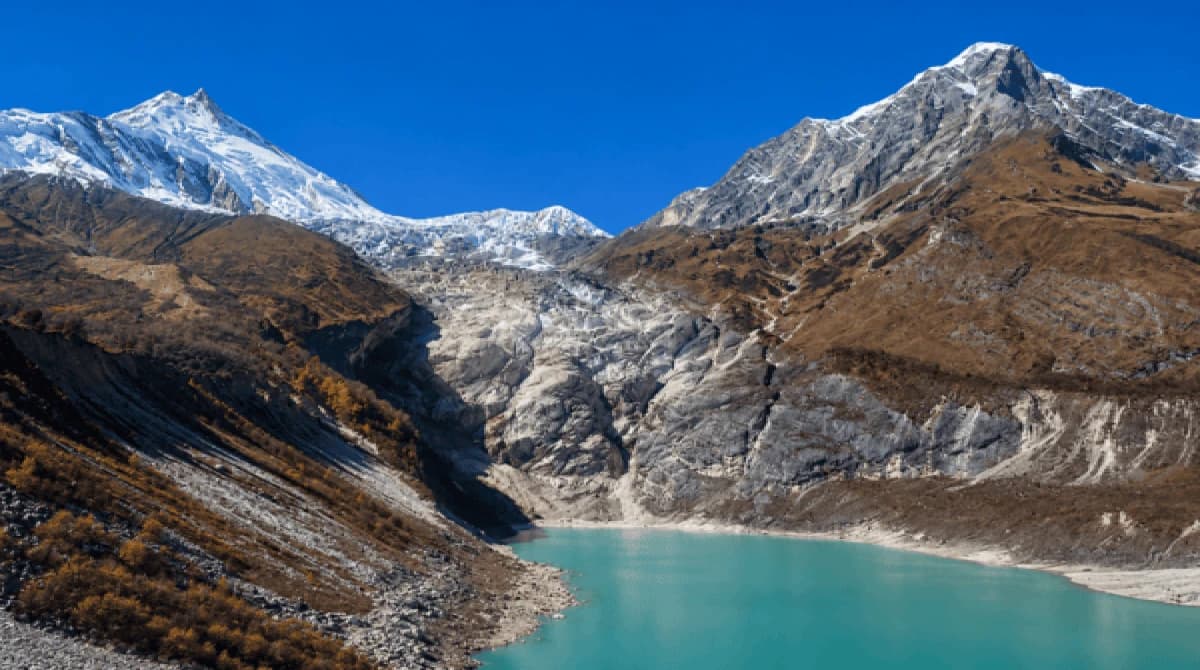
Highlights: Turquoise waters of Birendra Lake · Close-up Manaslu views from the lakeshore · Free afternoon in Samagaon · First full rest day

Today's job is simple: gain a little altitude, then come back down to sleep at the same height, the pattern that keeps altitude sickness at bay. The walk to Birendra Lake is gentle and short, following a glacial moraine trail to a striking turquoise lake sitting directly beneath Manaslu, with icebergs sometimes visible drifting across the surface. Most families are back in Samagaon well before lunch, leaving the whole afternoon free. This is usually the day the cards come out, dal bhat cooking lessons happen in teahouse kitchens, and the trek stops feeling like a checklist of destinations and starts feeling like a family holiday.

Good to know: Even on a rest day, keep drinking water steadily. Altitude has a habit of suppressing appetite and thirst together, and staying ahead of both makes tomorrow's short trek to Samdo feel easier.

Max Altitude: 3,530m / 11,581ftMeals: Breakfast, Lunch, DinnerAccommodation: Teahouse, SamagaonMode of Transportation: On Foot Trekking

Highlights: Open moraine terrain · Suspension bridge over a glacial tributary · Samdo's stone houses · Tibetan plateau landscape

The trail climbs steadily out of Samagaon across wide, open moraine terraces, with the vegetation thinning to scrub and stone as the valley widens. A suspension bridge over a glacial tributary marks roughly the halfway point before the final approach into Samdo, a compact village of flat-roofed stone houses that historically traded directly with Tibet across the nearby pass. The short walking time today is intentional, giving bodies a gentle introduction to another few hundred metres of altitude.

Good to know: Samdo sits at the head of a genuinely wide, open valley, and the afternoon wind tends to pick up here more than at Samagaon. A warm layer for the last hour of walking is worth having out and ready rather than buried in a pack.

Max Altitude: 3,875m / 12,713ftMeals: Breakfast, Lunch, DinnerAccommodation: Teahouse, SamdoMode of Transportation: On Foot Trekking

Highlights: Views toward the Tibetan border · Chance sightings of blue sheep · Climb high, sleep low in practice · Second full rest day

This second acclimatization day, the extra safety margin built specifically into the family itinerary, sends you climbing partway up the ridge above Samdo toward the old trading route into Tibet, with the day's high point offering sweeping views over the plateau country beyond the border. Blue sheep are a genuine possibility on these hillsides, one of the trek's most talked about wildlife sightings among teenagers. The whole family returns to sleep at Samdo's altitude, gaining the acclimatization benefit of the climb without spending the night higher than the body has adjusted to.

Good to know: Pace this hike as a family rather than as a race to the top of the ridge. Turning back a little earlier than planned, while still gaining real altitude benefit, is completely normal and exactly what the day is designed to allow for.

Max Altitude: 3,875m / 12,713ftMeals: Breakfast, Lunch, DinnerAccommodation: Teahouse, SamdoMode of Transportation: On Foot Trekking

Highlights: Final high camp before Larkya La · Increasingly stark, high-altitude scenery · Early dinner and early night · Last check-in before pass day

A short, steady climb brings your family to Dharamsala, sometimes called Larkya Phedi, a small cluster of teahouses at the true foot of the pass with little around it besides mountains and sky. This is where our Dharamsala turnaround rule applies: if any family member is showing more than mild altitude symptoms here, the whole group waits or descends together, no exceptions, a decision made calmly and well ahead of pass day rather than under pressure. For families who are acclimatizing well, the short walking day leaves plenty of time to rest, eat an early dinner, and get to sleep well before the very early start tomorrow demands.

Good to know: Lay out tomorrow's clothing and headlamp before you go to sleep tonight. A pre-dawn departure goes far more smoothly.

Max Altitude: 4,460m / 14,633ftMeals: Breakfast, Lunch, DinnerAccommodation: Teahouse, DharamsalaMode of Transportation: On Foot Trekking

Highlights: Sunrise from Larkya La Pass · Prayer flags at 5,106m · Panoramic Himalayan views toward Himlung and Kang Guru · Long descent into Bimthang's meadows

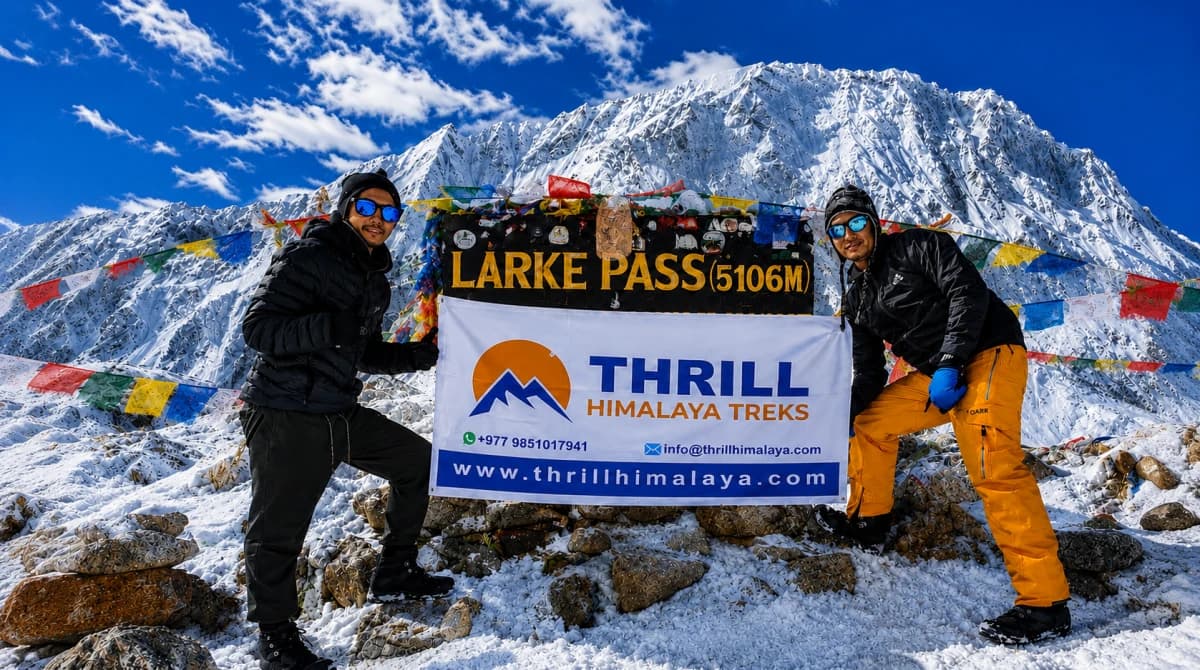
The whole family is up in the dark for a pre-dawn start, walking by headlamp across frozen ground before first light. The climb to Larkya La is steady rather than technical, and reaching the prayer flags at 5,106m as the sun clears the surrounding peaks is, by a wide margin, the moment teenagers on this trek talk about most afterward. The far side descends quickly and dramatically through glacial moraine before easing into the open meadows of Bimthang, ringed by Manaslu's rarely photographed south face. It is a long day by any measure, and finishing it together is genuinely something to be proud of, for teenagers and parents alike.

Good to know: Breakfast today is usually tea and something quick before departure, with a fuller meal often packed to eat once the sun is up and the group has warmed through. Ask your guide the evening before about what to expect so nobody starts the day hungry.

Max Altitude: 3,720m / 12,205ftMeals: Breakfast, Lunch, DinnerAccommodation: Teahouse, BimthangMode of Transportation: On Foot Trekking

Highlights: Manaslu's south face from Bimthang meadows · Forest of pine and rhododendron · Marsyangdi valley views · A genuinely gentle recovery day

After yesterday's effort, Day 13 is built for recovery. The trail drops steadily through pine and rhododendron forest, with the terrain doing most of the work as elevation falls away beneath your feet. Look back often during the morning for a last long view of Manaslu's south face from a completely different angle than earlier in the trek. By afternoon, the trail eases into greener, more populated country as you approach the Marsyangdi valley, and Tilije's neat stone houses make a comfortable, low-key stop for the night.

Good to know: Downhill days like this one are easier on the lungs but harder on the knees, especially after the long descent from the pass the day before. Trekking poles earn their keep again today.

Max Altitude: 2,300m / 7,546fMeals: Breakfast, Lunch, DinnerAccommodation: Teahouse, TilijeMode of Transportation: On Foot Trekking

Highlights: Entering Annapurna Conservation Area · Warmer, greener valley scenery · Final short trekking day · Reconnecting with phone signal

The shortest trekking day of the whole circuit brings your family down into Dharapani, where the trail joins the wider Annapurna Conservation Area and, with it, the first reliable phone signal in well over a week. It is a relaxed morning of walking through increasingly warm, green farmland, a striking contrast to the high, bare country you crossed just two days ago. Dharapani sits on the classic Annapurna Circuit trail, and the road access that resumes here is what carries your family back to Kathmandu tomorrow.

Good to know: Signal returning here often means a flood of messages arriving all at once. Give the family a few minutes to catch up with home before settling in for the evening, rather than letting it hang over dinner.

Max Altitude: 1,963m / 6,440ftMeals: Breakfast, Lunch, DinnerAccommodation: Teahouse, DharapaniMode of Transportation: On Foot Trekking

Highlights: Marsyangdi River valley by road · Besisahar market town · Return to the Kathmandu valley · Hot showers and real beds

Your private jeep collects the family in Dharapani for the long but scenic drive back, following the Marsyangdi valley down through Besisahar before joining the highway toward Kathmandu. It is a full day on the road, but a comfortable one in your own private vehicle, with plenty of stops possible along the way for lunch, photos, or simply stretching your legs. Arriving back in Kathmandu after two weeks in the mountains, most families agree that a hot shower has never felt quite so good.

Good to know: Keep snacks and water in the vehicle for this drive. Road conditions can add an hour or two depending on traffic and the season, and a family that has eaten travels a long day far more easily.

Max Altitude: 1,400m / 4,593ftMeals: Breakfast, Lunch, DinnerMode of Transportation: Private Jeep

Highlights: Built-in weather and schedule insurance · Optional Kathmandu sightseeing · Farewell dinner with your guide · Certificate presentation

This final day exists on purpose, as a cushion against the one thing no itinerary can fully control: mountain weather. If your trek ran smoothly and Larkya La cooperated, this day is entirely free for the family to explore Kathmandu, with Durbar Square, Swayambhunath, and the shops and cafes of Thamel all realistic options depending on energy levels. If a storm or a road closure cost you a day anywhere on the circuit, this is exactly the day that absorbs it, with no scrambling to rebook flights or extend hotel stays.

Note: If the buffer day is not needed for weather, we are happy to arrange a half-day guided Kathmandu sightseeing tour or a family cultural evening. Just let your guide know a day or two in advance.

Good to know: This is the natural day for your family's Trekking Completion Certificates to be presented, often over a relaxed farewell dinner with your guide. It is a nice, low-pressure way to close out the trip together.

Max Altitude: 1,400m / 4,593ftMeals: Breakfast, Lunch, DinnerMode of Transportation: On Foot Trekking
Start planning today.
Our travel experts are here to help. Our travel experts are here to help. Our travel experts are here to help.
Cost Details
Includes

What the Manaslu Circuit Family Trek Price Includes

  • A Nepal government-certified guide with wilderness first aid training and specific experience trekking with teenagers
  • Porters at a ratio of one porter per two trekkers, to carry your family's duffel bags for the full trek
  • All required permits: Manaslu RAP, MCAP, and ACAP, including full paperwork and processing for minors
  • All teahouse accommodation and three meals a day throughout the trek, with flexible portions for growing, hungry teenagers
  • Private jeep transport from Kathmandu to Machha Khola, and from Dharapani back to Kathmandu
  • Complimentary down jacket, four-season sleeping bag, and duffel bag for every family member, issued at your Kathmandu briefing and yours to use for the full trek
  • Water purification tablets provided for each trekker, so your family isn't buying bottled water at rising altitude prices
  • Pulse oximeter monitoring each evening from Samagaon onward, plus a dedicated family safety briefing in Kathmandu before you start walking
  • A trek completion certificate for every family member, including teenagers, recognizing the Larkya La crossing
  • 24/7 WhatsApp support, so relatives back home can reach us at any time during your trek
Excludes

What the Manaslu Circuit Family Trek Price Does Not Include

  • International flights and Nepal entry visa fees
  • Travel insurance with helicopter evacuation cover up to 5,500m. Each minor must be individually named on their own policy; a parent's insurance does not automatically extend to cover a child. We verify every policy at your pre-trek briefing
  • Drinks, hot showers, device charging, and WiFi at teahouses (budget USD 5 to 10 per person per day, more for teenagers who charge multiple devices)
  • Tips for your guide and porters, which we can guide you on at your briefing if this is your first trek in Nepal
Essential Information

Manaslu Circuit Trek Packing Tips for Teenagers

Packing for the Manaslu Circuit Trek with a teenager takes more thought than packing for a solo adult trekker. Here's what actually matters.

  • Never break in new hiking boots on the trail. Have your teenager wear their Manaslu Circuit trekking boots throughout the full 8-week training phase so blisters don't ruin day one
  • Layer smart for the Manaslu Circuit's extreme temperature range. The trek drops from warm sub-tropical valleys to the freezing Larkya La pass at 5,106m, so pack breathable base layers, an insulating fleece, and a windproof, waterproof outer shell
  • Plan for screen-free evenings on the trail. WiFi disappears for most of the Manaslu Circuit, so pack a deck of cards, a small travel game, or a Kindle to keep teens entertained after dinner

Charging and Wi-Fi on the Manaslu Circuit Trek

  • Teahouses charge $2-5 USD per device at higher elevations, so bring one high-capacity power bank (20,000mAh+) for the whole family instead of paying per phone
  • Buy an NTC or Ncell SIM card in Kathmandu before you leave. NTC generally covers the lower Manaslu villages better, but expect signal to drop completely past Deng

Manaslu Circuit Trek Showers and Toilets for Families

  • Lower villages offer gas-heated showers; higher stops only provide hot water by the bucket for $3-5 USD
  • Bring your own wet wipes, hand sanitizer, and toilet paper — these get expensive or run out entirely as you climb higher on the Manaslu Circuit

Staying Warm and Hydrated on the Manaslu Circuit Trek

  • Never drink raw tap or river water anywhere on the Manaslu Circuit. Carry purification tablets or a filter bottle (LifeStraw or Sawyer both work well), and aim for 3-4 liters of water a day to help your body handle the altitude
  • Even with a provided down jacket and sleeping bag, pack a personal thermal sleeping bag liner — it makes a real difference on freezing nights at Dharmasala before your Larkya La crossing

Manaslu Circuit Family Trek Packing List

Pack in layers and keep your family's duffel bags within porter weight limits. Here is the full Manaslu Circuit packing list for families with teenagers.

Documents and Money

  • Passport (valid 6+ months) and photocopies for each family member
  • Passport-size photos for Manaslu RAP, MCAP, and ACAP permits
  • Travel insurance printout naming each minor individually
  • Nepali cash in small denominations for teahouses without card facilities

Upper Body Layers

  • 2-3 quick-dry base layer t-shirts
  • 1-2 long-sleeve thermal tops
  • Fleece or light down mid-layer jacket
  • Insulated down jacket for evenings above 3,000m (provided, but bring a backup layer for teens who run cold)
  • Waterproof, windproof outer shell jacket

Lower Body

  • 2-3 trekking trousers (quick-dry, not jeans)
  • 1 thermal legging or base layer for cold nights
  • Waterproof shell trousers
  • Comfortable shorts for the warmer lower valley days

Footwear

  • Broken-in waterproof trekking boots with ankle support
  • 2-3 pairs of moisture-wicking wool trekking socks
  • Comfortable camp shoes or sandals for teahouses
  • Gaiters if trekking in shoulder season

Head, Hands, and Extremities

  • Warm wool or fleece hat
  • Sun hat or cap
  • Buff or neck gaiter
  • Warm gloves (inner liner plus outer waterproof pair)
  • UV-protection sunglasses

Sleeping and Comfort

  • Sleeping bag rated to at least -15°C (provided, see inclusions)
  • Personal thermal sleeping bag liner for extra warmth and hygiene
  • Inflatable pillow (optional but worth it for teens)

Technical Gear

  • Trekking poles (highly recommended for the Larkya La descent)
  • Headlamp with spare batteries for each family member
  • 60-70L duffel bag for porters plus a 30-35L daypack per person
  • Dry bags or packing cubes to organize and waterproof gear

Health and Toiletries

  • Personal first-aid kit and any prescription medication with a doctor's note
  • Water purification tablets or a filter bottle
  • High-SPF sunscreen and lip balm
  • Hand sanitizer, wet wipes, and a quick-dry travel towel
  • Toilet paper (teahouses don't reliably supply it above Namrung)

Electronics

  • One high-capacity power bank (20,000mAh+) for the family
  • Universal travel adapter
  • Camera or phone with extra memory or storage
  • NTC or Ncell SIM card bought in Kathmandu

Extras

  • Reusable water bottle per family member (1-2L capacity)
  • Energy bars and snacks from home for hungry teenagers
  • Cards, a small travel game, or a Kindle for screen-free evenings
  • Ziplock bags to keep documents and electronics dry

How Difficult Is the Manaslu Circuit Family Trek?

Parents researching the Manaslu Circuit Trek difficulty for families need an honest answer, not a marketing one. Here it is.

  • The Manaslu Circuit Family Trek is rated strenuous, not moderate. Crossing Larkya La at 5,106m puts it on par with Everest Base Camp in difficulty, and above Annapurna Base Camp
  • Daily walking on our family itinerary runs 3 to 8 hours, shorter than the standard adult schedule but still demanding on tired legs by week two
  • The hardest single day is the Larkya La pass crossing: an 8 to 10 hour day starting around 3 am, crossing snow and loose scree at high altitude, followed by a steep descent to Bimthang. This is the day that decides whether a teenager finishes the trek proud or finishes it broken, and we pace the two days before it specifically to protect it
  • Altitude, not distance, is what makes this trek hard for teenagers. Two dedicated acclimatization days at Samagaon and Samdo exist specifically to reduce this risk, not to pad the itinerary
  • Trail conditions add real difficulty beyond fitness. Suspension bridges, landslide-prone sections between Machha Khola and Deng, and uneven stone steps require steady footing, not just stamina
  • This trek suits fit, hiking-experienced teenagers aged 13 and above. It does not suit a family's first-ever multi-day hike. If your teen's hiking experience is limited, our 8-week training plan and an honest fitness conversation with us before booking will tell you whether Manaslu is the right first Himalayan trek or whether Annapurna Base Camp is the better starting point
Need Help?
Feel free to call or WhatsApp our expert.