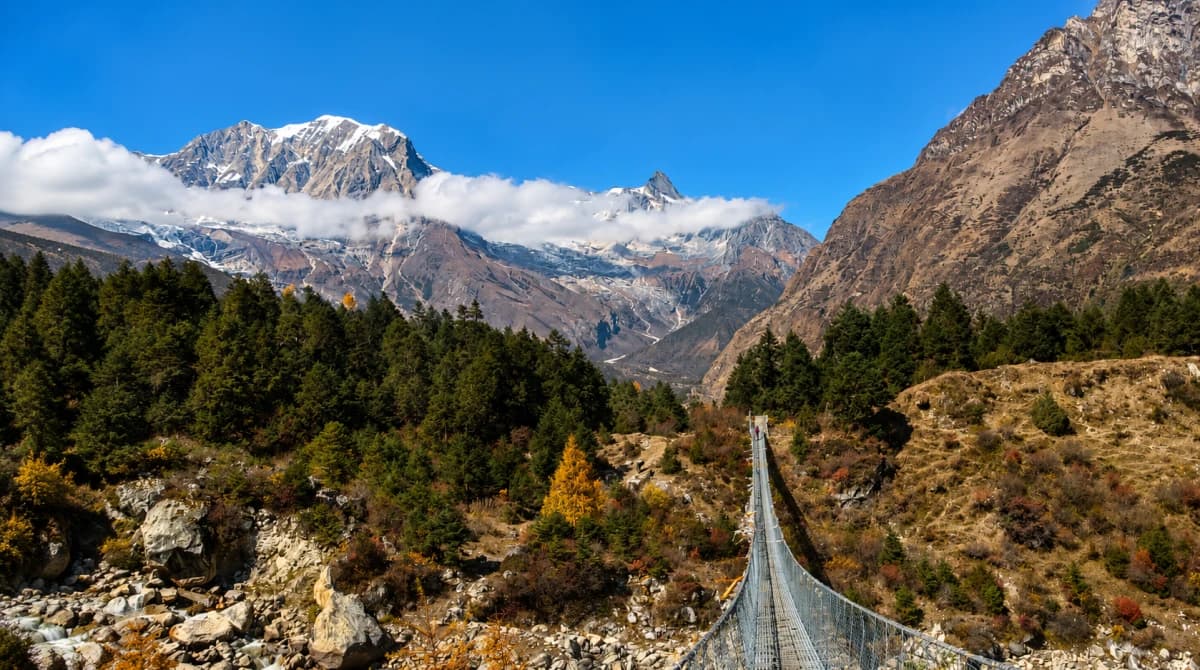
Manaslu Circuit Trek 14 days route with a panorama view of the Himalayas in Nepal
Stunning close up view of Mount Manaslu peak during the 14 days circuit trek in Nepal
Trekking group crossing the snow-covered Larkya La Pass at 5,106 meters during the 14 days Manaslu Circuit Trek in Nepal

Manaslu Circuit Trek - 14 Days

40 reviews in TripAdvisor
Recommended by 99% of travelers
Duration14 Days
Trip GradeStrenuous
Maximum Altitude5,106 m (Larkya La Pass)
Group Size2–15 pax
StartsKathmandu
EndsKathmandu
ActivitiesTrekking & Hiking
Best TimeAutumn (Sep–Nov) & Spring (Mar–May)

What Is the Manaslu Circuit Trek 14 Days Itinerary, Cost, and Full Package for 2026 and 2027?

I have crossed Larkya La Pass more times than I can count, and every sunrise from up there still gets me. If you want a raw Himalayan trek without Annapurna's crowds, the Manaslu Circuit Trek 14 days itinerary cost and full package gives you exactly that.

For both 2026 and 2027 departures, the total cost for Manaslu trek 14 days runs between $789 and $911 per person for group bookings, depending on your group size. A proper package covers your permits, your licensed guide, teahouse lodging, ground transport, and three meals a day on the trail. These figures hold steady across both years since permit fees have not shifted, and we flag it here directly if that changes.

 The Manaslu Circuit Trek 14 days costs $789 to $911 per person depending on your group size, or more for solo private departures, covers Larkya La Pass at 5,106m, and now permits solo trekkers since the March 2026 permit rule change. A licensed guide remains mandatory throughout.

Manaslu Circuit Trek 14 Days Key Facts & Overview

Trip Parameter Details
Duration 14 Days, Kathmandu to Kathmandu
Max Elevation 5,106 m at Larkya La Pass
Difficulty Strenuous alpine terrain
Permits RAP, MCAP, ACAP
Best Season Autumn (Sep to Nov), Spring (Mar to May)
Group Price $911 (2–6 pax) / $789 (7–10 pax) / $797 (11–15 pax)

Manaslu Circuit Trek 14 Days Highlights

  • Cross the Larkya La Pass at 5,106m, the highest and most demanding point of the trek, with sweeping views of Manaslu, Himlung, and Cheo Himal.
  • Trek through a restricted area of Nepal, so you share the trail with far fewer trekkers than the crowded Everest or Annapurna routes.
  • Pass through the Tibetan Buddhist villages of Samagaon and Samdo, where local culture and monastery life stay close to tradition.
  • Circle the Manaslu Conservation Area, home to snow leopards, Himalayan tahr, and over 2,000 species of flowering plants.
  • Walk the full Budhi Gandaki river valley, moving from subtropical forest at low elevation to stark high-alpine terrain near the pass.
  • Get a complimentary sleeping bag and down jacket for the high-altitude days, so you trek prepared without extra rental costs.
  • Trek with a government-licensed guide trained in wilderness first aid, a mandatory requirement on this restricted route and a built-in safety layer for you.
  • Enjoy a genuinely off-the-beaten-path Himalayan experience, close in scale to Everest Base Camp but with a fraction of the foot traffic.

Manaslu Circuit Trek 14 Days Price & Group Costs

Group Size Price Per Person
2–6 pax $911
7–10 pax $879
11–15 pax $797

Smaller groups of 2 to 6 people pay a bit more per person since fixed costs like transport and guide staffing spread across fewer trekkers. Once you hit 7 to 10 pax, the per-person cost drops to its lowest point. Groups of 11 to 15 pax sit slightly higher again, since larger groups need an extra assistant guide and porters for safety and pacing on Larkya La Pass.

March 2026 Manaslu Solo Trek Permit Rules & Requirements

The Department of Immigration dropped the two-person minimum for the Restricted Area Permit in March 2026, and this rule carries forward into 2027 as well. Solo trekkers can now obtain the permit individually, on their own dates, without pairing up with a stranger just to satisfy paperwork.

What has not changed is the guide requirement. A government-licensed guide remains mandatory from Jagat onward, all the way through to Dharapani, and that guardrail is not a formality. The terrain past Samdo gets serious fast. Our team handles your permit paperwork directly with Immigration, and we still put a fully licensed guide on your route whether you book for autumn 2026 or spring 2027.

See our full breakdown of Manaslu Circuit Trek permit requirements and fees if you want the complete RAP, MCAP, and ACAP cost structure.

What Hidden Teahouse Costs and Extra Trail Fees Will You Encounter Beyond the Full Package?

Your package covers room and board, but teahouses past Namrung run on solar power, not the grid. Budget extra rupees for these:

  • Device charging: Rs. 200 to 500 per phone or power bank in Samdo and Dharmashala
  •  
  • Gas hot showers: Rs. 300 to 600 per session at altitude
  • Satellite Wi-Fi cards: Rs. 400 to 800 per day, though weather kills the signal often
  • Boiled drinking water: around Rs. 400 for a thermos at Dharmashala

What Phone and Emergency Signal Coverage Does the Manaslu Circuit Trek 14 Days Itinerary Have Between Samagaon and Larkya La?

Nobody writes about this honestly, and it matters more than people realize. Your phone works fine through Jagat and Namrung on NTC network, spotty but usable. Past Samagaon, regular signal drops out almost completely. Samdo has a weak NTC pocket near the checkpoint building, nothing reliable beyond that.

From Dharmashala to the pass and down to Bhimtang, you stay off-grid unless your guide carries a satellite device. We carry a satellite phone on every group crossing Larkya La, not as an upsell, but because a weather delay or altitude emergency at 5,106m with zero signal poses a real risk, not a theoretical one. Ask any agency directly whether their guide carries satellite communication for this specific stretch. Most will not have a clear answer, and that tells you something.

How Does Trail Congestion on Pass Day Affect Your Manaslu Circuit Trek 14 Days Timing?

Larkya La has a narrow weather window each morning, and every group on the trail that week tends to leave Dharmashala around the same 3 to 4 AM slot. On busier autumn dates, you find yourself in a slow-moving line at the steepest icy sections near the summit ridge, not because the trail is crowded like Everest, but because everyone converges on the same 2 to 3 hour weather window.

We stagger our departure time based on your group's pace and recent trail reports from other guides on radio, sometimes leaving 30 to 45 minutes earlier or later than the pack. It shaves real time off your summit push and keeps you off the ice during the coldest, most crowded stretch. This single scheduling detail changes your entire pass-day experience, and almost no one plans around it.


Ready to Plan Your Manaslu Adventure for 2026 or 2027?

Planning a remote trek like the Manaslu Circuit Trek takes careful coordination, especially with shifting permit regulations and tight seasonal trail windows. Whether you're a solo trekker taking advantage of the new rules or organizing a private group departure, we handle all the background logistics for you, from securing your Restricted Area Permit to assigning an experienced, satellite phone-equipped guide.

Talk to a trekking specialist on WhatsApp today to check available departure dates, customize your 14-day itinerary, or secure your booking for the upcoming trekking season.
 

Itinerary
Trip PlanExpand all

Highlights: Warm welcome at the airport · Hotel transfer · Trek briefing with your guide · Gear check · Evening in Thamel

Your adventure begins the moment you step out of Tribhuvan International Airport, where a Thrill Himalaya Treks representative will be waiting to welcome you and drive you to your hotel. After you've settled in and freshened up, your trekking guide will meet you for a relaxed briefing. He will walk you through the route day by day, answer every question, and do a friendly gear check so you start the trail fully prepared and confident.

The rest of the day is yours. Kathmandu is a city that rewards curiosity: the lively lanes of Thamel are filled with gear shops, cafés, bookstores, and restaurants serving everything from authentic Nepali dal bhat to wood-fired pizza. There's a wonderful energy in the air the night before a big trek. Enjoy it, sleep well, and wake up ready for the Himalayas.

Good to know: Thamel is one of the best places in the world to pick up trekking gear at great prices, and anything you've forgotten can be found within a few minutes' walk of your hotel. Try a traditional Nepali welcome dinner tonight; momo dumplings are the perfect way to start your journey.

Note: A private jeep is available on request for this drive, offering a more comfortable and flexible journey at your own pace. If you'd like to arrange this, simply let us know at the time of booking and we'll take care of everything.

Max Altitude: 1,400m / 4,593 ftAccommodation: Hotel in Kathmandu

Highlights: Scenic Prithvi Highway · Trisuli and Budhi Gandaki river valleys · Terraced hillsides · Arughat bazaar · First taste of rural Nepal

Today is a wonderful introduction to Nepal beyond the city, with a full day of ever-changing scenery from your window seat. Leaving Kathmandu behind, the road follows the sparkling Trisuli River westward, winding past emerald rice terraces carved into hillsides, banana groves, roadside markets, and villages where daily life unfolds at its own gentle pace. Every bend brings something new: children waving from schoolyards, farmers working golden fields, suspension bridges swaying over turquoise water.

After the bustling little bazaar town of Arughat, the road turns north and begins tracing the Budhi Gandaki River, the very river you'll follow on foot for the next several days. The landscape grows greener and wilder as you approach Machha Khola, a friendly riverside village where the sound of the water will lull you to sleep. There's a real sense of arrival here. The mountains are close now, and tomorrow the walking begins.

Good to know: Grab a window seat and keep your camera within reach, because this drive is a highlight in itself. Roadside stops along the way serve excellent tea and fresh snacks, perfect for stretching your legs and soaking in village life.

Max Altitude: 870m / 2,854ftMeals: Breakfast, Lunch, DinnerAccommodation: Teahouse, Machha KholaMode of Transportation: Local Bus

Highlights: Tatopani natural hot spring · Dramatic Budhi Gandaki gorge · Thrilling suspension bridges · Waterfalls · Charming stone-paved Jagat village

Your first day on the trail is a beautiful one, easing you into the rhythm of trekking along the roaring Budhi Gandaki. The path winds through subtropical greenery, past tumbling waterfalls and small farming hamlets where locals greet you with a warm "Namaste." At Tatopani, which literally means "hot water," a natural hot spring bubbles up right beside the trail, and a soak here is a delightful early reward for your first miles.

The afternoon brings some of the most dramatic gorge scenery of the lower trek. You'll cross swaying suspension bridges draped in prayer flags, watch the river churn far below, and feel the valley walls rise around you. The day ends in Jagat, a beautifully preserved village of flagstone streets and traditional stone houses, where you officially enter the Manaslu Conservation Area. It's a milestone worth celebrating with a hot dinner and a cup of masala tea.

Good to know: Pack a small towel in your daypack so you can enjoy a relaxing dip at the Tatopani hot spring; it's a favorite moment for many trekkers. Jagat's stone architecture glows beautifully in the late afternoon light, so keep your camera handy as you arrive.

Max Altitude: 1,340m / 4,396ftMeals: Breakfast, Lunch, DinnerAccommodation: Teahouse, JagatMode of Transportation: On Foot Trekking

Highlights: Philim village and its golden terraced fields · Shringi Himal views · Bamboo and pine forests · Entry into the exclusive restricted region

Today you step into one of Nepal's most special protected regions, a privilege reserved for only a small number of trekkers each year. The trail climbs gently through terraced fields of wheat and barley to Philim, a large and welcoming Gurung village that makes a perfect mid-morning stop. From here, the glittering peak of Shringi Himal plays hide-and-seek through the trees, appearing at bends in the trail just when you least expect it.

Beyond Philim, the route becomes noticeably quieter and more pristine. This is where the Manaslu Circuit's famous sense of untouched wilderness truly begins. You'll wander through whispering bamboo groves and fragrant pine forest, cross the river on sturdy bridges, and pass the junction where the trail to the mystical Tsum Valley branches away. By late afternoon you'll arrive in Deng, a peaceful cluster of stone houses where the first hints of Tibetan culture begin to appear.

Good to know: Philim is a lovely spot for lunch with a view, as its hillside terraces overlook the whole valley. Keep glancing back as you climb; some of the best Shringi Himal views today are behind you!

Max Altitude: 1,860m / 6,102ftMeals: Breakfast, Lunch, DinnerAccommodation: Teahouse, DengMode of Transportation: On Foot Trekking

Highlights: Ancient mani walls and kani gateways · Living Tibetan Buddhist culture · Forests of fir, oak, and blooming rhododendron · Comfortable lodges of Namrung

Today the trek's cultural magic truly comes alive. As you walk through the villages of Bihi Phedi and Ghap, you'll pass beneath beautifully painted kani gateways, the arched chortens that bless every traveler who walks through them, and alongside long mani walls intricately hand-carved with Buddhist prayers by generations of local artisans. Walking past them on the left, as locals do, makes you feel part of a living tradition that stretches back centuries.

The trail weaves in and out of side canyons and through gorgeous forest of fir, oak, and rhododendron that blazes red and pink in spring, with the river never far from earshot. The day's steady ascent delivers you to Namrung, a welcoming village with a handsome stone gateway and some of the most comfortable lodges on the entire route. It's the perfect place to relax, recharge, and toast your progress: you've now climbed into the true Himalayan zone.

Good to know: Namrung is famous among trekkers for its cozy lodges. Several offer attached bathrooms, freshly baked goods, and genuinely good coffee. Treat yourself to a slice of apple pie this evening; you've earned it!

Max Altitude: 2,630m / 8,629ftMeals: Breakfast, Lunch, DinnerAccommodation: Teahouse, NamrungMode of Transportation: On Foot Trekking

Highlights: First full view of Mt. Manaslu (8,163m) · Lho village and Ribung Gompa monastery · Himalchuli and Peak 29 · Shyala's breathtaking mountain amphitheater

This is the day the Manaslu Circuit delivers its first jaw-dropping reveal. As you climb steadily out of Namrung through the traditional villages of Lihi and Sho, the landscape opens up. Then, at Lho, it happens: Mt. Manaslu, the eighth highest mountain on Earth, fills the sky in front of you in all its twin-peaked glory. Lho itself is a treasure, home to the impressive Ribung Gompa monastery where young monks study Buddhist philosophy amid one of the most scenic settings imaginable.

Every step of today's ascent rewards you with bigger and bolder views. By the time you reach Shyala in the afternoon, you'll find yourself standing in a natural amphitheater of giants. Manaslu, Himalchuli, and Peak 29 rise on all sides, with glaciers tumbling between them. Many trekkers call Shyala the most beautifully situated village of the entire trek, and watching the peaks turn gold at sunset here is a memory that stays with you forever.

Good to know: Set your alarm for sunrise. The dawn light on Manaslu from Shyala is pure magic, and you can enjoy it with a hot cup of tea in hand right from the lodge. If you visit Ribung Gompa in Lho, the views of Manaslu framed behind the monastery make for a truly iconic photograph.

Max Altitude: 3,530m / 11,581ftMeals: Breakfast, Lunch, DinnerAccommodation: Teahouse, ShyalaMode of Transportation: On Foot Trekking

Highlights: Relaxed short day · Optional visit to sacred Pungyen Gompa · Arrival at Samagaun, the heart of the Nubri Valley · Free afternoon in a living Himalayan village

Today is a wonderfully gentle day, thoughtfully placed in the itinerary so your body settles beautifully into the altitude while you enjoy the scenery at a leisurely pace. Many trekkers take the rewarding side trail to Pungyen Gompa, a serene monastery tucked beneath the glaciers of Manaslu and steeped in local legend. It's a peaceful, spiritual detour that few travelers in the world ever get to experience.

By early afternoon you'll stroll into Samagaun, the cultural heart of the upper valley and one of the most fascinating villages in the Himalayas. It's a place to slow down and simply absorb: traditional stone houses topped with firewood, yaks grazing between prayer wheels, ancient monasteries, and warm-hearted locals going about mountain life. With the whole afternoon free, you can wander the village lanes, visit the monastery, or relax in the lodge sunroom with Manaslu towering right outside the window.

Good to know: The afternoon tea-with-a-view from Samagaun's lodges is one of the simple pleasures of this trek. Take a gentle stroll through the village before dinner. The light is lovely, the people are friendly, and everyday life here feels like stepping back in time in the best possible way.

Max Altitude: 3,540m / 11,614ftMeals: Breakfast, Lunch, DinnerAccommodation: Teahouse, SamagaunMode of Transportation: On Foot Trekking

Highlights: Turquoise Birendra Lake · Standing at the base camp of the world's 8th highest mountain · Glacier panoramas · The classic "climb high, sleep low" day that makes you stronger

Today is one of the most rewarding days of the whole journey: a spectacular day hike with a light daypack while your main luggage stays at the lodge. The trail first reaches the dazzling Birendra Lake, a glacial lake of the most surreal turquoise color, framed by ice cliffs. It's one of the most photographed spots on the entire circuit. From there, the path climbs through juniper and alpine meadows to Manaslu Base Camp itself, where mountaineering expeditions launch their bids for the summit.

Standing at 4,800 metres beneath the immense ice faces of Manaslu is a genuine bucket-list moment. Very few trekkers on Earth can say they've stood at the base camp of an 8,000-metre peak. And this day is as smart as it is beautiful: hiking high and sleeping back down in Samagaun is the classic mountaineer's technique that lets your body adapt naturally, so you'll feel strong and ready for the days ahead. Trekkers who prefer a gentler day can enjoy a relaxed walk to Birendra Lake or Pungyen Gompa instead. Every option today is a winner.

Good to know: Ask your lodge to pack you a picnic lunch, fill up your water bottles, and bring your camera with a full battery. Between Birendra Lake and the base camp panoramas, today might just fill your entire memory card. The sense of achievement at the top is incredible!

Max Altitude: 4,800m / 15,748ftMeals: Breakfast, Lunch, DinnerAccommodation: Teahouse, SamagaunMode of Transportation: On Foot Trekking

Highlights: Gentle, scenic half-day walk · Manaslu's majestic north face · Samdo village and its rich Tibetan trading heritage · Optional afternoon ridge walk

After yesterday's adventure, today is a short and delightful walk that lets you savor the high valley at an easy pace. The trail crosses the Budhi Gandaki one more time and rises gently through juniper scrub and yak pastures, with Manaslu now showing you a completely new profile: its dramatic north face, a view most photographs never capture. The landscape up here has a wide-open, big-sky beauty all its own.

By lunchtime you'll reach Samdo, the highest village on the circuit and one of its most culturally fascinating. Founded by Tibetan traders, Samdo still carries the spirit of the old salt-trade caravans that once crossed the nearby border passes. The village's stone houses, fluttering prayer flags, and centuries-old customs make it a wonderful place to spend an afternoon. With plenty of free time, you can enjoy an optional walk up the ridge behind the village for sweeping sunset views, or simply relax with tea and watch yak trains amble past.

Good to know: The optional afternoon ridge walk above Samdo offers phenomenal views toward the Tibetan border and is a lovely way to spend an hour or two. The locals here are wonderfully welcoming, so don't be shy about a chat over tea. Their trading stories are fascinating.

Max Altitude: 3,860m / 12,664ftMeals: Breakfast, Lunch, DinnerAccommodation: Teahouse, SamdoMode of Transportation: On Foot Trekking

Highlights: Historic Larkya Bazaar trading grounds · Sparkling Syacha Glacier views · Wild high-alpine scenery · Blue sheep spotting · Star-filled night sky

Today's short, steady walk carries you into the wild upper reaches of the circuit, a landscape of vast, sculpted beauty that feels like another world. You'll pass the site of Larkya Bazaar, where Tibetan and Nepali traders once gathered for seasonal markets, and enjoy superb views of the Syacha Glacier spilling down from the peaks. Keep your eyes on the slopes: this is prime territory for spotting herds of blue sheep, and Himalayan griffons often circle overhead.

Arriving at Dharmasala by early afternoon gives you plenty of time to rest, enjoy a hearty meal, and organize your gear for tomorrow's grand adventure. There's a special camaraderie in the air here, with trekkers from around the world sharing stories and excitement on the eve of the pass. And when night falls, step outside for a moment: at 4,460 metres with zero light pollution, the star-filled sky above Dharmasala is simply extraordinary.

Good to know: Tonight's stargazing is among the best you'll ever experience. The Milky Way feels close enough to touch. Enjoy an early, hearty dinner and lay out your gear before bed; tomorrow you rise early for the most triumphant day of the trek!

Max Altitude: Larkya La Pass (5,106m)Meals: Breakfast, Lunch, DinnerAccommodation: Teahouse, DharmasalaMode of Transportation: On Foot Trekking

From today onward you will be hiking downwards to Tilche. Passing through dense forests filled with Rhododendrons. This trail continues with the beautiful sight of Mt Manaslu and Lamjung Himal.  

Before reaching Tilche you will pass through Karche and Gho where you will be immersed in the Gurung village. After reaching Tilche you will be spending your night at the local tea house.

Max Altitude: 3,720m / 12,205ftMeals: Breakfast, Lunch, DinnerAccommodation: Teahouse, BhimthangMode of Transportation: On Foot Trekking

Highlights: Waking up in Bhimthang's mountain amphitheater · Descent through rhododendron and pine forests · Dudh Khola valley · Charming villages of Gho and Tilije · Joining the classic Annapurna Circuit trail

Wake up to one of the finest lodge views in Nepal: Bhimthang's meadow bathed in morning light with Manaslu and Lamjung Himal glowing above. Then begins one of the most pleasurable walking days of the trek, a long, joyful descent following the milky-blue Dudh Khola through forests that grow taller, greener, and more fragrant with every hour. In spring, the rhododendrons here erupt in red and pink blooms; in autumn, the forest glows gold.

The air becomes rich and warm, waterfalls tumble beside the trail, and the charming villages of Gho and Tilije welcome you back into the middle hills with smiling faces and excellent lunch stops. By afternoon you'll reach Dharapani, where the Manaslu Circuit meets the legendary Annapurna Circuit, a wonderful full-circle moment. Tonight is your last night on the trail, and it's the perfect occasion for a celebratory dal bhat with your guide and porters, swapping favorite memories from an unforgettable two weeks.

Good to know: Gho and Tilije are lovely villages for a relaxed lunch in the sunshine. Make tonight's dinner a celebration. Sharing stories (and maybe a toast) with your trekking crew on the final trail night is a tradition worth keeping!

Max Altitude: 1,960m / 6,430ftMeals: Breakfast, Lunch, DinnerAccommodation: Teahouse, DharapaniMode of Transportation: On Foot Trekking

Highlights: Scenic drive along the Marsyangdi River · Besisahar · Return to Kathmandu · Farewell dinner with your team · Manaslu Circuit Trekking Certificate

Sit back, relax, and let the scenery do the work today. The drive follows the beautiful Marsyangdi River valley down through Besisahar, passing waterfalls, gorges, and hillside villages, a lovely visual encore to your trek as the mountains slowly give way to the green middle hills and then the Kathmandu Valley. It's the perfect time to flip through your photos and realize just how far you've walked.

Arriving in Kathmandu by evening, you'll check back into your hotel for that first glorious hot shower. Then comes the most celebratory moment of the entire trip: a special farewell dinner with your guide and the Thrill Himalaya Treks team, where you'll be presented with your official Manaslu Circuit Trekking Certificate. This certificate is your permanent proof that you crossed the Larkya La at 5,106 metres and completed one of the most rewarding high-altitude treks in the entire Himalayan range. It's a moment of genuine pride, and one that stays with you long after you've returned home. Thamel feels completely different on the way back, buzzing, colorful, and festive, and there's no better place to raise a glass to the Larkya La and the incredible journey behind you.

Good to know: If you have extra days in Nepal, ask us about continuing to beautiful lakeside Pokhara instead of Kathmandu, since the road junction passes right by. Either way, tonight calls for great food, warm company, and happy stories shared around the table with the team that walked every step of this adventure alongside you!

Max Altitude: 1,400m / 4,593ftMeals: BreakfastAccommodation: Hotel, KathmanduMode of Transportation: Local Bus

Highlights: Free morning for sightseeing or souvenir shopping · UNESCO heritage options · Airport transfer and warm farewell

Depending on your flight time, enjoy a final relaxed morning in Kathmandu. It's a lovely chance to pick up souvenirs in Thamel: pashmina shawls, singing bowls, handmade paper, and prayer flags. If time allows, you can also squeeze in a visit to the iconic Swayambhunath Stupa or Boudhanath, two of the valley's magnificent UNESCO World Heritage Sites.

When it's time, a Thrill Himalaya Treks representative will transfer you to Tribhuvan International Airport with plenty of time for your flight. You'll leave Nepal with legs a little stronger, a camera full of Himalayan giants, and memories of the Manaslu Circuit that will last a lifetime. And when the mountains call again, we'll be right here.

Good to know: A string of prayer flags makes a beautiful souvenir. Hang them at home as a colorful reminder of the pass. Safe travels, and see you on the next adventure!

Max Altitude: 1,400m / 4,593ftMeals: Breakfast
Start planning today.
Our travel experts are here to help. Our travel experts are here to help. Our travel experts are here to help.
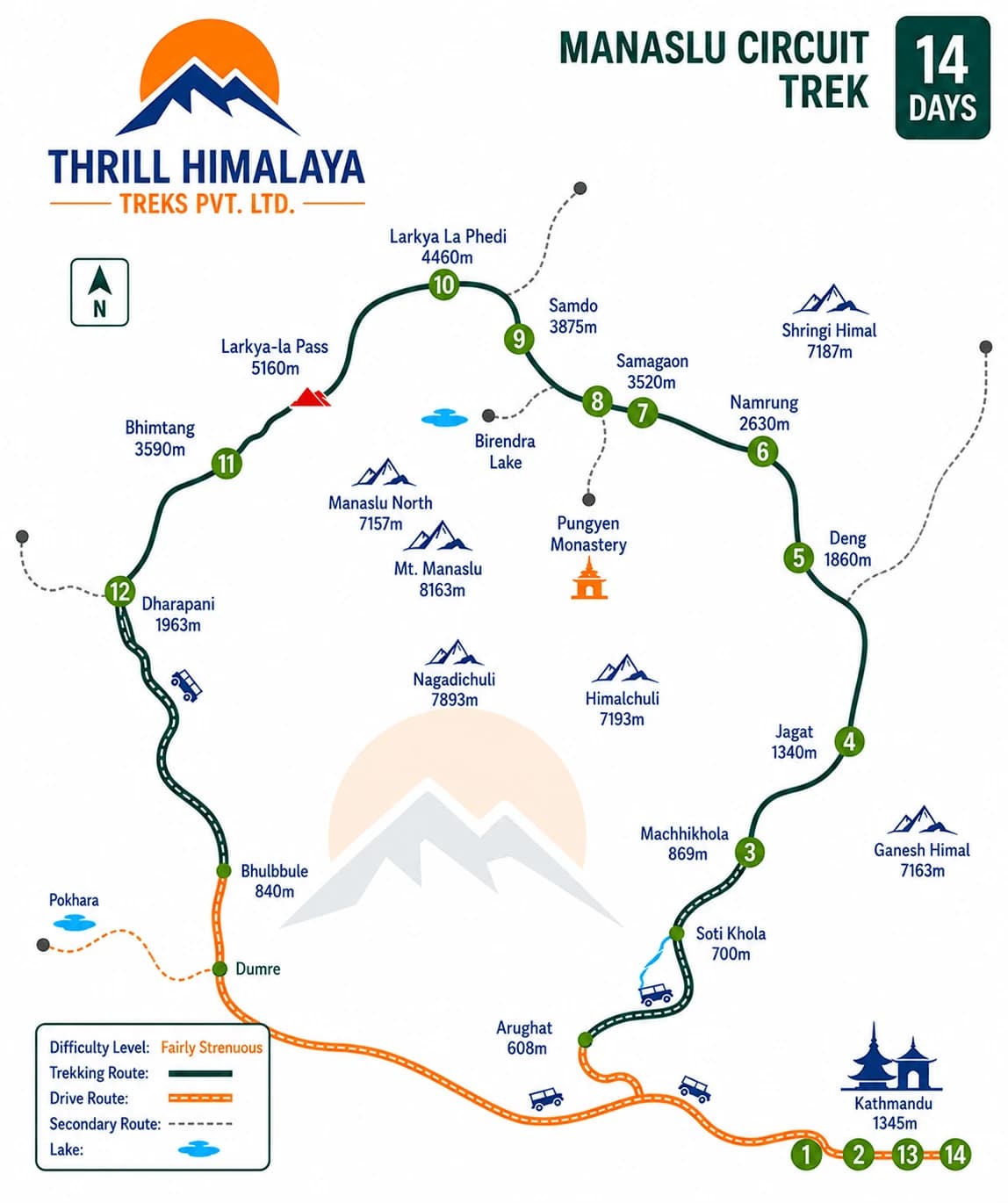
Route Map
Manaslu Circuit Trek route map for the 14-day itinerary in Nepal showing Kathmandu, Soti Khola, Samagaon, Samdo, Larkya La Pass, Bimthang, Dharapani, and the complete trekking route.
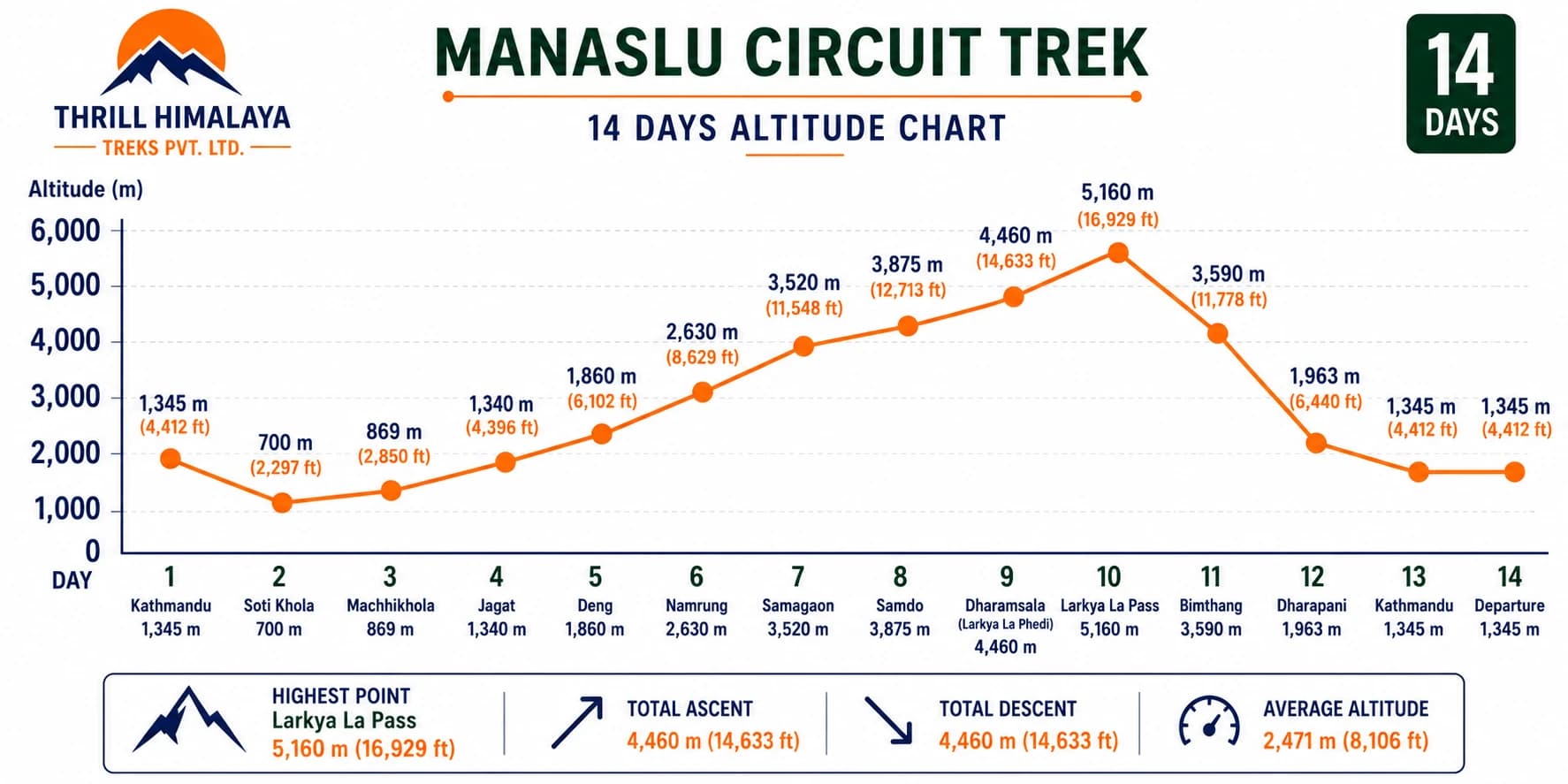
Altitude Chart
Manaslu Circuit Trek altitude chart for the 14-day itinerary showing daily elevation gain from Kathmandu to Larkya La Pass at 5,160 meters in Nepal.
Cost Details
Includes
  • Airport Transfer: Pick-up and drop-off from the airport to the hotel.
  • Road Transportation: All necessary ground transportation during the trip.
  • Accommodation: 2 nights stay in Kathmandu.
  • Internal Flights: Domestic flights (if required) during the trek.
  • Guiding Services: Certified English-speaking guide for the trek.
  • Permits and Fees:
  • Manaslu trekking special permit.
  • Trekkers’ Information Management System (TIMS) card.
  • Annapurna and Manaslu conservation area fees.
  • Trekking Equipment: Kits including sleeping bags and puffer jackets.
  • Meals: Meals as per the itinerary.
  • First Aid: First aid tools available for emergencies.
  • Local Taxes: All applicable local taxes.
Excludes
  • Personal Expenses: Any personal costs such as shopping or souvenirs.
  • Trekking Gear: Personal trekking gear not included in the provided kits.
  • Sightseeing: Additional sightseeing trips not listed in the itinerary.
  • Drinks: Any kind of beverages including bottled water, soft drinks, or alcoholic drinks.
  • Tips: Gratuities for the guide, porter, or other staff.
  • Travel Insurance: Comprehensive travel insurance (mandatory).
  • Emergency Evacuation: Costs related to emergency evacuation (if required).
  • Nepal Entry Visa Fee: Visa costs for entering Nepal.
  • International Flights: Airfare for international travel to and from Nepal.
Essential Information

Evaluating the Manaslu Circuit Trek 14 Days Difficulty for 2026/2027

The Manaslu Circuit Trek is categorized as moderately tough or moderate trekking only for avid trekkers. The trek passes through comparatively difficult and tougher terrains because of which it requires physical strength and energy. The total time of the trekking journey which normally takes from 14 to 18 days, trekkers will cross over various terrains from the sub-tropical monsoon forests to lean alpine zones. 

 The trail goes over 10,000 feet (3,048 meters), the highest being at Larkya La Pass at 16,752 feet (5,106 meters). As a result of these rises trekkers begin to show signs of altitude sickness.

The trek in question is relatively demanding, however, it may be quite possible even for beginners though it requires good physical shape and will to walk many hours a day. The reward entails stunning hiker views such as the mountain, natural deal, and traditional experience.

If you are keen on an amazing trek in the Himalayas with satisfying environments, then Manaslu Circuit Trek is a go-to trek for you.

Altitude Sickness Risks During the Manaslu Circuit Trek 14 Days

Acute mountain sickness is always a factor to contend with on the Manaslu Circuit Trek especially because the trek involves high altitudes. Every time you go up the level of oxygen in the environment reduces and consequently, it becomes hard to breathe. To mitigate the risk, consider these tips: There are different strategies for altitude acclimatization depending on factors like time, and one such effective strategy is the step-wise approach to altitude; most of the trips should start at a low altitude and gradually increase the elevation daily to allow the body to adapt to the low oxygen levels. 

Hydration is critical, so ensure that you take many fluids to facilitate the body’s adaptation processes. In terms of physical orientation, there is a need to pay attention to your body’s state because one may include things like breathing problems, headache, nausea, dizziness, or any other thing related to the physical capabilities of a person if any need to be taken then they need to be taken. 

One must always bear in mind that altitude sickness is complicated and, therefore, adequate preparation along with the provision of safety is of paramount importance during the trek.

Mandatory Travel Insurance for the Manaslu Circuit Trek 14 Days Schedule

Since the Manaslu Circuit Trek is located in a restricted region in Nepal, insurance is required. It is essential to get insurance so that you can be safeguarded against various risks that may arise during a hike. 

First and foremost, in addition to covering medical costs, your travel insurance should include a precautionary clause for helicopter evacuation. This is crucial since the trekking location is typically characterized by steep hills, making medical care scarce should one find themselves in an emergency. Before the expedition, you must also provide a copy of your travel insurance, which also necessitates preparation and payment. 

It is important to note that most so-called standard travel insurance policies do not cover trekking beyond 4,500 meters. Thus, the best course of action is to look for specialized trekking insurance that makes mention of the high altitude in their offers. This will ensure that you will be safe in the event of an emergency or exciting activities. One can expect travel insurance costs to range between $150 to $200 for 30 days.

Essential Permits Needed for the Manaslu Circuit Trek 14 Days in 2026/2027

To plan a trip to the stunning backgrounds of the Manaslu Circuit Trek in Nepal, several permits are necessary. To trek in this region, you need to obtain the following permits: To trek in this region, you need to obtain the following permits: 

The Manaslu Restricted Area Permit is important, which ranges from $7-$10 per day per person. This is a crucial document for hiking in the Manaslu area as well is valid for up to one year; however, the cost might alter according to nationality and the season. Furthermore, the Manaslu Conservation Area Project (MCAP) Permit is required, and the cost is 30$. 

This permit helps in the conservation of the environment and is essential when planning to hike in the Manaslu Conservation Area. Finally, the Annapurna Conservation Area Project (ACAP) Permit costs $30 to obtain the entry pass to trek in the Annapurna region that covers the Manaslu Circuit trail. 

However, permits play a very crucial role in undertaking the Manaslu Circuit Trek for the following reasons. First, they are useful for conservation and environmental protection as the living organisms donate to preserve the Manaslu Conservation Area and keep it stunning. Second, the collected money from these permits is used in the construction and maintenance of trekking facilities including trails, and bridges. 

In other words, it is mandatory to secure such permits as well as a form of responsible tourism practice.

Teahouse Accommodation & Food Options on the Manaslu Circuit Trek 14 Days

Let's delve into the details of accommodation and food during the Manaslu Circuit Trek: It is now time to talk about the accommodation and food on the Manaslu Circuit Trek in more detail. 

For lodging, Teahouses which are referred to as lodges since they are available almost in all the trekking villages. These teahouses have very basic accommodation. These teahouses could vary from a simple one to a comparatively comfortable one and though most teahouses have their bathroom, some of them have a common bathroom. It is advised to have a sleeping bag around. 

Regarding food, teahouses provide meals that one can purchase in the areas where teahouses are situated and this can include for instance Nepal’s staple meal which is dal bhat, a meal prepared from rice, lentil soup, and vegetables. One can also find noodles, momos, and fried rice. Other foods such as pancakes, pasta, omelets, and other foods that are aligned with Western food options are also available in many of the tea houses due to the difference in demand.

However, standards may be different, so it would be wise to choose better-known teahouses and do without such products as raw green vegetables and fruits. Prevent getting a food-borne illness by avoiding raw salads or any raw food product. Also, having some small portion, for instance, an energy bar or a bowl of nuts, that can be eaten apart from the main meals is also useful. 

Do not forget to hydrate yourself by drinking a lot of water, praise the food and be delighted with the views of the Himalayas throughout the trekking.

Official Solo Trekker Rules: Manaslu Circuit Trek 14 Days 2026/2027 Update

As of March 22, 2026, Nepal's immigration department removed the two-person minimum requirement for the Manaslu Restricted Area Permit, so you can now trek the Manaslu Circuit alone. You still need a licensed guide by law, but you no longer need to find a trekking partner or join a group just to get your permit approved. This change makes Manaslu one of the few restricted-area treks in Nepal open to true solo travelers, as long as you book through a registered agency that can arrange your guide and permits.

If you're planning a solo trek, book early during peak autumn and spring windows, since guide availability tightens even though the group-size rule has relaxed.

Budgeting Your Trip: Manaslu Circuit Trek 14 Days Cost Breakdowns

The Manaslu Circuit Trek requires three permits: the Restricted Area Permit (RAP), the Manaslu Conservation Area Permit (MCAP), and the Annapurna Conservation Area Permit (ACAP), since the route exits through Annapurna territory near Dharapani.

Permit Cost (Sep–Nov) Cost (Dec–Aug) Valid For
RAP (first 7 days) $100 $75 Restricted zone entry
RAP (each extra day) $15/day $10/day Beyond 7 days
MCAP $30 $30 Entire trek
ACAP $30 $30 Entire trek

For a standard 14-day trek in autumn, expect around $185–$210 total in permit fees, plus the local Chumnubri Rural Municipality Fee collected at Jagat (see below). We handle all three permits for you in Kathmandu before departure, no extra paperwork on your end.

Do You Need a TIMS Card for the Manaslu Circuit Trek 14 Days Itinerary?

No. The TIMS card, required on treks like Annapurna Base Camp and Langtang, does not apply to the Manaslu Circuit. Manaslu runs on its own permit system (RAP, MCAP, and ACAP), which already covers the government tracking and conservation fees that TIMS would otherwise handle. If you've trekked elsewhere in Nepal before, drop the TIMS card from your checklist entirely for this route. Your guide will carry your RAP, MCAP, and ACAP permits at all checkpoints instead.

Acclimatization Strategy: Safe Manaslu Circuit Trek 14 Days Pacing

Day 7 of the Manaslu Circuit Trek is a rest day at Samagaon (3,530m), and skipping it is one of the biggest mistakes trekkers make on compressed itineraries. Your body needs roughly 24 hours at this altitude to build enough red blood cells to handle the thinner air above, before pushing toward Dharamsala (4,460m) and then Larkya La Pass (5,106m).

Trekkers who rush past this rest day face a sharply higher risk of acute mountain sickness (AMS), with symptoms like headache, nausea, and dizziness. The gap between Samagaon and the pass is over 1,500 meters, so this single rest day does more for your safety than almost any other part of the itinerary. We never compress this day out of our schedule, regardless of group requests.

Local Chumnubri Government Fees for Manaslu Circuit Trek 14 Days Hikers

Beyond the RAP, MCAP, and ACAP permits, trekkers pay a small local fee of NPR 1,000 to 2,000 at Jagat, collected by the Chumnubri Rural Municipality. This fee supports local infrastructure and community services along the trail and is separate from your national park or conservation permits. It's a minor cost, usually included in your guide's checkpoint handling, but worth knowing about so nothing catches you off guard at the checkpoint.

Transportation Logistics: Manaslu Circuit Trek 14 Days Jeep vs. Bus Options

Option Cost Time Best For
Local bus $10–$15 6–8 hours Budget travelers, flexible schedule
Private jeep $300–$400 (round trip) 4–6 hours Comfort, small groups, time savings
Walking Free 1–2 extra trek days Trekkers wanting the full trail experience

Most trekkers walk the core route but consider a jeep on the Jagat-to-Dharapani stretch if time is tight or if a teammate needs an easier exit after the pass. We help you decide this on a case-by-case basis depending on your fitness, schedule, and budget, not a fixed rule for everyone.

Compulsory Guide Regulations for the Manaslu Circuit Trek 14 Days in 2026

Every trekker on the Manaslu Circuit needs a government-licensed guide, a legal requirement for this restricted area. Our guides hold official trekking licenses issued by Nepal's government, along with wilderness first aid training, so you're covered by someone qualified for the terrain, altitude, and emergency situations you may face on this route.

This requirement exists because Manaslu falls under a restricted area classification, meaning independent trekking without a licensed guide isn't permitted by law. Beyond meeting the legal requirement, your guide handles permit checkpoints, navigates the trail in changing weather, and makes real-time calls on pace and rest days to keep your acclimatization schedule safe.

A Few Things to Know Before You Go

The Manaslu Circuit Trek is one of the most rewarding journeys in the entire Himalayan range, and every detail of this itinerary has been carefully crafted by the Thrill Himalaya Treks team to give you the most fulfilling, comfortable, and memorable experience possible.

Your Pace, Your Journey: This itinerary is designed with the perfect balance of walking days, rest stops, and acclimatization built right in. Your guide will always set a comfortable pace that lets you enjoy every view, every village, and every moment along the trail.

Accommodation: You will stay in warm and welcoming teahouse lodges throughout the trek, each one run by local families who take genuine pride in making you feel at home. Rooms are twin-sharing, and single supplements are available on request.

Meals: A hearty breakfast, lunch, and dinner are included every day from Day 2 onward. The trail kitchens along the Manaslu Circuit are known for their generous portions and surprisingly varied menus, from steaming bowls of dal bhat to fresh-baked bread, pasta, and the best apple pie you'll ever have at altitude.

Permits: All three required trekking permits, including the Restricted Area Permit, Manaslu Conservation Area Permit, and Annapurna Conservation Area Permit, are fully arranged by Thrill Himalaya Treks on your behalf. All you need to bring are two passport-sized photos and a copy of your passport.

Private Vehicle: A private jeep is available on request for all road transfer days, offering a relaxed and comfortable journey at your own pace. Just let us know at the time of booking.

Your Team: From your first day in Kathmandu to your farewell dinner on Day 13, you will be accompanied by an experienced, licensed, and deeply knowledgeable local guide who knows this trail inside and out. Porters carry your main luggage so you walk light and enjoy the journey fully.

Flexibility: The mountains have their own magic, and occasionally that means a small adjustment to the plan. Any changes made along the way are always in your best interest, ensuring you have the safest and most enjoyable experience possible.

Trekking Certificate: Upon completing the Manaslu Circuit Trek, you will receive an official Trekking Completion Certificate from Thrill Himalaya Treks, a proud and lasting reminder of one of the greatest adventures of your life.

Manaslu Circuit Trek - 14 Days FAQs

Yes. Manaslu sits inside a restricted trekking area, so Nepal's government requires every trekker to hire a licensed guide through a registered trekking agency. This is not a formality: the Restricted Area Permit can only be issued to a registered agency, so there is no way to apply for it independently. Groups also need a minimum of two trekkers on the permit, though agencies routinely satisfy this for solo travelers by pairing them with a private guide. Route markings thin out past Samagaon, teahouse availability shifts with the season, and the Larkya La Pass crossing is meaningfully safer with someone who reads the weather and the route for a living.

You can travel as the only client on a trip, but you cannot trek without a guide. Manaslu's restricted area status means Nepali regulations require a licensed guide for every trekker, and the permit itself cannot be issued without one. What most people actually mean by "solo," moving at your own pace with no fixed group and no shared itinerary, is entirely possible. Book a private trip rather than a group departure, and it will be just you and your guide, plus a porter if you choose one, on your own schedule.

Three permits cover the full 14-day route. The Manaslu Restricted Area Permit (RAP) is the main one, and it can only be arranged through a registered trekking agency, never independently. Pricing depends on season: roughly USD 100 for the first week of trekking during September to November, and around USD 75 for the same period from December to August, with a smaller daily fee added for extra days beyond the first week. A 14-day trip typically covers close to two weeks of RAP validity. You'll also need the Manaslu Conservation Area Permit (MCAP) and the Annapurna Conservation Area Permit (ACAP), since the route crosses into Annapurna Conservation Area territory near Dharapani, together usually under USD 60 combined. A registered agency arranges all three as part of your package, and permit checks happen at posts in Jagat and further up the valley, so keep your passport handy on the trail.

A well-paced 14-day itinerary breaks into four stages. The first stretch, roughly days 1 to 6, covers the drive from Kathmandu to the trailhead at Machha Khola followed by several days trekking up the Budhi Gandaki river valley through Jagat, Deng, and Namrung to Lho and Samagaon, gaining altitude gradually as the scenery shifts from subtropical forest to high alpine terrain. Day 7 is a built-in acclimatization day at Samagaon (3,530m), with an optional side hike toward Manaslu Base Camp. The itinerary then pushes higher through Samdo and Dharmasala, the final stop before the pass. The Larkya La Pass crossing itself, at 5,106 meters, usually falls around day 11: a long, demanding push that descends into Bimtang on the far side. From there, the final stretch retraces down through Dharapani, where transport picks you up for the drive back to Kathmandu, with the last day held as a buffer for flight timing. The core rhythm, days climbing the valley, a rest day, the final push, the pass, and the descent home, stays consistent across most 14-day Manaslu itineraries. For the full day-by-day breakdown with altitudes and walking times, see our complete Manaslu Circuit Trek itinerary.

Spring (March to May) and autumn (September to November) are the two strongest windows, and most trekkers choose autumn first. Skies clear up right after the monsoon, temperatures stay stable, and mountain views are about as good as Nepal gets, which is also why this is the busiest season on the trail. Spring runs a close second, with warmer days, rhododendron forests blooming lower in the valley, and noticeably quieter teahouses than the September to November peak. Both seasons keep Larkya La Pass reasonably clear of fresh snow, which matters far more on a crossing above 5,000 meters than it does lower down.

Larkya La Pass, at roughly 5,106 meters (16,752 feet), is the highest point on the standard route and the highlight most trekkers remember first. It sits between Dharmasala on the Samagaon side and Bimtang on the descent, and crossing it is a single long day rather than a gradual climb. If your itinerary includes the optional side trip to Manaslu Base Camp from Samagaon during the acclimatization day, that adds a second high point around 4,800 meters, though it's a shorter out-and-back rather than part of the main route.

The trek begins with a drive from Kathmandu to the trailhead at Machha Khola, usually seven to eight hours by private jeep. From there, you walk north along the Budhi Gandaki river, loop around Mount Manaslu via the Larkya La Pass, and drop down into the Marsyangdi valley on the Annapurna side of the mountain. The trek officially ends at Dharapani, where the route rejoins the classic Annapurna Circuit trail and vehicles pick you up for the drive back to Kathmandu. Exact start and end points shift slightly year to year as road construction pushes further into the valley, so confirm the current trailhead with your operator before you travel.

The full Manaslu Circuit covers roughly 150 to 180 kilometers (95 to 110 miles) of walking, depending on the exact route variations and any side trips you add, like the Manaslu Base Camp detour. Daily distances vary a lot: some valley days cover 15 to 20 kilometers on relatively gentle terrain, while the Larkya La Pass day alone can run over 20 kilometers of demanding, high-altitude walking. Total elevation gain matters more than raw distance here. You climb from around 900 meters at Machha Khola to 5,106 meters at the pass, then drop back down, which is a bigger physical undertaking than the kilometer count alone suggests.

Technically yes, but both come with real trade-offs worth knowing before you book. Winter (December to February) brings clear, cold, often spectacular mountain views, and December is genuinely trekked, but by January and February heavy snow can make the Larkya La Pass crossing risky or occasionally impassable, and several high-altitude teahouses reduce hours or close. Monsoon (June to August) keeps the lower valley sections wet, leech-prone, and vulnerable to landslides, with clouds regularly hiding the views, though the upper valley beyond Samagaon sits in a rain shadow and can stay surprisingly clear. If your travel dates are flexible at all, spring or autumn will give you a meaningfully better trip.

Moderate to strenuous is the honest answer, and that's genuinely manageable for most people with reasonable fitness and the right preparation. You don't need mountaineering skills or technical climbing experience. Most days involve five to seven hours of walking on uneven trails with steady elevation gain up the Budhi Gandaki valley, and the Larkya La Pass day is the biggest test: a long push that starts before dawn, climbs to 5,106 meters, then descends steeply to Bimtang on the other side. Altitude adds effort to every step above roughly 3,500 meters, which is part of why the itinerary builds in a full acclimatization day. If you can comfortably hike six to eight hours over hilly terrain with a daypack, you already have the fitness base this trek asks for.

Altitude is something every Manaslu trekker needs to take seriously, and the good news is that a well-built 14-day itinerary is specifically designed to manage it well. The route includes a full acclimatization day at Samagaon (3,530m), following the standard climb high, sleep low approach that gives your body time to adjust before pushing toward the 5,106 meter pass. Early symptoms such as headache, mild nausea, or unusual fatigue are common and manageable if you mention them to your guide right away. Licensed guides on this route are trained to monitor these signs and adjust the plan if needed. Staying well hydrated, walking at a steady pace, and getting a pre-trip check-up are the simplest ways to set yourself up well. Some trekkers also discuss preventive medication like Diamox with their doctor before departure.

All three routes now require a licensed guide, since Nepal introduced that rule nationwide in 2023, so that's no longer the differentiator it once was. What still sets Manaslu apart is its restricted area status: you need an additional permit, a minimum group size of two on that permit, and the trail carries a fraction of the foot traffic you'll find on Everest Base Camp or Annapurna Base Camp. Teahouses here are simpler too, closer to what EBC and ABC looked like a decade or two ago. In terms of altitude, Manaslu sits above Annapurna Base Camp, which tops out around 4,130 meters, but below Everest Base Camp's highest viewpoint, Kala Patthar, at roughly 5,545 meters. Overall physical effort is broadly comparable to Everest Base Camp, and the Larkya La Pass crossing gives Manaslu its own distinct, demanding day that neither of the other two treks quite matches.

Often not, and this is worth checking carefully before you fly out. Many standard travel insurance policies cap altitude coverage around 4,000 meters or exclude high-altitude trekking and emergency helicopter evacuation entirely, and Larkya La Pass sits well above that at 5,106 meters. Look specifically for a policy that covers trekking up to at least 6,000 meters and includes helicopter rescue and evacuation, not just general medical cover. Insurers such as World Nomads or True Traveller are commonly used by trekkers in Nepal for their altitude-specific policies, though the details matter more than the brand, so read the altitude cap and evacuation clause on any policy before buying.

Start eight to twelve weeks out if you can, focusing on cardio endurance and leg strength rather than raw speed. Hiking on hilly terrain with a loaded daypack is the single best preparation, since it trains the exact muscles and lungs this trek will use, but running, cycling, and stair climbing all build a useful base too. Add squats, lunges, and step-ups a couple of times a week, and try to get in at least one or two long back-to-back hiking days before you travel. A general health check with your doctor before high-altitude travel is worth doing regardless of your fitness level, since altitude affects everyone differently.

Package cost depends mainly on group size and service level. A small group departure (roughly 6 to 10 people) typically runs USD 1,200 to 1,600 per person, a standard private trip for 2 to 4 people usually falls between USD 1,800 and 2,500, and a premium private package with extra comforts can run USD 2,800 and up. These figures generally include permits, a licensed guide, porter, teahouse accommodation, and full board meals on the trail. What they usually don't include is your Nepal visa, international flights, travel insurance, personal spending on the trail such as hot showers, Wi-Fi, and snacks (often USD 150 to 300 over two weeks), and tips for your guide and porter, which trekkers commonly budget at around 10 percent of the total trip cost. Group size is the biggest lever on price, so for an exact quote, check current pricing directly.

Most trekkers hire a porter, and it's worth it. A porter typically carries around 15 kilograms of your gear, sometimes shared between two trekkers per porter, which lets you walk with only a light daypack while your legs and lungs focus on the altitude rather than the weight. Given how much elevation this trek gains, that trade-off matters more here than on an easier route. Porter fees are modest by Western standards and are a meaningful part of the local economy along the trail. If you're a strong, experienced trekker who genuinely prefers carrying everything yourself, that's entirely possible with a guide-only setup.

No, and this is one of the most important practical things to plan around. Once you leave the road head at Machha Khola, there's no banking infrastructure on the trail at all, no ATMs and no card payment options at teahouses. Carry all the Nepali rupees you'll need for the entire trek before you leave Kathmandu, ideally with a comfortable buffer, since prices for food, tea, and charging rise the higher you climb. As a rough guide, many trekkers carry NPR 50,000 to 80,000 (roughly USD 370 to 600) in cash for two weeks on the trail, on top of whatever the package already covers.

Accommodation is teahouse-style throughout: simple, family-run lodges with twin-sharing rooms, a shared dining hall warmed by a wood or yak-dung stove, and basic furnishings, a bed, a pillow, and usually a blanket. Bathrooms are mostly shared, though a handful of lodges in lower villages like Jagat or Deng offer attached bathrooms. Rooms get simpler and colder the higher you climb, and walls in the higher villages are often thin, so a good sleeping bag matters even though blankets are provided. It's comfortable rather than luxurious, and that's part of the trek's appeal, since you're staying in genuine mountain villages, not purpose-built tourist infrastructure.

Layering is the core principle, since you'll move from subtropical valley heat to high-altitude cold within the same trip.

  • A down jacket and insulating mid-layers for camp and evenings
  • A waterproof, windproof outer shell
  • Moisture-wicking base layers, top and bottom
  • Broken-in, sturdy trekking boots (never brand new ones)
  • A sleeping bag rated to at least minus 15 to minus 20 degrees Celsius
  • Warm gloves plus a thinner liner pair
  • A warm hat and a sun hat, plus UV-protective sunglasses for glare near the pass
  • Trekking poles, genuinely useful on the Larkya La descent
  • A headlamp with spare batteries
  • A water purification method: tablets, drops, or a filter
  • A power bank, since charging isn't always guaranteed near the pass
  • A basic personal first aid kit with any regular medications

Pack light where you can, since your porter has a weight limit, but don't compromise on the sleeping bag or the layering system. Those two things do the most work in keeping you comfortable above 3,500 meters.

Wi-Fi is available at most teahouses for a small daily fee, though speed and reliability drop the higher you go and it can disappear entirely for a day or two near Samdo and Dharmasala. Mobile coverage follows a similar pattern: Nepal Telecom generally has the better signal in this region, working reasonably well through the lower and middle villages, and getting patchy or vanishing completely above Samdo. Treat connectivity on this trek as a bonus rather than something to plan around.

Teahouse menus are simple but genuinely varied, built around what can realistically be carried or grown at altitude. Dal bhat, Nepal's staple rice, lentil, and vegetable curry plate, is the trekking classic for good reason, since it usually comes with free refills. Beyond that, expect fried rice, noodles, momos, pasta, potato dishes, and simple soups, with garlic soup a trail favorite many trekkers swear helps with acclimatization. Breakfast options run from porridge and pancakes to eggs and Tibetan bread. Prices climb steadily with altitude, since everything is carried in by porter or mule.

Yes, most teahouses offer charging for a small fee that rises with altitude, whether through solar power, micro-hydro, or a generator depending on the village. It's not something to fully rely on though, especially in the last day or two before Larkya La, where electricity is limited. Bring at least one power bank, keep it and your camera batteries in an inner pocket at night since cold drains batteries fast, and pack a couple of spare camera batteries if photography matters to you.

Water itself is easy to find, since teahouses sell both bottled and boiled water at every stop, but tap and stream water should never be drunk untreated. The more practical and more responsible choice is to carry a purification method, tablets, a filter, or a UV steripen, and refill from teahouses rather than buying bottled water at every meal. It works out cheaper over two weeks, and it keeps plastic waste out of a trail that already deals with a genuine litter problem at altitude. Boiled water, sold cheaply at most teahouses, is another safe and popular option.

Yes, generally, up to around Samagaon, usually solar or gas-heated and available for a small fee that increases with altitude. Above Samagaon, at Samdo and Dharmasala especially, hot water becomes rare simply because there isn't enough fuel or power to heat it reliably at that elevation and cold. Pack a few biodegradable wipes for those higher nights near the pass, since a quick wipe-down is a realistic substitute when a proper hot shower isn't on offer.

Need Help?
Feel free to call or WhatsApp our expert.
10-day Manaslu Circuit Trek

I joined the 10-day Manaslu Circuit Trek with two friends through Thrill Himalaya Treks, and it was an amazing experience. The team was reliable, the guide was knowledgeable and patient, and everything was arranged smoothly. We enjoyed every day of...

read more +
Lee You Wan, Singapore
Lee You Wan, Singapore- Singapore
May 21, 2026
Manaslu circuit Trekking

Manaslu Circuit Trek
Our Manaslu Circuit Trek with Thrill Himalaya Treks was an unforgettable adventure and one of the best trekking experiences in Nepal. The trail is beautiful, peaceful, and less crowded, with amazing views of Mt. Manaslu, Himalchuli, Ganesh Himal, and traditional Tibetan-style villages.

read more +
Narayan P.
Narayan P.- United Kingdom
November 11, 2025
Need Help? Call Us.+977 9851017941