-1200x670-1.webp&w=3840&q=75&dpl=dpl_8tVMsCCp6KPn1weGamAJsh55Bzvo)
.webp&w=3840&q=75&dpl=dpl_8tVMsCCp6KPn1weGamAJsh55Bzvo)
Annapurna Base Camp with Mardi Himal Trek: Cost, Itinerary, and Complete 2026 Guide
The Annapurna Base Camp with Mardi Himal Trek, often searched as the annapurna base camp and mardi himal trek or simply the ABC Mardi Himal trek, combines two of the most rewarding short routes in the Annapurna region into a single journey. You walk the quiet Mardi Himal ridge first, descend to the valley, then climb into the Annapurna Sanctuary itself. Two base camps, two completely different kinds of mountain views, one trip of around 10 days from Pokhara.
We are Thrill Himalaya Treks, a government-registered local agency (NTB Reg. No. 3303/81/82, TAAN member) based in Kathmandu. Our founder guided in the Annapurna region for 14 years before starting the company, and this combined route is the one we recommend most often to trekkers who have more than one week in Nepal and cannot choose between the two trails.
Quick Facts: Annapurna Base Camp with Mardi Himal Trek
- Duration: 9 days, 8 nights on the trail, our standard combined itinerary from Pokhara
- Route: Jhinu Danda, Lower Sinuwa, Deurali, Annapurna Base Camp, Bamboo, Jhinu hot springs, Forest Camp, High Camp, Mardi Himal Base Camp, Low Camp, Kande, Pokhara
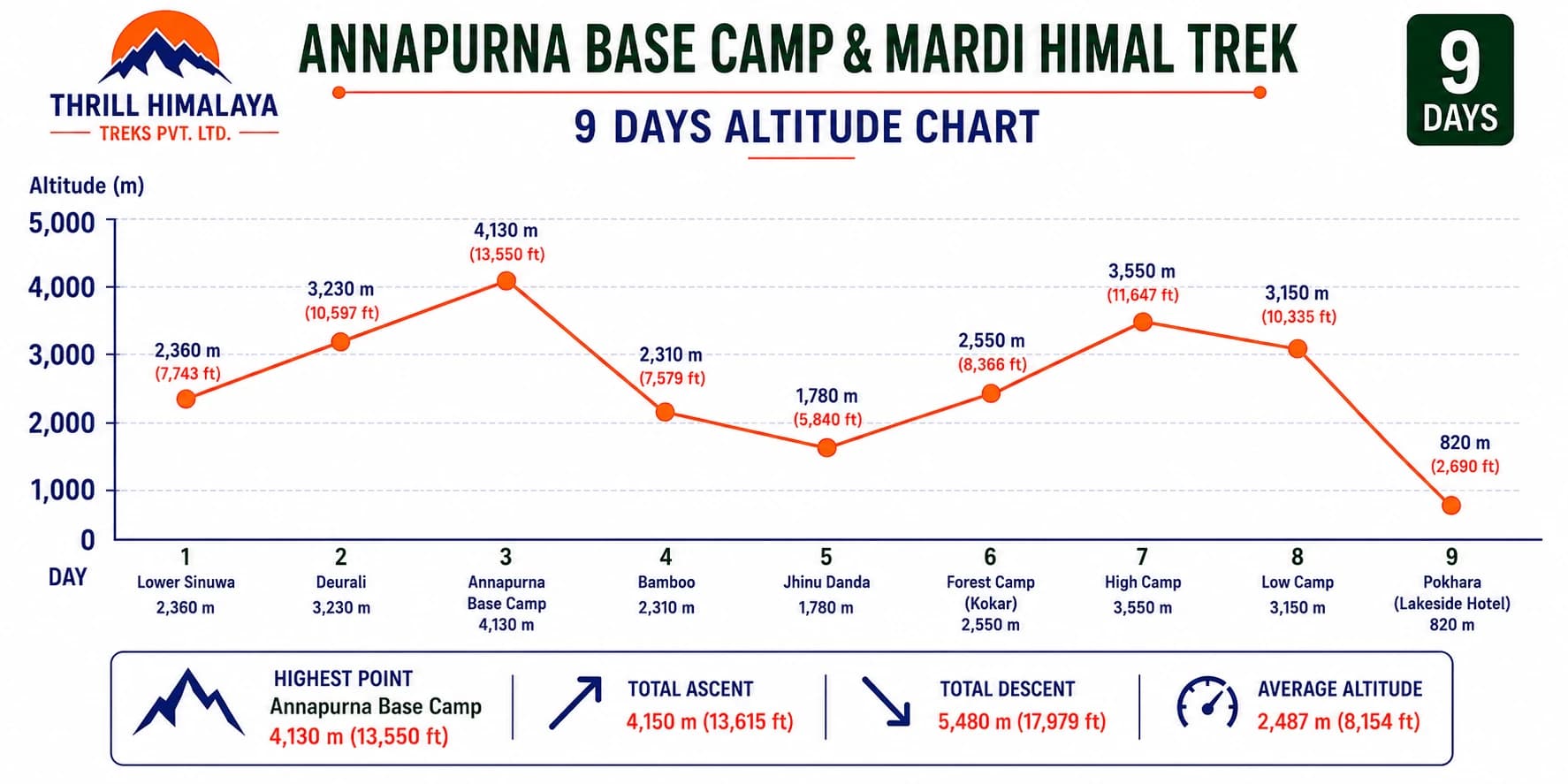
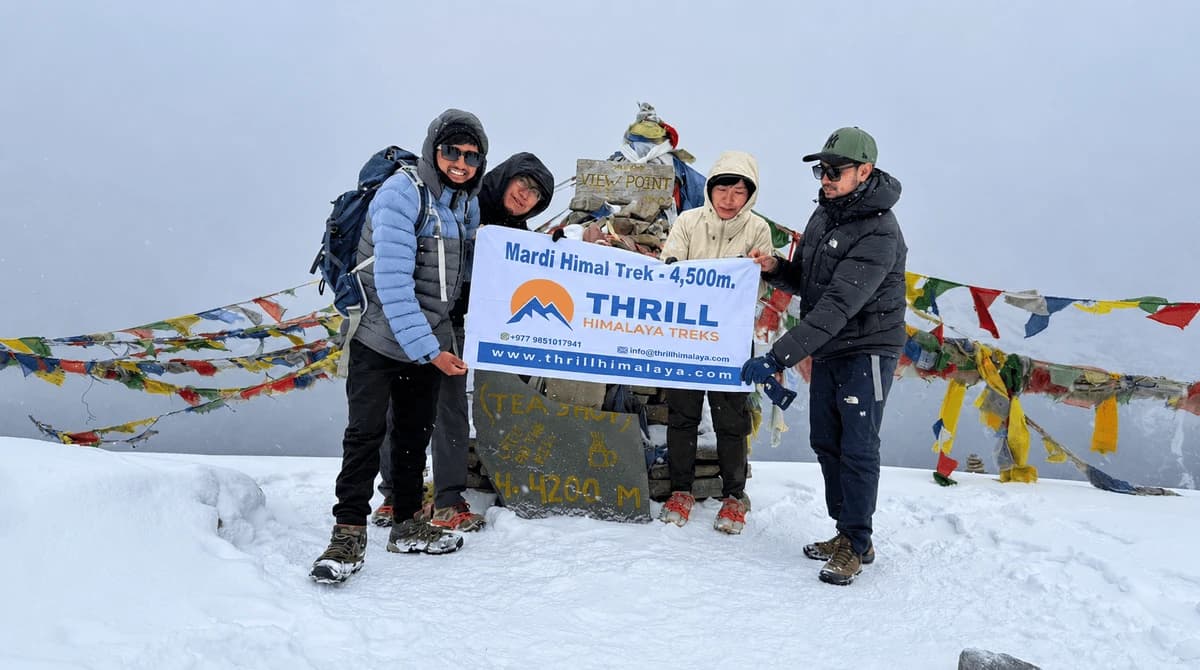
- Maximum altitudes: Annapurna Base Camp 4,130 m and Mardi Himal Base Camp around 4,500 m
- Difficulty: moderate, consecutive walking days of 5 to 7 hours
- Permits: ACAP and TIMS
- Best seasons: March to May and September to November
- Accommodation: teahouses throughout
- Start and end point: Pokhara
- Price: from USD 797 per person (see full pricing table below)
These quick facts answer the most common questions about the combined trek's duration, altitude, difficulty, permits, and best time in one view. Every point is explained in detail below.
What Is the Annapurna Base Camp with Mardi Himal Trek?
The Annapurna Base Camp with Mardi Himal Trek is a combined route that links the classic walk into the Annapurna Sanctuary with the Mardi Himal ridge trail, giving you two distinct base camp experiences on one trip. Trekked separately, each route takes 4 to 7 days. Combined, this annapurna mardi himal trek itinerary runs 9 days on our standard plan, starting and ending in Pokhara, and extends to 13 days with add-ons like Poon Hill.
The two trails could not feel more different, and that contrast is the whole point. Annapurna Base Camp takes you up the Modi Khola valley and into a glacial amphitheatre where Annapurna I, Annapurna South, Hiunchuli, and Gangapurna rise almost directly above your head at 4,130 m. Mardi Himal is the newer, quieter route: an open ridgeline through rhododendron forest with sweeping, wide-angle views of the entire Annapurna skyline, including the closest teahouse-trek view of Machhapuchhre (Fishtail) in Nepal.
If you are considering only the classic sanctuary route rather than combining both trails, our Annapurna Base Camp Trek follows the traditional route into the sanctuary.
Our itinerary begins on the ABC side, driving to the Jhinu Danda road head and climbing through Chhomrong, Sinuwa, Bamboo, Dovan, and Deurali to Annapurna Base Camp. After descending, you soak in the Jhinu hot springs, then cross the valley to the Mardi side and climb through Forest Camp and High Camp to Mardi Himal Base Camp, exiting via Kande. You finish having seen the sanctuary from inside and the whole skyline from above, with no repeated trail.
Why Combine Annapurna Base Camp and Mardi Himal Trek?
Combining the Annapurna Base Camp and Mardi Himal trek gives you two genuinely different mountain experiences instead of one, plus a real acclimatization advantage that most trekkers never think about. Mardi Himal delivers ridge-top panoramas, the full Annapurna skyline viewed from open ground. Annapurna Base Camp delivers the close-up: an enclosed sanctuary of 7,000 and 8,000 m peaks surrounding you on all sides.
The practical reason matters just as much as the scenery. On our itinerary, the ABC section comes first, climbing steadily over three days to sleep at base camp at 4,130 m, with your guide monitoring everyone closely on the fastest ascent day. By the time you cross to the Mardi side on Day 6, your body is fully acclimatized, so the climb to Mardi Himal Base Camp at around 4,500 m, the highest point of the whole trip, feels far easier than it does for trekkers arriving fresh from Pokhara. The Jhinu hot springs sit exactly in the middle of the route, giving your legs a genuine recovery day between the two halves. A well-built combined itinerary uses this sequencing to your advantage rather than treating the trip as two separate treks bolted together. That is exactly how we build ours.
One more honest point from our guides: trekkers who do only ABC often tell us the trail felt crowded in peak season. Trekkers who do the combined route get the quiet ridge first and arrive at the sanctuary already feeling like they earned it.
How Many Days Does the Annapurna Base Camp with Mardi Himal Trek Take?
The Annapurna Base Camp with Mardi Himal trek takes between 9 and 13 days for most trekkers, and our standard 9-day itinerary is the balance of pace and acclimatization we recommend. Here is how the common durations compare:
| Duration | Best Suited For |
|---|---|
| 9 days | Our standard combined itinerary: both base camps, the Jhinu hot springs rest point, and the best balance of pace and price |
| 10 to 11 days | Trekkers who want shorter walking days, families, and guests in their 50s and 60s who prefer a gentler pace |
| 12 to 13 days | Trekkers adding the Poon Hill sunrise or Khopra Ridge extension to the combined route |
| 14 to 16 days | First-time high-altitude trekkers who want extra rest days and a fully relaxed pace with no long days |
If you are comparing shorter ABC-only options, you can also see our 5-day Annapurna Base Camp Trek and 7-day Annapurna Base Camp Trek itineraries before deciding whether the combined route is right for you.
Trekkers who want a longer, more relaxed ABC-only itinerary can also compare our 10-day Annapurna Base Camp Trek.
We build the itinerary around you, not the other way around. If you are arriving with a fixed return flight or a shorter holiday allowance, we adjust the day count and pacing so acclimatization is never rushed to hit an arbitrary trip length. Tell us your dates and we will tell you honestly what fits.
What Is the Day-by-Day Itinerary for the Annapurna Base Camp with Mardi Himal Trek? (Our 9-Day Route)
The day-by-day itinerary for the Annapurna Base Camp with Mardi Himal trek follows our standard 9-day route from Pokhara, completing the classic Annapurna Base Camp path first and finishing on the Mardi Himal ridge trail. Walking times come from our own trip records, not optimistic brochure estimates.
| Day | Route | Max Altitude | Walking Time |
|---|---|---|---|
| 1 | Pokhara to Jhinu Danda (drive), trek to Lower Sinuwa | 2,360 m | 4 to 5 hrs |
| 2 | Lower Sinuwa to Deurali via Bamboo and Dovan | 3,230 m | 6 to 7 hrs |
| 3 | Deurali to Annapurna Base Camp via MBC | 4,130 m | 5 to 6 hrs |
| 4 | Annapurna Base Camp to Bamboo | 2,310 m | 5 to 6 hrs |
| 5 | Bamboo to Jhinu Danda hot springs | 1,780 m | 4 to 5 hrs |
| 6 | Jhinu Danda to Forest Camp via Landruk | 2,550 m | 6 to 7 hrs |
| 7 | Forest Camp to High Camp via Badal Danda | 3,550 m | 5 to 6 hrs |
| 8 | High Camp to Mardi Himal Base Camp, descend to Low Camp | 4,500 m / 3,150 m | 7 to 9 hrs |
| 9 | Low Camp to Kande, drive back to Pokhara | 1,770 m | 5 to 6 hrs |
For travelers who want to focus entirely on the sanctuary section, our Annapurna Base Camp Trek itinerary provides the ABC-only route and pacing.
We customize rest days and side trips like Poon Hill based on your group's fitness and available time. Message us for the exact day-by-day plan for your dates.
How Much Does the Annapurna Base Camp with Mardi Himal Trek Cost?
The Annapurna Base Camp with Mardi Himal trek costs from USD 867 per person for a solo trekker and drops to USD 597 per person for larger groups with Thrill Himalaya, with permits, guide, porter, teahouse accommodation, meals, and Pokhara transport all included. As with all our packages, we price by group size because guide, porter, and vehicle costs are shared as the group grows:
| Group Size | Price per Person (USD) |
|---|---|
| 1 person (solo/private) | $867 |
| 2 to 3 people | $697 |
| 4 to 6 people | $667 |
| 7 to 10 people | $647 |
| 11 to 15 people | $597 |
A 20% deposit confirms your booking. Our quotes list everything included and excluded line by line, so the number on your invoice and the number you pay on the trail match. These are 2026/2027 rates, and we confirm your exact written quote within 24 hours of enquiry.
Be careful comparing headline prices between agencies. Ask any operator quoting a very low price exactly what is included: a bare number without a breakdown is the most common way trekkers end up paying more than expected once on the trail.
.webp&w=3840&q=75&dpl=dpl_8tVMsCCp6KPn1weGamAJsh55Bzvo)