Everest Base Camp with Gokyo Lake Trek: 17 Days via Cho La Pass
The Everest Base Camp with Gokyo Lake Trek is a 17-day high-altitude teahouse loop in Nepal that connects EBC (5,364 m) and Gokyo Lakes via the 5,420 m Cho La Pass. Prices start at USD 1,497 per person.You walk to Everest Base Camp and climb Kala Patthar first, cross the 5,420 m Cho La Pass, then finish at the turquoise Gokyo Lakes with a sunrise climb of Gokyo Ri before walking out to Lukla. It is harder than the standard Everest Base Camp trek and suits fit, healthy hikers who have done multi-day walks before and are comfortable on steep, rocky ground.
The package costs from USD 1,497 per person for a group of 7 to 12, or USD 1,689 if you trek on your own, and the price is the same for every departure in 2027 and 2028. If you would rather not walk the last three days back to Lukla, you can fly out of Gokyo by helicopter after the Gokyo Ri sunrise.
Key facts
17 days, Kathmandu to Kathmandu, with 14 days on foot
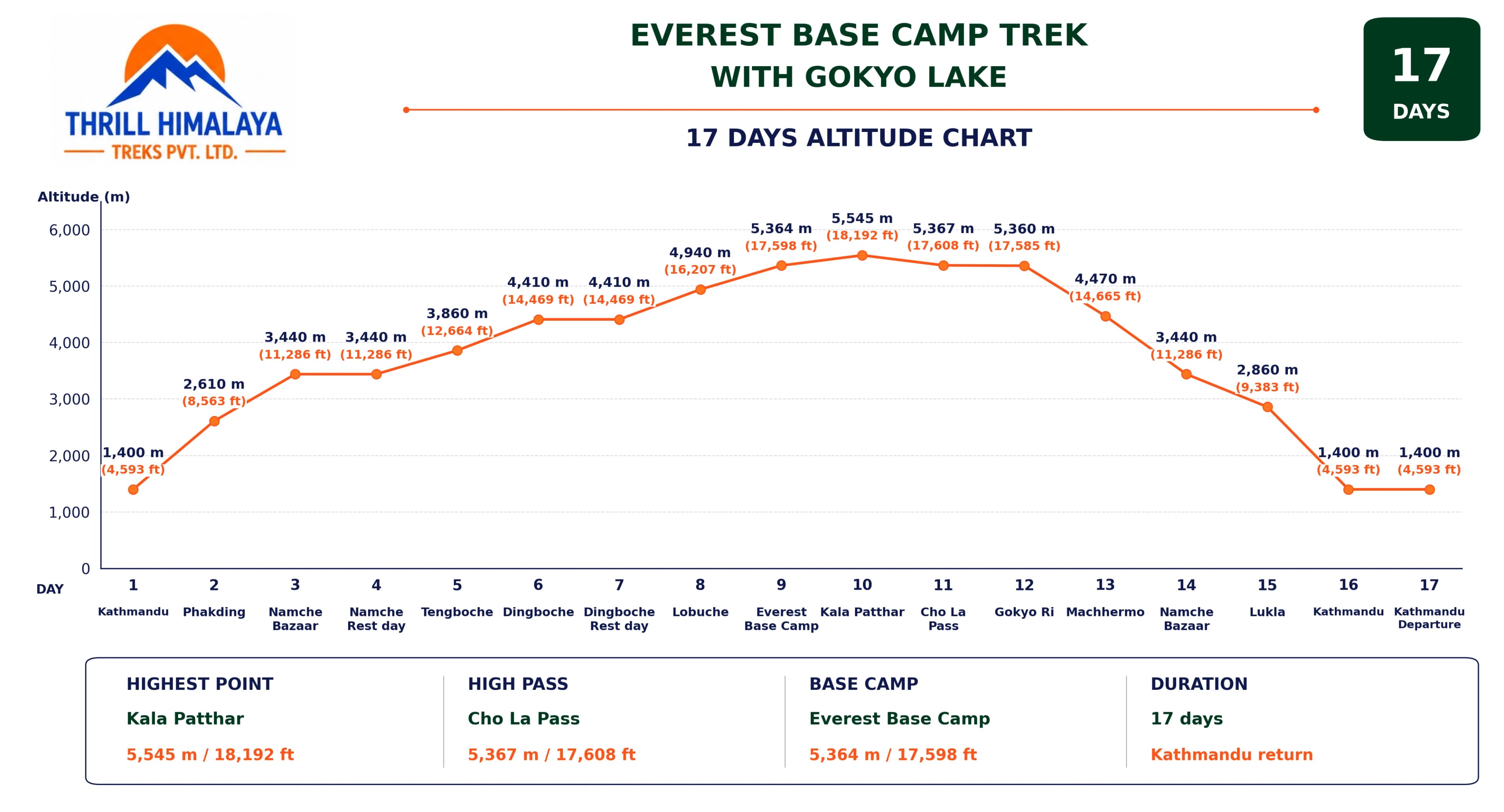
Highest point: Kala Patthar, 5,545 m (18,192 ft)
Hardest day: Day 11, Cho La Pass, 5,420 m (17,782 ft)
Grade: challenging, for fit hikers who have done multi-day treks
Price: from USD 1,497 per person, same price all year
Best months: October and November; late March to May
Departures: private or small group, any start date, every departure guaranteed
Option: helicopter return from Gokyo, from USD 1,000 per person
EBC and Gokyo Lakes Trek: full trip facts
|
Duration |
17 days, Kathmandu to Kathmandu, with 14 days on foot (Days 2 to 15). We recommend one extra contingency day, which is not included in the 17 days. |
|
Route |
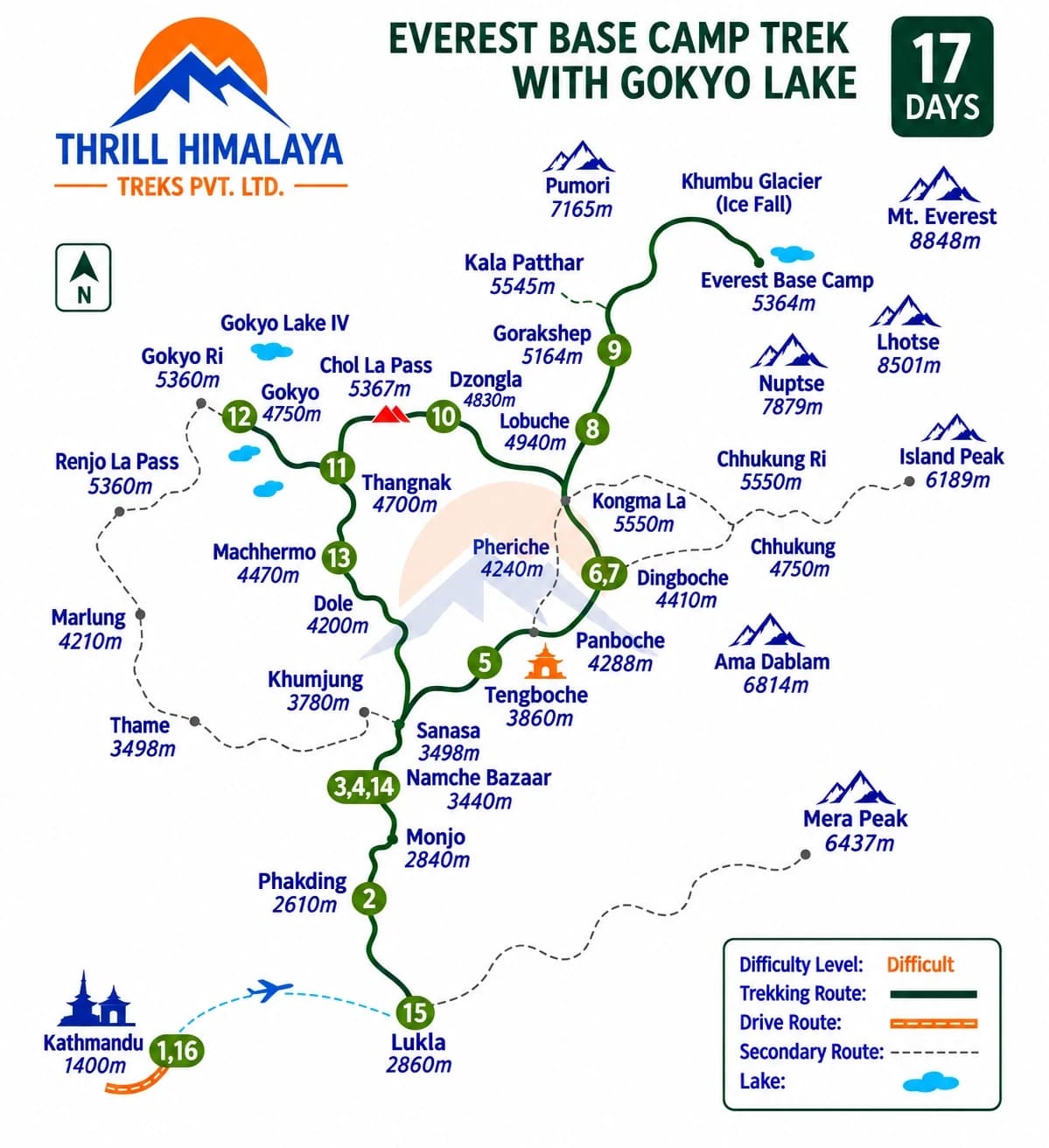
Lukla, Namche Bazaar, Dingboche, Everest Base Camp, Kala Patthar, Cho La Pass, Gokyo, Gokyo Ri, Namche Bazaar, Lukla |
|
Route direction |
Everest Base Camp first, then east to west over Cho La Pass to Gokyo |
|
Highest point |
Kala Patthar, 5,545 m (18,192 ft) |
|
Highest overnight |
Gorak Shep, 5,164 m (16,942 ft) |
|
Hardest day |
Day 11, Cho La Pass (5,420 m / 17,782 ft), about 7 to 9 hours |
|
Walking per day |
Usually 4 to 7 hours; 7 to 10 hours on Days 9 to 11, and 6 to 8 hours on Day 13 |
|
Total distance |
About 150 km on foot over 14 days |
|
Grade |
Challenging: long days above 4,800 m and one high pass with a short glacier section |
|
Nights in Gokyo |
One (Day 12) |
|
Helicopter option |
Optional helicopter return from Gokyo on Day 13: USD 1,000 per person extra on a shared flight, or USD 5,700 for a private helicopter |
|
Accommodation |
Kathmandu hotel (2 nights), teahouse lodges on the trek (14 nights) |
|
Trip style |
Private trek or small-group departure, starting any day; every departure is guaranteed to run |
|
Group size |
1 to 12 trekkers, with an assistant guide for groups of 8 or more |
|
Start and finish |
Kathmandu, with airport pickup and drop-off |
|
Best months |
October and November; late March to May |
|
Price |
From USD 1,497 per person (see the cost section) |
What is the Everest Base Camp with Gokyo Lake Trek?
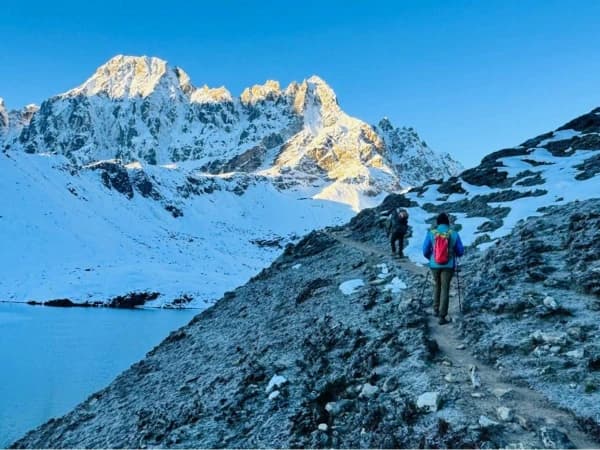
It is a guided teahouse trek that combines the classic Everest Base Camp route with the Gokyo Valley, joined by the Cho La Pass. Both valleys lie in the Khumbu region of north-east Nepal, inside Sagarmatha National Park. You may also see the same route sold as the Everest Base Camp trek via Gokyo Lakes, the Gokyo Cho La Pass trek or the Gokyo to Everest Base Camp trek. The main difference between these versions is which valley comes first.
The classic trail follows the Dudh Koshi and Imja valleys up to Gorak Shep, the last settlement below base camp. The Gokyo Valley runs parallel to the west, beside the Ngozumpa Glacier, with a chain of glacial lakes and the village of Gokyo on the shore of the third lake. Cho La is the high pass between the two.
Because the pass links the two valleys, the route forms a loop and cuts out much of the backtracking of an out-and-back trek. Some sections still repeat: the lower trail between Lukla and Namche Bazaar (walked on Days 2 and 3, and again on Day 15), the stretch from Gorak Shep back towards Lobuche on Day 10, and the last part of the walk into Namche on Day 14.
Which route does the EBC Gokyo trek take via Cho La Pass?
We walk to Everest Base Camp first, cross Cho La from east to west, and finish in the Gokyo Valley. From Lukla, the trail climbs through Namche Bazaar and Dingboche to Gorak Shep, Everest Base Camp and Kala Patthar. From there it turns west via Dzongla to cross Cho La (about 5,420 m), then continues over the Ngozumpa Glacier to the Gokyo Lakes and Gokyo Ri. You walk back to Lukla through Machhermo and Namche.
Going to Base Camp first means you have already slept at the trek’s highest stops before the pass, so you reach Cho La better acclimatised.
Why does our team go to Everest Base Camp first?
We chose this direction for our 17-day trek for three practical reasons:
- By the time you reach Cho La on Day 11, you have slept at Gorak Shep (5,164 m) and climbed Kala Patthar (5,545 m), so you approach the pass after more time at altitude.
- You reach Everest Base Camp in the first half of the trip. If weather later closes the pass, you have already reached the main goal.
- The quieter Gokyo Valley comes at the end, when you are heading downhill towards Namche.
It is not automatically the better direction for everyone. Going this way puts three hard days back to back (Days 9 to 11), and the steepest loose ground on Cho La comes on the descent to Thangnak, which is tiring on the knees. Gokyo-first itineraries reach the lakes earlier and spread the effort differently, and some trekkers prefer them. We can explain the difference before you book.
Guide's note
We go to Everest Base Camp first for three reasons. Reaching base camp is the big achievement of the trip, and the acclimatisation days on the way mean you arrive at Cho La well adjusted. From this side the climb to the pass is easier than from Gokyo. And if anyone falls ill later on, they have still reached base camp. Then Gokyo comes at the end, like dessert after a good meal.
Pravin Baniya, lead team leader
EBC first or Gokyo first: how do the two directions compare?
Both directions cross the same pass and visit the same places. The difference is when the hard days fall and what you have already seen if Cho La is closed.
|
|
EBC first (our route) |
Gokyo first |
|
Reach Everest Base Camp |
Day 9, in the first half of the trip |
Towards the end of the trip |
|
Climb to Cho La |
From Dzongla: steady climb, short glacier near the top |
From Thangnak: steep, loose climb up the western side |
|
Descent from Cho La |
Steep, loose rock and scree down to Thangnak |
Across the glacier, then down the rocky valley to Dzongla |
|
Altitude before the pass |
You have slept at Gorak Shep (5,164 m) and climbed Kala Patthar (5,545 m) |
You have usually slept at Gokyo (4,750 m) and climbed Gokyo Ri (5,357 m) |
|
If Cho La is closed |
You have already reached base camp; Gokyo is missed or reached by a longer route |
You have seen Gokyo; base camp is missed or reached by a longer route |
|
Best for |
Trekkers for whom base camp is the main goal |
Trekkers who want the lakes and the quieter valley first |
What is Cho La Pass like from the Dzongla side?
Cho La (5,420 m / 17,782 ft) links Dzongla (4,830 m) in the Khumbu Valley with Thangnak (4,700 m) in the Gokyo Valley. Crossing from east to west, as we do, the day has three distinct parts:
- The climb from Dzongla. A steady ascent up a rocky valley, then a steep section over boulders and rock steps.
- The glacier. Near the top, the trail crosses a small glacier on the eastern side of the pass. The slope is usually gentle, but it can be icy or snow-covered, especially early in the morning.
- The descent to Thangnak. The western side drops steeply over loose rock and scree before easing off towards Thangnak.
Microspikes, light traction devices that fit over your boots, help on icy sections. You can buy or rent a pair in Kathmandu before the trek. Trekking poles help on the long descent.
Is Cho La Pass dangerous?
Cho La is the most serious day of the trek, but in normal trekking-season conditions it is a walking pass, not a climb: you do not need ropes or mountaineering skills. The risks come from the setting rather than from technical difficulty:
- Altitude. At 5,420 m everyone moves slowly, and altitude illness can affect fit trekkers too.
- Ice on the glacier. The short glacier section near the top can be icy early in the morning, especially after fresh snow.
- Loose rock. The steep western descent to Thangnak is loose rock and scree, where a slip or a dislodged stone is the main hazard.
- Weather. Wind, cold and cloud can build quickly near the top, and visibility can drop.
- Fatigue. The crossing comes straight after two long days, so you descend on tired legs.
On our departures we manage these risks in a few practical ways:
- We start at about 5 am, so you reach the pass and begin the descent before the weather usually changes later in the day.
- Your guide checks everyone's oxygen saturation and heart rate twice a day, and decides on the morning whether it is safe to cross.
- Anyone whose altitude symptoms are getting worse does not cross. They go down with a member of our team.
- We lend trekking poles, and we recommend microspikes for the glacier.
- Our guides lead Cho La every season, and Pravin has crossed it more than 13 times.
You can help by training for long descents, keeping a steady pace on the day and telling your guide straight away if you feel unwell.
What happens if Cho La Pass is closed?
Snow, ice, strong wind or poor visibility can make the pass unsafe. Closures are most common in winter and early spring, but conditions can change in any season. Your guide makes the decision on the morning of the crossing, and safety comes before the itinerary.
If the pass is not safe, there are two usual options from Dzongla:
- Reach Gokyo the long way. You walk down the Khumbu Valley and around via Phortse into the Gokyo Valley. This takes longer than crossing the pass and does not usually fit within the 17 days, so it means adding days to the trip.
- Walk out without Gokyo. You return to Namche and Lukla on the main trail. This fits within the original dates.
Extra days needed to reach Gokyo the long way, via Phortse, are charged separately. If you walk out early instead, we cannot refund unused nights, as lodges, flights and staff are arranged in advance.