annapurna base camp trek
annapurna base camp trekking
annapurna base camp trek

Annapurna Base Camp Trek 13 Days

40 reviews in TripAdvisor
Recommended by 99% of travelers
Duration13 Days
Trip GradeModerate
Maximum Altitude4,130 m / 13,550 ft
Group Size1 - 15 Persons
StartsKathmandu
EndsKathmandu
ActivitiesTrekking / Hiking
Best TimeSpring (Mar - May), Autumn (Sep - Nov) & Winter (Dec - Feb)

If you are searching for the Annapurna Base Camp trek, also known simply as the ABC trek, this page is our complete, arrival-to-departure guide: you land at Tribhuvan International Airport in Kathmandu, and thirteen days later, we put you back on a flight home, with every night, every permit, and every trekking day in between fully organized. This page covers our standard Nepal Annapurna Base Camp trek itinerary (13 days), real Annapurna Base Camp trek cost figures, difficulty, permits, packing, and everything you need to book with confidence. If you are comparing this Annapurna Base Camp trek tour against other operators, this is the exact day-by-day plan and pricing structure we run, not a marketing outline.

Thrill Himalaya is a Kathmandu-based, government-registered trekking company (NTB Reg. No. 3303/81/82, TAAN member) operating out of Thamel. Our lead guide, Pemba Sherpa, is government-certified by Nepal's Ministry of Culture, Tourism and Civil Aviation and has led trekkers along this exact route through the Annapurna Sanctuary for years. We also run shorter Annapurna Base Camp package formats (4 nights/5 days, 6/7 days, and 10 days) for travelers with tighter schedules; this page focuses entirely on our full 13-day package, described below start to finish.

Annapurna Base Camp Trek Package (13 Days): Quick Answer on Itinerary, Cost & Difficulty

Our Annapurna Base Camp trek package runs 13 days from arrival in Kathmandu to final departure, reaching a maximum altitude of 4,130 m at Annapurna Base Camp on day 8. The Annapurna Base Camp trek itinerary includes a scenic drive to Pokhara, the classic Ghorepani-Poon Hill approach, the Annapurna Sanctuary trail to Base Camp, and a relaxing stop at Jhinu's natural hot springs on the way down. Annapurna Base Camp trek cost depends on group size and season; we send a full itemized quote within 24 hours of your enquiry. Trek difficulty is moderate, no technical climbing skill required, and permits (ACAP and TIMS) are included and processed for you.

Ready to check dates and pricing for this exact package? Message us on WhatsApp now for a same-day, itemized quote.

What Is the Annapurna Base Camp Trek Package?

The Annapurna Base Camp trek sits inside the Annapurna Conservation Area, Nepal's largest protected area, and is consistently ranked among the most rewarding moderate treks in the world for the ratio of scenery to physical difficulty. This 13-day package is our complete, fully organized version of the Nepal Annapurna Base Camp trek: it begins the moment you land in Kathmandu and ends when we see you off at the airport, so you never have to arrange a single transfer, permit, or hotel booking yourself.

Quick Facts: Duration, Highest Altitude, Difficulty, Package Type

Detail Information
Package duration 13 days, arrival to departure
Highest altitude 4,130 m / 13,550 ft at Annapurna Base Camp
Trek difficulty Moderate; no technical climbing or mountaineering skills required
Trip style Arrival in Kathmandu, full itinerary through to final departure
Region Annapurna Conservation Area, Kaski and Myagdi districts
Accommodation Hotel nights in Kathmandu and Pokhara Lakeside, guesthouse/teahouse on trek
Permits required ACAP (Annapurna Conservation Area Permit) and TIMS card
Group size Private, small group, or group-join departures

How Long Is the Annapurna Base Camp Trek?

this Annapurna Base Camp trek package runs 13 days from arrival in Kathmandu to final departure, including 8 days of actual trekking (Days 3-10) plus travel and rest days in Kathmandu and Pokhara. If you only count trail time, the core trek itself takes 8 days; including the road transfers and hotel nights on both ends, the complete trip is 13 days start to finish.

We also offer shorter versions of the Annapurna Base Camp trek package for travelers with less time, including a 4 nights/5 days format and a 6/7-day format, and a 10-day format for those who want a slightly faster version of this same route. Each of those runs its own separate itinerary and pricing; this page is dedicated entirely to the full 13-day ABC trek described below.

What Are the Annapurna Base Camp Trek Highlights?

Beyond the day-by-day logistics, here is what actually makes this Annapurna Base Camp trek tour memorable. These are the moments our clients mention most often when they talk about the trip afterward.

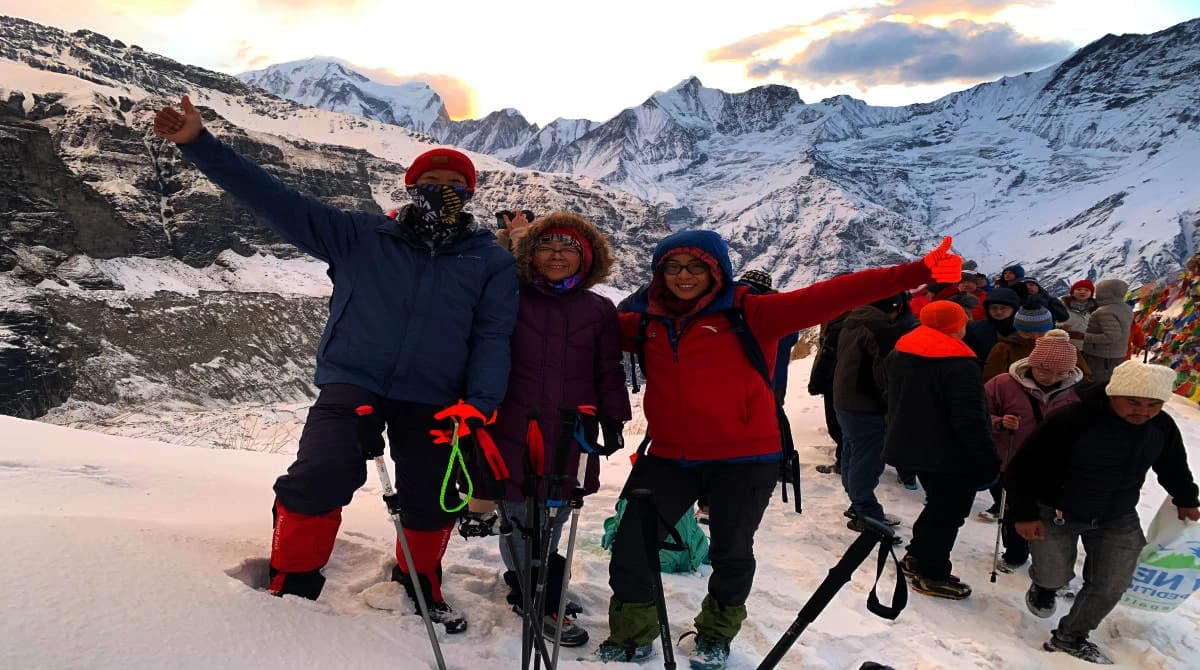
  • Poon Hill sunrise panorama (Day 5): a 360-degree view of Dhaulagiri, Annapurna South, and Machhapuchhre from 3,210 m, widely considered one of the best sunrise viewpoints in Nepal.
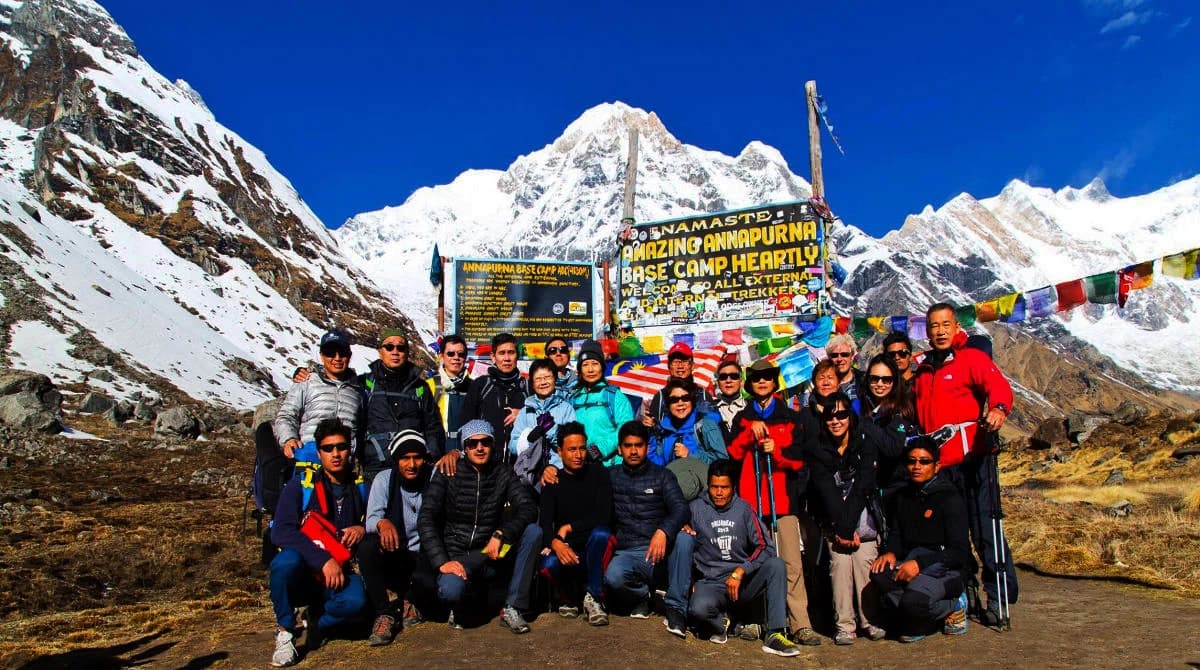
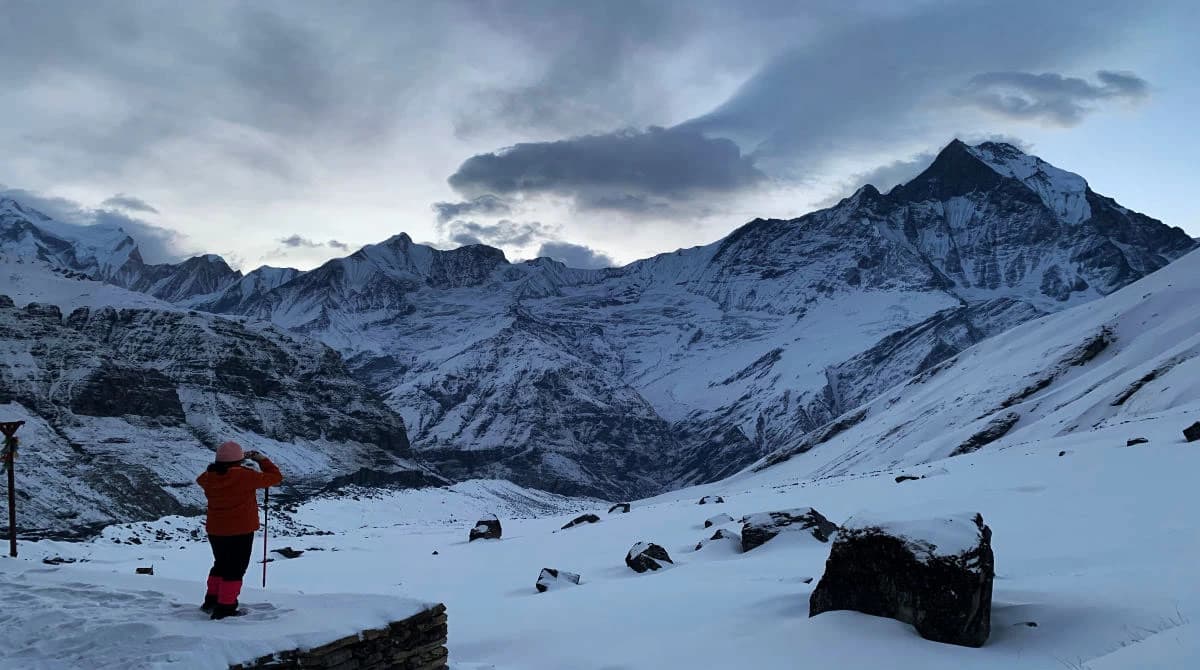
  • Arrival at Annapurna Base Camp (Day 8): reaching 4,130 m inside a natural amphitheater ringed by Annapurna I, Annapurna South, and Machhapuchhre's iconic fishtail summit.
  • Natural hot springs at Jhinu (Day 10): a riverside soak that has become one of the most talked-about rest stops on the entire route.
  • Traditional Gurung and Magar villages: stone-paved paths, terraced farmland, and genuine mountain hospitality throughout the lower trekking days.
  • Rhododendron forest in bloom (spring departures): the forest between Ulleri and Ghorepani turns red and pink from March through April.
  • The Annapurna Sanctuary approach (Days 6-8): a dramatic shift from forest to alpine terrain as the valley narrows toward Base Camp.

What Is the Complete Annapurna Base Camp Trek Itinerary (13 Days)?

Below is the exact Annapurna Base Camp trek complete itinerary for this package, from your Kathmandu arrival to your final departure. This is the real, field-tested itinerary we run, not a placeholder outline, and it is the version we recommend when people ask us how many days for Annapurna Base Camp trek including international arrival and departure days.

Day 01: Arrival at Tribhuvan International Airport in Kathmandu (1,400 m/4,593 ft) and transfer to hotel. Overnight at a hotel.

Day 02: Drive to Pokhara (900 m/2,953 ft) from Kathmandu in a Tourist Bus – 7 to 9 hours. Overnight at the hotel in Lakeside.

Day 03: Drive to Birethanti (1,039 m/3,409 ft) from Pokhara – 1 hour and Trek to Ulleri (2,020 m/6,627 ft) – 4 to 5 hours. Overnight at a guesthouse.

Day 04: Trek to Ghorepani (2,840 m/9,286 ft) from Ulleri – 5 to 6 hours. Overnight at a guesthouse.

Day 05: Early morning hike up to Poon Hill (3,210 m/10,531 ft) & back and then trek to Chuile (2,284 m/7,493 ft) – 7 to 8 hours. Overnight at a guesthouse.

Day 06: Trek to Sinuwa (2,360 m/7,740 ft) from Chuile – 6 to 7 hours. Overnight at a guesthouse.

Day 07: Trek to Deurali (3,230 m/10,597 ft) from Sinuwa – 6 to 7 hours. Overnight at a guesthouse.

Day 08: Trek to Annapurna Base Camp (4,130 m/13,550 ft) from Deurali – 5 to 6 hours. Overnight at a guesthouse.

Day 09: Trek to Bamboo (2,345 m/7,694 ft) from Annapurna Base Camp – 6 to 7 hours. Overnight at a guesthouse.

Day 10: Trek to Jhinu (1,780 m/5,839 ft) from Bamboo – 4 to 5 hours. Overnight at a guesthouse.

Day 11: Trek to Syauli Bazaar (1,170 m/3,839 ft) from Jhinu – 2 to 3 hours & Drive back to Pokhara – 2 to 4 hours. Overnight at the hotel in Lakeside.

Day 12: Drive Back to Kathmandu (1,400 m/4,593 ft) from Pokhara in a Tourist Bus – 7 to 9 hours. Overnight at a hotel.

Day 13: Transfer to the International Airport for Your Final Departure.

Good to Know Before You Go

Road work continues along the Prithvi Highway between Kathmandu and Pokhara, and it has slowed travel times and increased dust along parts of the route. The drive normally takes 6-7 hours, but you should currently plan for 8-9 hours on this leg. We monitor road conditions closely and will keep you updated if anything changes closer to your travel dates.

If you'd rather skip the road entirely, we can arrange a domestic flight between Kathmandu and Pokhara instead of the tourist bus, for an additional cost. This cuts the journey down to about 25 minutes each way and is a popular upgrade for travelers short on time or simply wanting to avoid the highway. Let us know if you'd like a quote for this option.

Nepal's mountains don't always follow a fixed schedule. Weather, flight delays, trail conditions, government regulations, or a trekker's own health can all call for a change of plan. When that happens, our guides work with you on the ground to find the best available alternative and keep the trip moving safely, and we ask for your flexibility and patience if adjustments are needed.

We recommend arriving in Kathmandu at least one day before your trek begins. That gives you time to rest after your flight and pick up any last-minute gear in Thamel before setting off. It's also worth building a spare day or two into your international flights in case of delays on either end. If you'd like to extend your trip, we're happy to add on sightseeing in Kathmandu or Pokhara, other adventure activities, or day trips elsewhere in Nepal, either before or after the trek.

Want this itinerary adjusted around your own arrival date, or with an extra acclimatization day? Send us your travel window on WhatsApp and we'll confirm availability free of charge.

Itinerary Highlights: What Each Stage of This Trek Looks Like

Reading a day-by-day itinerary as a table is useful for planning, but it helps to understand what each stage of this specific Annapurna Base Camp trek itinerary actually feels like on the ground.

Days 1-2: Arrival and the road to Pokhara. After your Kathmandu arrival and first overnight, Day 2 is a full travel day on the tourist bus to Pokhara. It is long, but the road follows river valleys with steadily improving mountain views the closer you get to Pokhara Lakeside, where you'll spend the night before the trek begins.

Days 3-5: Birethanti to Poon Hill. This is the classic entry into the Annapurna foothills. Day 3's climb from Birethanti to Ulleri includes the well-known stone staircase, and Day 4 continues climbing through rhododendron forest to Ghorepani. Day 5 starts before sunrise with the short, steep hike up to Poon Hill for the 360-degree Himalayan panorama, before continuing on to Chuile the same day, making it the longest single day on this itinerary.

Days 6-8: Into the Annapurna Sanctuary. From Sinuwa onward, the trail narrows and the forest thins out as you move deeper into the Sanctuary. Day 7's push to Deurali puts you within striking distance of Base Camp, and Day 8 is the shortest trekking day of the entire itinerary, arriving at Annapurna Base Camp itself with time to spare for photos and acclimatization before the following morning's sunrise.

Days 9-11: Descent via Jhinu. The way down moves faster than the way up, dropping through Bamboo and on to Jhinu, where Day 10's shorter trekking day leaves time to relax at the natural hot springs on the riverbank. Day 11 finishes the trek at Syauli Bazaar before driving back to Pokhara.

Days 12-13: Return and departure. The final two days retrace the road journey back to Kathmandu and conclude with your international departure transfer, closing out the full arrival-to-departure package.

How Much Does the Annapurna Base Camp Trek Cost?

The single most-searched question we get is simply "what does this trek cost." Annapurna Base Camp trek cost depends on group size and season, and this 13-day package covers considerably more than the trekking days alone: it includes your Kathmandu hotel nights, the Pokhara transfers, and the airport departure transfer too, so the total figure reflects the complete trip, not just the days on trail.

What's Included in the Annapurna Base Camp Trek Package Cost

  • Airport pickup on arrival (Day 1) and airport drop-off for final departure (Day 13)
  • Hotel accommodation in Kathmandu (Day 1 and Day 12 nights)
  • Hotel accommodation in Pokhara Lakeside (Day 2 and Day 11 nights)
  • Tourist bus transport Kathmandu–Pokhara–Kathmandu
  • ACAP and TIMS permit processing
  • Government-licensed guide and insured porter service for the full trek
  • Guesthouse/teahouse accommodation for every trekking night (Days 3-10)
  • Three meals a day while on trek (breakfast, lunch, dinner)
  • Complimentary sleeping bag and down jacket for the trek
  • All government and local taxes

What's Not Included

  • International flights and Nepal visa fees
  • Personal travel insurance (mandatory; must cover trekking up to at least 4,500 m)
  • Meals in Kathmandu and Pokhara outside the trek days (breakfast at your hotel is typically included, other meals are not)
  • Hot showers, Wi-Fi, and battery charging at teahouses (small local fees apply)
  • Tips for your guide and porter
  • Personal trekking gear not listed as complimentary
  • Any optional sightseeing tours, adventure activities, or extra day trips in Kathmandu or Pokhara

Annapurna Base Camp Trek Price Options

Package Type What It Means Best For
Group join Annapurna Base Camp trek package Join a small fixed-departure group on set dates for this same 13-day itinerary Solo trekkers who want company without paying private rates
Private Annapurna Base Camp trek package Your own guide and porter, flexible daily pace and start dates Couples, families, small private groups
All-inclusive upgrade Adds better hotel categories in Kathmandu/Pokhara and extra sightseeing days Travelers who want zero logistics to manage beyond the trek itself

Exact Annapurna Base Camp trek price per person for this 13-day package depends on your dates and group size; a group-join departure is generally the most economical way to book it, since guide, porter, and transport costs are shared across the group. Contact us directly for a current, itemized quote; we send a full cost breakdown within 24 hours of your enquiry so you know exactly what you are paying for before you commit to anything.

What Affects the Annapurna Base Camp Trek Cost

Factor How It Affects Price
Group size Larger group-join departures reduce the per-person cost of guide, porter, and transport
Season Peak autumn and spring dates carry standard rates; shoulder-season and winter dates can sometimes be discounted
Hotel category Standard vs upgraded hotel nights in Kathmandu and Pokhara change the total package cost
Private vs group-join Private departures cost more per person since you are not sharing guide and transport costs with others
Add-ons Optional sightseeing days, extra nights, or adventure activities in Kathmandu or Pokhara are quoted separately

Want a precise, line-by-line quote for this exact 13-day package instead of a range? Message us your travel dates and group size and we'll reply with real numbers, not estimates.

Why Choose Thrill Himalaya for Your Annapurna Base Camp Trek?

There is no shortage of operators offering an Annapurna Base Camp trek guide and package online. Here is what genuinely sets Thrill Himalaya apart for this exact 13-day itinerary:

  • Local, licensed guides: every trek is led by a government-certified Annapurna Base Camp trek guide with direct, first-hand experience on this exact route, not a subcontracted freelancer.
  • Insured porter and guide service: every staff member on your trek is covered by insurance, and we carry emergency evacuation planning as standard.
  • Eco-friendly trekking in Nepal: we brief every group on Leave No Trace principles and support local, family-run guesthouses along the route rather than large commercial lodges.
  • Fully organized arrival to departure: your airport pickup, Kathmandu and Pokhara hotels, transport, and trek are all handled as one package.
  • 24/7 WhatsApp support: you can reach our Kathmandu office at any point before, during, or after your trip.
  • Complimentary gear: sleeping bag and down jacket included at no extra cost.
  • TripAdvisor Travelers' Choice 2026: rated 5.0/5 from 98 reviews, ranked 66th of 2,561 Kathmandu outdoor activities.
  • Transparent pricing: we quote a real, itemized cost within 24 hours, not a marketing "from" price that changes once you enquire.
Itinerary
Trip PlanExpand all

Highlights: Airport pickup in a private vehicle · Pre-trip briefing with your guide · First views of the Kathmandu Valley · Permit paperwork begins

Your trip begins the moment you land at Tribhuvan International Airport, where a Thrill Himalaya Treks representative will be waiting to meet you and take you to your hotel in a private vehicle. Kathmandu sits in a wide valley ringed by green hills at 1,400m, and after a long flight it is worth treating this first day as a chance to rest, adjust to the time zone, and settle in before the trek itself begins in a couple of days.

You will also sit down with your trekking guide for a pre-trip briefing, either at our office in Thamel or at your hotel depending on when you land. This is your chance to ask anything you are still unsure about, from packing to pacing to what the first few days on the trail will actually feel like. Bring two passport sized photos and a readable copy of your travel insurance policy, since both are needed to process your ACAP permit and TIMS card, and this is also when you settle any remaining balance on your invoice and sign the trip form and liability waiver that make everything official.

Good to know: If you land before 4pm, your briefing happens at our office in Thamel; later arrivals are met at the hotel instead, so there is no need to rush straight from the airport.

Max Altitude: 1,400m / 4,593ftAccommodation: 3-star hotel, KathmanduMode of Transportation: On Foot Trekking

Highlights: Full-day valley drive · Trishuli and Marsyangdi river valleys · First glimpse of the Annapurna skyline · Evening at Phewa Lake, Lakeside

Your trekking staff will pick you up from the hotel at 6:30am and take you to the tourist bus station for the roughly 7am departure to Pokhara. The drive follows the Trishuli and then the Marsyangdi river valleys most of the way, past terraced hillsides and small roadside towns, before climbing over a final ridge into the Pokhara valley. Road work is currently ongoing along this stretch of the Prithvi Highway, so plan for the journey to take 8-9 hours rather than the usual 6-7, with some dust and slower traffic through the construction sections.

Pokhara sits on the banks of Phewa Lake at 900m and works as the gateway to the Annapurna region, with clear-day views of Annapurna and Machhapuchhre's distinctive fishtail peak to the north, Dhaulagiri to the west, and Lamjung Himal and Manaslu to the east. It is noticeably quieter and more laid back than Kathmandu, and Lakeside, where you will spend the night, is the natural place to enjoy that change of pace before the trek proper begins tomorrow.

Good to know: This drive is a good one to keep your camera within reach. The road follows river valleys most of the way, and the terraced hillsides make for some of the best roadside photography of the whole trip.

Note: If you would rather skip the road entirely, a domestic flight between Kathmandu and Pokhara is available for an additional cost, cutting the journey to about 25 minutes. Let us know if you would like a quote.

Max Altitude: 900m / 2,953ftMeals: BreakfastAccommodation: Hotel, Lakeside (Pokhara)Mode of Transportation: Tourist Bus

Highlights: ACAP checkpoint at Birethanti · Confluence of the Bhurungdi Khola and Modi Khola · Hile village lunch stop · The stone staircase into Ulleri

A private vehicle takes you from Pokhara to Birethanti, a lively village at the confluence of the Bhurungdi Khola and Modi Khola where your guide registers your permits at the ACAP checkpoint. From here, the trail follows the Bhurungdi Khola upstream through small settlements to Hile, a larger village with enough shops and teahouses that it makes a natural stop to rest before the climb ahead. Beyond Hile, the trail begins the long, steady staircase this stretch is known for, thousands of stone steps built into the hillside, climbing through forest to Ulleri.

Ulleri itself is a large Magar village at 2,020m, with traditional stone and slate-roofed houses built into the slope. It is a short trekking day by distance, but the staircase makes it a proper introduction to what trekking in Nepal actually demands, and a good early measure of how your body is adjusting before the trail gets more remote.

Good to know: The staircase into Ulleri is long rather than technical, so a slow, steady pace with trekking poles will serve you better here than trying to power through it quickly.

Max Altitude: 2,020m / 6,627ftMeals: Breakfast, Lunch, DinnerAccommodation: Guesthouse, UlleriMode of Transportation: Private Jeep/ Van

Highlights: Oak and rhododendron forest · Banthanti and Nangethanti villages · Ridge-top arrival in Ghorepani · Views toward Dhaulagiri

Today's climb is gentler than yesterday's staircase, working its way up through fine oak and rhododendron forest rather than exposed steps. The trail passes through Banthanti and then Nangethanti, both small clusters of lodges set among the trees, before a final push brings you up onto the ridge at Ghorepani. If you are trekking in spring, the rhododendron forest along this stretch is one of the most colorful sections of the whole trip, with Nepal's national flower blooming in shades of red, pink, and white through March and April.

Ghorepani sits at 2,840m and is one of the best known villages on this route, mainly because it is the base for tomorrow's early morning hike up to Poon Hill. The village has a good range of lodges with clear views toward Dhaulagiri and the southern Annapurna peaks, and it is worth getting to bed early tonight given how early tomorrow's start will be.

Good to know: If you are trekking between March and April, keep an eye out for the rhododendron forest along this stretch. It is one of the most colorful parts of the whole trek.

Max Altitude: 2,840m / 9,286ftMeals: Breakfast, Lunch, DinnerAccommodation: Guesthouse, GhorepaniMode of Transportation: On Foot Trekking

Highlights: Pre-dawn climb to Poon Hill · 360-degree Himalayan sunrise panorama · Tadapani viewpoint · Longest day of the whole itinerary

Well before sunrise, you set out on the short, steep climb from Ghorepani up to Poon Hill at 3,210m, reaching the top with enough time to find a good spot before the sky opens up. The panorama from here takes in Dhaulagiri, the full Annapurna range, Machhapuchhre's fishtail peak, Annapurna South, and Himchuli, and on a clear morning it is one of the most complete mountain views of the entire trek. After enough photos and time to take it in, you head back down to Ghorepani for a hot breakfast before continuing on.

The rest of the day covers a lot of ground, which is why this ends up being the longest single day on the whole itinerary. From Ghorepani, the trail climbs briefly to a ridge point also called Deurali, not the larger Deurali you will reach later near the Sanctuary, before descending through rhododendron and pine forest to Banthanti, a good lunch stop. From there you climb again toward Tadapani, known for close up views of Annapurna South, before a long, scenic descent through more rhododendron forest brings you down to Chuile for the night.

Good to know: Poon Hill mornings are cold even when the rest of the day warms up quickly, so keep a down jacket and gloves in your daypack rather than packed away. You will want them before sunrise.

Max Altitude: 2,284m / 7,493ftMeals: Breakfast, Lunch, DinnerAccommodation: Guesthouse, ChuileMode of Transportation: On Foot Trekking

Highlights: Ghurjung village · Chhomrong, gateway to the Sanctuary · Steep descent to the Chhomrong Khola · Forest climb into Sinuwa

From Chuile, the trail leads through forest and across a couple of suspension bridges before an uphill climb into Ghurjung village, a quiet settlement along the way. Continuing on, you reach Chhomrong at 2,140m, the last proper village before the trail heads deeper into the Annapurna Sanctuary. Chhomrong is worth the stop, both for lunch and for the views it offers of Annapurna South and Machhapuchhre, and it is also your last real chance to pick up snacks, charge devices, or grab something from a bakery before the villages ahead get smaller and more basic.

After lunch, the trail drops steeply down a long stretch of stone steps to the Chhomrong Khola, then climbs back up through dense forest on the far side to reach Sinuwa. It is a day with real ups and downs rather than one steady direction, so the effort is spread out even though the net elevation gain by the end is modest.

Good to know: Chhomrong is your last village with proper shops and bakeries before the trail heads deeper into the Sanctuary, so it's worth stocking up on snacks or charging devices here if you think you will need them.

Max Altitude: 2,360m / 7,740ft)Meals: Breakfast, Lunch, DinnerAccommodation: Guesthouse, SinuwaMode of Transportation: On Foot Trekking

Highlights: Upper Sinuwa and Bamboo forest · Riverside waterfall trail · Hinku Cave · Arrival on the edge of the Sanctuary

The trail climbs first to Upper Sinuwa before dropping down a rocky bank to Bamboo, a small rest stop tucked into a gorge thick with bamboo groves. From there, you stay on the western side of the Modi Khola, passing through Dovan and a scenic waterfall on the way to Himalaya, a small village marking your entry into higher, more open country. The trail then climbs steadily past Hinku Cave, a large natural rock shelter tucked into the mountainside that has sheltered trekkers and locals alike for generations, before reaching Deurali itself.

By the time you reach Deurali at 3,230m, the valley has opened up noticeably, with the peaks of the Sanctuary starting to close in around you. This is a good day to slow your pace slightly and pay attention to how your body is handling the altitude, since the effects of thinner air become more noticeable from here on.

Good to know: You'll gain real elevation today, so this is a good point to start pacing yourself a little more deliberately and drinking more water than you think you need.

Max Altitude: 3,230m / 10,597ftMeals: Breakfast, Lunch, DinnerAccommodation: Guesthouse, DeuraliMode of Transportation: On Foot Trekking

Highlights: Machhapuchhre Base Camp · Entry into the Annapurna Sanctuary · Arrival at Annapurna Base Camp · Amphitheater of 7,000m and 8,000m peaks

Today's trail leads first to Machhapuchhre Base Camp at 3,700m, sitting directly beneath the sheer faces of Machhapuchhre, the fishtail peak that has never been officially summited and remains off limits to climbers out of respect for its sacred status. Even without being able to climb it, standing at its base gives you an unusually close, dramatic view of the mountain that you do not get anywhere else on the trek.

From MBC, the final push of around two hours brings you into the Annapurna Sanctuary itself and up to Annapurna Base Camp at 4,130m, ringed by Annapurna I, Annapurna South, Hiunchuli, and Gangapurna. It is the shortest trekking day of the whole itinerary by distance, which works in your favor, since it leaves you a full afternoon at Base Camp to rest, take photos while the light is still good, and let your body settle in before an early start tomorrow.

Good to know: You'll likely arrive at Base Camp with good afternoon light still on the peaks, so use it for photos rather than waiting only for tomorrow morning.

Max Altitude: 4,130m / 13,550ftMeals: Breakfast, Lunch, DinnerAccommodation: Guesthouse, Annapurna Base CampMode of Transportation: On Foot Trekking

Highlights: Long descent back through the Sanctuary · Return views of Annapurna South and Hiunchuli · Singu Chuli and Tharpu Chuli · Modi Khola riverbank trail

You retrace yesterday's and the day before's route back down through the Sanctuary, dropping close to 1,700m over the course of the day to reach Bamboo. Retracing a trail on the way down is never quite the same as the way up, since you catch views you were too focused on climbing to notice the first time, and the Annapurna range, Machhapuchhre, Hiunchuli, Singu Chuli, and Tharpu Chuli all stay in view for much of the descent.

It is the longest day of the trek by distance, though the downhill direction makes it faster going than the climb up. Bamboo has a small handful of lodges tucked into the gorge, and after two demanding days at altitude, it is a reasonable place to let your legs recover before the trail eases further tomorrow.

Good to know: Long downhill days are easier on the lungs but harder on the knees, so this is a good day to lean on trekking poles and ease your pace slightly rather than rushing the descent.

Max Altitude: 2,345m / 7,694ftMeals: Breakfast, Lunch, DinnerAccommodation: Guesthouse, BambooMode of Transportation: On Foot Trekking

Highlights: Return through Khuldighar's experimental sheep farm · Rhododendron and bamboo forest · Steep descent from Chhomrong · Natural hot springs at Jhinu

The trail retraces your steps back toward Chhomrong, passing an experimental sheep farm near Khuldighar before continuing through more rhododendron and bamboo forest. From Chhomrong, the route breaks away from your earlier path and descends steeply down to Jhinu, dropping through forest and terraced fields on the way.

Jhinu sits at 1,780m on the banks of the Modi Khola, and its natural hot springs are one of the best rewards on the entire trek. After nine days of walking, most trekkers head straight down to the riverbank to soak tired legs before dinner, and it is worth building in the time to actually enjoy it rather than rushing through.

Good to know: Pack a swimsuit and a small towel for today. The hot springs sit a short walk down from the guesthouses, right on the riverbank, and they are worth making time for.

Max Altitude: 1,780m / 5,839ftMeals: Breakfast, Lunch, DinnerAccommodation: Guesthouse, JhinuMode of Transportation: On Foot Trekking

Highlights: Final stretch along the Modi Khola · Trek finishes at Syauli Bazaar · Return drive to Pokhara · Evening at leisure in Lakeside

You follow the Modi Khola downstream to Syauli Bazaar, the point where the trek officially ends. It is a gentle, easy walk by this trek's standards, and after ten days on the trail it tends to be one of the most enjoyable stretches of the whole itinerary, more about taking in the last of the scenery than pushing to get anywhere.

From Syauli Bazaar, a private vehicle takes you the rest of the way to Pokhara. The first stretch to Nayapul is on a road that was recently built and is still rough and unpaved in places, so expect a bumpy ride for this section. From Nayapul onward, the road is properly paved and the drive smooths out considerably for the final approach into Pokhara, where you have the evening free in Lakeside to relax and enjoy a meal that is not dal bhat if you are in the mood for a change.

Good to know: This is one of the easiest and most enjoyable walks of the whole trek, so there's no need to rush it. Take your time along the river before the drive back to Pokhara.

Max Altitude: 900m / 2,953ftMeals: Breakfast, LunchAccommodation: Hotel, Lakeside (Pokhara)Mode of Transportation: Private Jeep/ Van

Highlights: Return valley drive to Kathmandu · Free time in Thamel · Farewell dinner with your guide & crew and certificate presentation · Trip debrief

You drive back to Kathmandu the same way you came, retracing the Trishuli and Marsyangdi valleys in reverse. The same road work mentioned on Day 2 applies here too, so plan for around 8-9 hours rather than the usual 6-7, with the trip likely to feel shorter this time simply because you now recognize the towns and landmarks along the way.

In the evening, Thrill Himalaya Treks hosts a farewell dinner at a good restaurant in Kathmandu, with your guide and a member of our office team joining you to properly close out the trip. This is also when you receive your official Trekking Completion Certificate, marking the finish of your Annapurna Base Camp trek. It's a good chance to ask any last questions, trade photos, and celebrate a journey that started as a plan on paper and finished as an actual mountain behind you.

Good to know: Save some appetite for the evening. The farewell dinner is a proper sit-down meal to celebrate finishing the trek with your guide and crew.

Note: The same domestic flight option from Day 2 is available for this return leg too, if you would rather skip the road a second time. Just let us know.

Max Altitude: 1,400m / 4,593ftMeals: Breakfast, Farewell DinnerAccommodation: 3-star hotel, Kathmandu

Highlights: Final hotel checkout · Airport transfer · Flight departure from Nepal

Your trip concludes today. A Thrill Himalaya Treks representative will pick you up from your hotel and take you to Tribhuvan International Airport in good time for your onward flight, bringing an official close to your Annapurna Base Camp trek.

Good to know: Let us know your flight time in advance so we can schedule your airport transfer with enough buffer. Kathmandu traffic can be unpredictable, especially in the morning.

Note: If your flight isn't until later in the day, we can arrange a few hours of sightseeing before your transfer. Boudhanath Stupa and Pashupatinath Temple are both close to the airport and work well as a quick add-on ahead of an afternoon or evening departure. Just mention it when you confirm your flight time with us.

Meals: Breakfast
Start planning today.
Our travel experts are here to help. Our travel experts are here to help. Our travel experts are here to help.
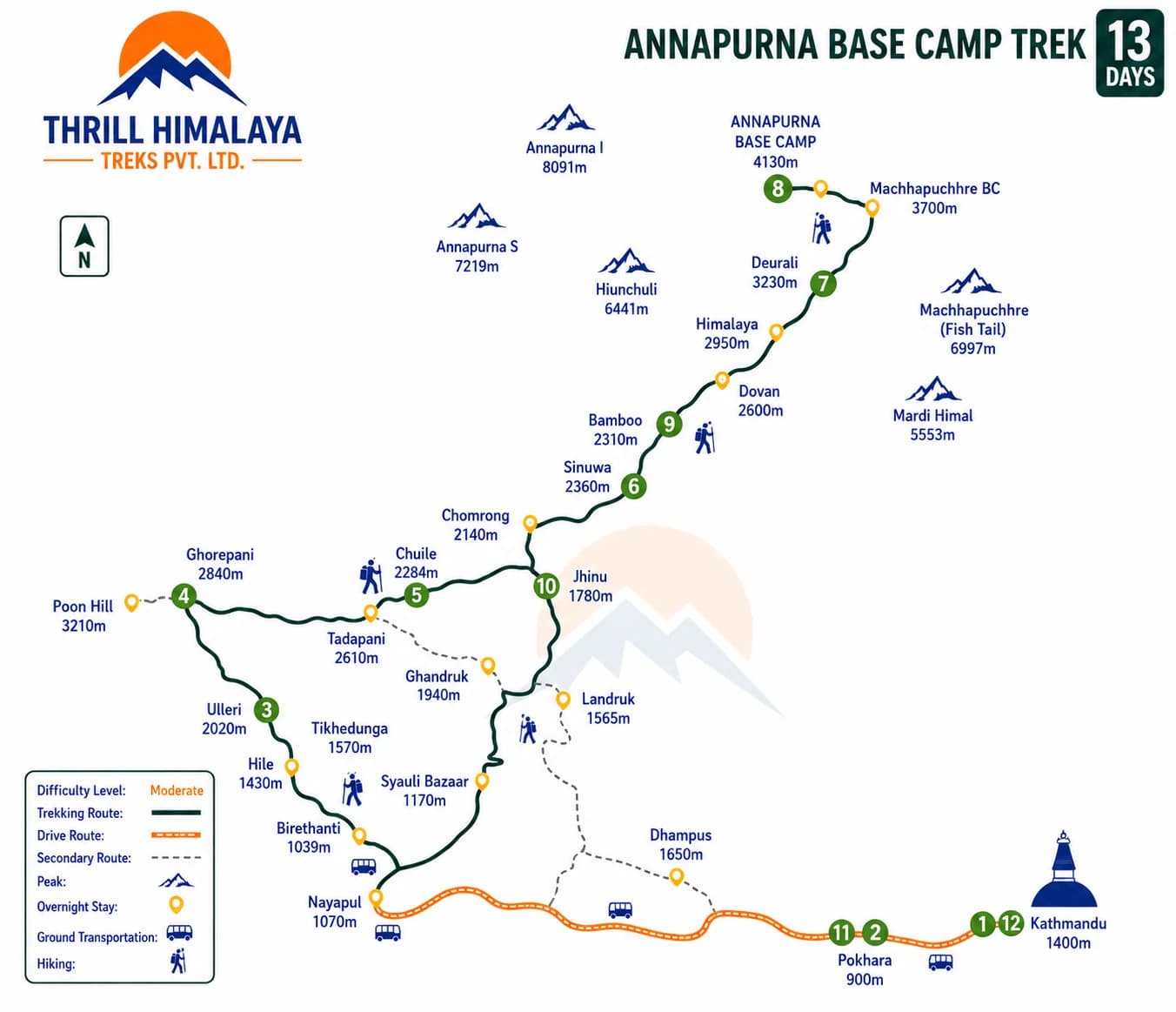
Route Map
Annapurna Base Camp Trek 13-day route map showing Kathmandu, Pokhara, Poon Hill, Chhomrong, Deurali, Machhapuchhre Base Camp, Annapurna Base Camp, and return route by Thrill Himalaya Treks.
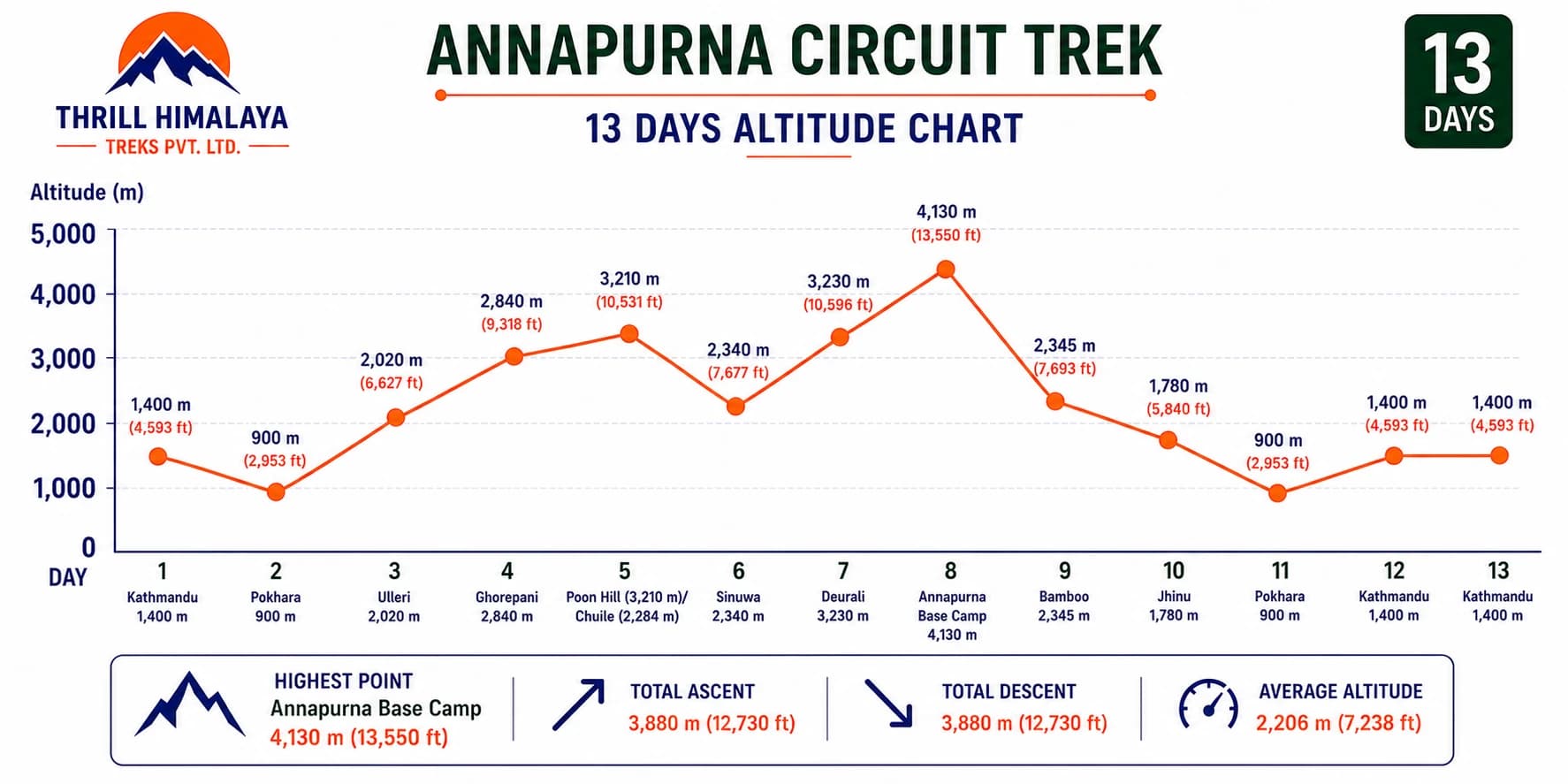
Altitude Chart
Annapurna Base Camp Trek 13-day altitude chart showing daily elevation changes from Kathmandu to Annapurna Base Camp (4,130m) and back by Thrill Himalaya Treks.
Cost Details
Includes

What's Included in the Annapurna Base Camp Trek Package Cost

  • Airport pickup on arrival (Day 1) and airport drop-off for final departure (Day 13)
  • 3-star hotel accommodation in Kathmandu on bed & breakfast basis (Day 1 and Day 12 nights), with a complimentary cup of tea or coffee at breakfast
  • Hotel accommodation in Pokhara Lakeside (Day 2 and Day 11 nights)
  • Tourist bus transport Kathmandu–Pokhara–Kathmandu
  • ACAP and TIMS permit processing
  • Government-licensed guide and insured porter service for the full trek
  • Guesthouse/teahouse accommodation for every trekking night (Days 3-10)
  • Three meals a day while on trek (breakfast, lunch, dinner), with tea or coffee included at breakfast
  • Complimentary sleeping bag, down jacket, and duffel bag for the trek
  • Water purification tablets for the trek
  • A farewell dinner in Kathmandu after the trek
  • Trekking completion certificate from Thrill Himalaya
  • All government and local taxes
Excludes

What's Not Included

  • International flights and Nepal visa fees
  • Personal travel insurance (mandatory; must cover trekking up to at least 4,500 m)
  • All drinks (alcoholic, cold/soft drinks, and any extra tea or coffee beyond what's included with meals)
  • Meals in Kathmandu and Pokhara outside the trek days, aside from breakfast at your hotel
  • Hot showers, Wi-Fi, and battery charging at teahouses (small local fees apply)
  • Tips for your guide and porter
  • Personal trekking gear not listed as complimentary
  • Kathmandu-Pokhara domestic flight upgrade (available on request, at additional cost, in place of the tourist bus)
  • Any optional sightseeing tours, adventure activities, or extra day trips in Kathmandu or Pokhara
Essential Information

What Permits Do You Need for the Annapurna Base Camp Trek?

Annapurna Base Camp trek permits are mandatory for this route, and trekking without them can result in fines or being turned back at checkpoints. Two documents cover the entire itinerary above.

ACAP (Annapurna Conservation Area Permit)

The Annapurna Conservation Area Permit is issued by the Nepal Tourism Board and funds conservation, trail maintenance, and community projects inside the Annapurna Conservation Area. Every trekker entering the region needs one, and rangers do check for it at entry checkpoints along the trail, including near Birethanti on day 3.

TIMS Card

The Trekkers' Information Management System (TIMS) card is a safety-tracking document that records your route and dates so authorities can locate trekking groups in an emergency. It is required alongside ACAP for this trek.

Annapurna Base Camp Trek Permit Cost

Permit Who It's For Approximate Cost
ACAP Foreign nationals (non-SAARC) NPR 3,000 per person
ACAP SAARC nationals NPR 1,000 per person
TIMS card Trekking with an agency NPR 1,000 per person

We process both permits for every client as a standard part of this package. You only need to send us clear passport copies and passport-sized photos in advance, and we handle the paperwork before you arrive in Kathmandu.

How Difficult Is the Annapurna Base Camp Trek?

Annapurna Base Camp trek difficulty is best described as moderate. You do not need prior mountaineering experience, ropes, or crampons. What you do need is a reasonable baseline of fitness, since several days on this itinerary involve 5 to 8 hours of walking with sustained ascents and descents, including the stone staircase above Ulleri on Day 3-4 and the long Day 5 push over Poon Hill to Chuile.

Direct answer — how hard is the Annapurna Base Camp trek? It is a moderate trek, not a technical one. No climbing gear, ropes, or mountaineering experience is required. The main physical challenges are long walking days (up to 8 hours), a steep stone staircase near Ulleri, and gradual altitude gain to 4,130 m. Trekkers with regular hiking or cardio fitness typically manage it without difficulty.

How Difficult Is This Itinerary, Day by Day

Days 3 and 4 are the steepest sustained climbing on the route, gaining roughly 1,800 m combined from Birethanti to Ghorepani. Day 5 is the longest single day (7-8 hours), combining the early Poon Hill sunrise hike with a full trekking day onward to Chuile. From Sinuwa onward (Days 6-8), the trail narrows into the Sanctuary itself, with the final approach to Base Camp on Day 8 being steady rather than steep. The descent (Days 9-11) is faster, dropping over 2,000 m back down to Syauli Bazaar before the drive back to Pokhara.

Acclimatization on This Route

Because this itinerary's highest point (4,130 m on Day 8) is well below the altitudes where severe altitude sickness typically strikes, acclimatization is more manageable here than on treks to Everest Base Camp or the Annapurna Circuit's Thorong La. That said, altitude still matters, especially between Deurali (Day 7) and Annapurna Base Camp (Day 8):

  • Walk at a steady, unhurried pace, especially from Sinuwa onward
  • Drink at least 3 to 4 liters of water daily
  • Avoid alcohol at altitude, particularly the night before reaching Base Camp
  • Report any headache, nausea, or dizziness to your guide immediately
  • Our guides monitor group members with a pulse oximeter from Sinuwa onward

Best Time for This Annapurna Base Camp Trek Package

Season What to Expect on This Route
Spring (Mar-May) Rhododendron forests in bloom around Ghorepani and Chuile, mild days, clear Poon Hill sunrise views
Autumn (Sep-Nov) The best time for Annapurna Base Camp trek: stable skies, the clearest Poon Hill panorama of the year
Winter (Dec-Feb) Cold at Deurali and Base Camp, occasional snow above Sinuwa, quieter trails and guesthouses
Monsoon (Jun-Aug) Wet lower sections (Days 3-4), leeches in the forest, limited Poon Hill visibility; not recommended for first-time trekkers

Fitness Level Required

This 13-day package, including the guided trekking days, is achievable for most reasonably active adults. We recommend at least four to six weeks of preparation: regular walking or hiking, stair climbing, and some cardio work. If you can comfortably walk 6-7 hours on hilly terrain carrying a light daypack, you are ready for this itinerary.

Safety Practices We Follow on This Package

  • Every group travels with a government-licensed guide trained in first aid and altitude sickness recognition
  • Guides carry a pulse oximeter and check group members daily from Sinuwa onward
  • We confirm every client has travel insurance covering trekking to at least 4,500 m before departure
  • Our Kathmandu office maintains 24/7 WhatsApp contact with your guide throughout the trip
  • We maintain relationships with rescue and evacuation services for the Annapurna region should an emergency arise

Who Is This Annapurna Base Camp Trek Package Suitable For?

Families

This 13-day package is a realistic family friendly Annapurna Base Camp trek for children roughly 10 years and older who are used to walking. The built-in Kathmandu and Pokhara hotel nights on Days 1, 2, 11, and 12 also give families natural rest breaks before and after the trekking days.

Beginners

If this is your first multi-day trek, the well-established teahouse infrastructure on this route, the gradual altitude gain through Day 8, and the fully organized transfers make this a genuinely beginner friendly Annapurna Base Camp trek.

Couples

An Annapurna Base Camp trek for couples works well as a private departure on this same 13-day itinerary, with the option to add extra Pokhara lakeside nights before or after the trek.

Small Groups

Small group Annapurna Base Camp trekking departures (typically 4-10 people) keep the guide-to-client ratio strong while sharing costs across this itinerary, which is why group-join departures remain our most-booked format for this package.

What Should You Pack for the Annapurna Base Camp Trek?

Our Annapurna Base Camp trek packing list covers everything from Kathmandu and Pokhara's warm lower valleys to the near-freezing nights at Deurali and Base Camp itself.

  • Layers: moisture-wicking base layer, fleece or light down mid-layer, waterproof outer shell
  • Footwear: broken-in waterproof trekking boots, camp shoes, wool trekking socks
  • Sleep system: a warm sleeping bag rated to at least -10°C (we provide this as part of your package)
  • Accessories: sun hat, warm hat, gloves, UV-protective sunglasses, buff or scarf
  • Health: personal first-aid kit, blister care, water purification tablets or a filter bottle
  • Gear: headtorch, trekking poles, a daypack (20-30L), power bank
  • Documents: passport copies, passport-sized photos for permits, proof of travel insurance

Seasonal Packing Adjustments

Season Extra Items to Pack
Spring / Autumn Standard layering system above is sufficient; a light rain jacket is still worth carrying
Winter Add a heavier down jacket, insulated gloves, and thermal base layers for Deurali and Base Camp nights
Monsoon Add a dedicated rain cover for your pack, quick-dry clothing, and anti-leech socks for Days 3-4

We send every client a detailed, printable packing checklist along with these seasonal adjustments once your booking is confirmed. As noted in our itinerary above, we recommend arriving in Kathmandu at least one day before Day 1 so you have time to rest and pick up any last-minute gear before starting the trek.

Annapurna Base Camp Trek 13 Days FAQs

Thrill Himalaya is a Kathmandu-based, government-registered trekking company (NTB Reg. No. 3303/81/82) and a TAAN member operating out of Thamel. Every departure on this route is led by a government-licensed guide with direct, first-hand experience on this exact itinerary, backed by an insured porter and standard emergency-evacuation planning. This 13-day package is arranged door to door — airport pickup, Kathmandu and Pokhara hotel nights, tourist bus transport, ACAP and TIMS permit processing, and the full trekking itinerary are all handled as one booking, so you don't have to organize a single transfer yourself. Other reasons trekkers book with us specifically for this trip: a complimentary sleeping bag, down jacket, and duffel bag; 24/7 WhatsApp contact with our Kathmandu office throughout your trip; an eco-friendly approach that briefs every group on Leave No Trace principles and prioritizes family-run local guesthouses over large commercial lodges; and transparent, itemized pricing sent within 24 hours of enquiry rather than a vague "from" price. We're rated 5.0/5 on TripAdvisor from client reviews and hold a 2026 Travelers' Choice award.

Yes. This is one of the most beginner-friendly multi-day treks in Nepal. The trail follows well-established teahouse infrastructure the entire way, altitude gain is gradual (you don't cross 4,000 m until Day 8), and no technical climbing skills, ropes, or prior mountaineering experience are needed. What does help is a reasonable baseline of cardio fitness, since several days involve 5–8 hours of walking with sustained uphill and downhill sections. If you can comfortably manage a full day of hiking on hilly terrain with a light daypack, this itinerary — with its built-in rest nights in Kathmandu and Pokhara and a licensed guide managing the pace — is a realistic first big trek.

ABC is generally considered less physically and logistically demanding than Everest Base Camp (EBC). The main differences:

  • Altitude: ABC tops out at 4,130 m; EBC trekking routes go up to around 5,364–5,545 m (Everest Base Camp itself and the Kala Patthar viewpoint), which puts EBC trekkers into thinner air and a higher risk zone for altitude sickness.
  • Access: ABC starts with a road drive from Pokhara, avoiding the short, weather-dependent mountain flight to Lukla that EBC requires — a flight that regularly causes delays or cancellations.
  • Duration on trail: ABC's core trekking portion (8 days on this itinerary) is generally shorter than EBC's typical 10–12 trekking days.
  • Terrain: Both routes involve long daily walking hours and significant elevation gain/loss, but EBC's high-altitude stretches (above Namche/Dingboche) are colder, drier, and more physically taxing.

In short: both are moderate-to-challenging non-technical treks, but ABC is the gentler introduction to Himalayan trekking, while EBC demands more altitude preparation and a bigger fitness and time commitment.

Autumn (September–November) is widely considered the single best window — stable skies and the clearest Poon Hill sunrise panorama of the year. Spring (March–May) is a close second, with mild daytime temperatures and rhododendron forests in bloom around Ghorepani and Chuile. Winter (December–February) is also doable on this route: expect cold nights at Deurali and Base Camp and occasional snow above Sinuwa, but trails and guesthouses are much quieter. Monsoon season (June–August) is not recommended for this trek — the lower sections (Days 3–4) get wet and leech-prone, and cloud cover limits Poon Hill visibility.

This package runs 13 days from arrival in Kathmandu to final departure. That breaks down as: 2 travel/arrival days at the start (Kathmandu, then the drive to Pokhara), 8 days of actual trekking (Days 3–10, from Birethanti through Poon Hill and the Annapurna Sanctuary to Base Camp and back down to Jhinu), and 3 days of return travel and departure (Syauli Bazaar back to Pokhara, then Pokhara to Kathmandu, then your flight home). If your schedule is tighter, shorter formats of this same trek are also available (4–5 days, 6–7 days, or 10 days), each with its own separate itinerary.

On this route (via Birethanti, Ulleri, Ghorepani, Poon Hill, Chuile, Sinuwa, Deurali, Annapurna Base Camp, Bamboo, and Jhinu), total walking distance is approximately 70–80 km (roughly 43–50 miles) round trip over the 8 trekking days. Daily distances vary considerably more than daily hours because of steep terrain — some days cover only 8–10 km but take 6–7 hours due to elevation change, while lower-altitude descent days cover more ground faster.

The highest point is Annapurna Base Camp itself, at 4,130 m (13,550 ft), reached on Day 8 of this itinerary. It sits inside a natural amphitheater ringed by Annapurna I, Annapurna South, and Machhapuchhre (the "Fishtail" peak). This is significantly lower than Everest Base Camp (~5,364 m), which is one reason ABC carries a comparatively lower altitude-sickness risk.

Yes, this is a legal requirement, not just a recommendation. Since April 2023, Nepal has required all foreign trekkers entering national parks, conservation areas (which includes the entire Annapurna Conservation Area), and restricted regions to be accompanied by a licensed guide employed through a government-registered trekking agency. This rule remains fully in force for the 2026 season and is checked at trail entry checkpoints, including near Birethanti on Day 3 of this itinerary. Trekking without a licensed guide in the Annapurna Conservation Area can result in fines or being turned back at a checkpoint. On this package, your guide is included and government-certified.

Not entirely unguided, no; independent trekking without a licensed guide is no longer permitted inside the Annapurna Conservation Area. However, "solo" in the sense of traveling as an individual rather than in a group is absolutely possible: you can book a private departure with your own licensed guide and porter, or join a small group-join departure and trek among other travelers while still being accompanied by a licensed guide throughout. The old system where independent trekkers could get their own "green" TIMS card and walk the route alone no longer exists: TIMS registration is now issued only through a registered agency as part of a guided booking.

Yes. Two permits are mandatory for this entire route, and rangers do check for them at trail checkpoints,  trekking without them can result in fines or being turned back. We process both for every client on this package as standard; you just send us passport copies and passport-sized photos in advance.

  • ACAP (Annapurna Conservation Area Permit): issued by the National Trust for Nature Conservation, this funds conservation work, trail maintenance, and community projects inside the Annapurna Conservation Area. Cost: NPR 3,000 (~US$25) per person for non-SAARC foreign nationals; NPR 1,000 for SAARC nationals.
  • TIMS Card (Trekkers' Information Management System): a safety-tracking document recording your route and dates so authorities can locate trekking groups in an emergency. Cost: NPR 1,000 per person when processed through a registered agency (the only way it's issued in 2026).

Both are included and organized for you as part of this package's cost.

Officially, ACAP permits are issued through National Trust for Nature Conservation counters and the Nepal Tourism Board offices in Kathmandu (Bhrikutimandap) and Pokhara (Damside), and TIMS cards are now issued only through a registered trekking agency as part of a guided booking — there's no longer a walk-in "independent" TIMS option. In practice, almost no one queues for these themselves anymore: as part of this package, we handle both permits on your behalf once you send us passport copies and photos, so you arrive in Kathmandu with everything already processed.

Cost depends on your group size, season, and whether you book a private or group-join departure. As a guide, our per-person pricing for this 13-day package ranges from around US$847 (groups of 11–15) up to US$1,149 (solo/private, 1 person), with mid-range group sizes falling in between. This covers considerably more than the trekking days alone — it includes Kathmandu and Pokhara hotel nights, transport, permits, guide and porter service, and all trek meals. We send a full, itemized quote within 24 hours of enquiry based on your exact dates and group size, since prices are more accurate that way than a generic "from" figure.

For this 13-day package, inclusions typically cover:

  • Airport pickup on arrival and airport drop-off for final departure
  • Hotel accommodation in Kathmandu (bed & breakfast basis)
  • Hotel accommodation in Pokhara Lakeside
  • Tourist bus transport Kathmandu–Pokhara–Kathmandu
  • ACAP and TIMS permit processing
  • A government-licensed guide and insured porter for the full trek
  • Guesthouse/teahouse accommodation for every trekking night
  • Three meals a day while on trek (breakfast, lunch, dinner)
  • A complimentary sleeping bag, down jacket, and duffel bag
  • Water purification tablets
  • All government and local taxes

Typically not included: international flights and Nepal visa fees, personal travel insurance (mandatory, must cover trekking to at least 4,500 m), drinks and extra meals off the standard menu, meals in Kathmandu/Pokhara beyond breakfast, hot showers/Wi-Fi/device charging at teahouses (small local fees apply), tips for guide and porter, and any optional sightseeing or add-on activities.

Beyond what's covered in your package, budget cash for: hot showers, Wi-Fi, and device charging at teahouses (each usually a small per-use fee that increases with altitude), snacks and extra drinks, bottled or boiled water if you're not using purification tablets, souvenirs, and tips for your guide and porter (customary and appreciated, though not mandatory). A reasonable daily allowance for personal extras on trek is roughly US$15–25 per day, more if you plan to shower daily and use Wi-Fi at every stop. Carry Nepali rupees in cash — cards are not accepted at teahouses, and there are no ATMs once you leave Pokhara.

No reliable ones. Kathmandu and Pokhara have plenty of ATMs, and Pokhara is your last realistic chance to withdraw cash before starting the trek. Once you're on the trail (from Birethanti/Ulleri onward), there are no functioning ATMs, and card payments aren't accepted at teahouses. Withdraw and carry all the Nepali rupees you'll need for the full 8 trekking days before leaving Pokhara.

In Kathmandu and Pokhara, you'll stay in comfortable hotels (typically 3-star category on this package) on a bed-and-breakfast basis. On the trail itself (Days 3–10), accommodation is in local teahouses/guesthouses — simple, twin-share rooms with a bed, pillow, and blanket, generally with shared bathroom facilities, especially at higher altitude. Rooms are basic but clean, and the family-run lodges along this route are part of what makes the trek feel personal rather than commercial. Heating (usually a wood or gas stove in the communal dining area) is standard in the evenings at higher elevations.

Usually yes at lower-altitude teahouses, often for a small single-supplement fee, and we're happy to arrange this on request. At the higher, smaller lodges near Deurali and Base Camp itself, room availability is more limited, especially in peak autumn and spring season, so a single room can't always be guaranteed at every stop — occasionally trekkers may need to share a twin room with another group member on the busiest nights. Let us know in advance if a private room matters to you and we'll do our best to accommodate it throughout.

Teahouse menus along this route are surprisingly varied: the Nepali staple dal bhat (lentils, rice, vegetable curry, usually with free refills) is the most filling and commonly recommended option, alongside noodle and pasta dishes, fried rice, soups, momos (dumplings), potato dishes, porridge, pancakes, toast, and eggs for breakfast. Menus get simpler and prices rise slightly the higher you climb, since everything has to be carried in. Three meals a day (breakfast, lunch, dinner) are included in this package.

Vegetarian food is widely available and easy — dal bhat, vegetable curries, fried rice, noodles, and soups are all naturally vegetarian, and it's genuinely one of the easiest trekking regions in Nepal to eat vegetarian throughout. Vegan food is possible but takes a bit more communication, since dairy (milk tea, ghee, cheese) appears in a lot of dishes; plain dal bhat without ghee, vegetable curries, and plain rice/noodle dishes are usually workable. Let your guide know your dietary needs on Day 1 so they can flag it to teahouse kitchens throughout the trek.

Not straight from taps or streams — you'll need to treat it. This package includes water purification tablets, and teahouses also sell boiled water and bottled water along the route (though bottled water gets pricier at altitude and creates plastic waste in a fragile environment). Many trekkers use a combination of purification tablets or a filter/UV device plus refilling from teahouse-boiled water stations. Avoid drinking directly from streams or taps regardless of how clear the water looks.

Yes, at most teahouses, for a small extra fee (usually gas or solar heated). Availability and water temperature become less reliable the higher you go — expect a proper hot shower at Ulleri or Ghorepani, but a lukewarm bucket wash or no hot water at all near Deurali or Base Camp, particularly in winter when solar systems struggle. Jhinu, on the way down, has natural hot springs as a bonus soak.

Yes, most teahouses offer charging for a per-device or per-hour fee, which increases with altitude as it typically runs on solar or generator power. It's worth bringing a power bank as backup, since charging can occasionally be slow, expensive, or limited to certain hours at the higher, smaller lodges near Base Camp.

Wi-Fi is available at most teahouses along the route for a small fee, generally reliable at lower altitude and patchier (or absent) near Deurali and Base Camp. For mobile data, Nepali SIM cards (NTC/Namaste or Ncell) offer partial coverage along the trail — NTC tends to have better reach in the Annapurna Sanctuary section, but expect gaps, especially between Sinuwa and Base Camp. Don't rely on constant connectivity on this route; treat any signal as a bonus rather than a given.

Weather varies a lot by season and altitude. Lower sections (Birethanti to Ghorepani) are mild and forested most of the year. Higher up, especially from Deurali to Base Camp, conditions turn noticeably colder, windier, and more exposed. Autumn and spring bring the most stable, clear conditions; winter brings cold, dry air with occasional snow; monsoon brings daily rain, humidity, and low cloud that can block mountain views for days at a time.

Approximate ranges at Base Camp (4,130 m):

Season Daytime Night
Spring (Mar–May) 8–15°C 0 to −5°C
Autumn (Sep–Nov) 10–15°C −2 to −8°C
Winter (Dec–Feb) 0–8°C −10 to −18°C
Monsoon (Jun–Aug) 10–18°C, often wet 2 to −2°C

Lower elevations on the itinerary (Ghorepani, Sinuwa) run noticeably warmer than these figures at every season.

Yes, it's possible, mainly above roughly 3,000 m from December through February, with occasional light snow in the shoulder months of November and March as well. Snow can dust the trail between Deurali and Base Camp and occasionally cause short delays or require extra care underfoot, but it doesn't typically require technical gear like crampons on this particular route. Heavy snow years can occasionally affect trail conditions above Sinuwa — your guide will assess this daily and adjust pace or timing if needed.

Start 4–6 weeks out with a mix of: regular walking or hiking (ideally on hills or inclines, building toward 5–6 hours), stair climbing to build leg and lung capacity, general cardio (running, cycling, or swimming) 3–4 times a week, and some strength work for your legs and core to help with the sustained climbs (like the stone staircase above Ulleri) and long descents. Practicing a few hikes with a loaded daypack — similar to what you'll actually carry on trek — helps your shoulders and back adjust before you're on the mountain.

Moderate. You don't need mountaineering experience, technical skills, or elite athletic conditioning, but you do need to be comfortable walking 5–8 hours a day on uneven, hilly terrain for multiple consecutive days, including some genuinely steep, sustained sections (the Ulleri staircase and the long Poon Hill-to-Chuile day in particular). If you can comfortably manage a full day of hiking with a light daypack, you're at the right fitness level for this itinerary.

Key categories:

  • Layers: moisture-wicking base layer, fleece or light down mid-layer, waterproof outer shell
  • Footwear: broken-in waterproof trekking boots, comfortable camp shoes, wool trekking socks
  • Sleep system: a warm sleeping bag rated to at least −10°C (provided as part of this package)
  • Accessories: sun hat, warm hat, gloves, UV-protective sunglasses, buff or scarf
  • Health: personal first-aid kit, blister care, water purification tablets or a filter bottle
  • Gear: headtorch, trekking poles, a 20–30L daypack, power bank
  • Documents: passport copies, passport-sized photos for permits, proof of travel insurance

Adjust seasonally — add a heavier down jacket, insulated gloves, and thermal base layers for winter departures; add a rain cover, quick-dry clothing, and anti-leech socks if trekking in monsoon season. A detailed, printable packing checklist is sent to every client once their booking is confirmed.

Need Help?
Feel free to call or WhatsApp our expert.
You May Also Like
everst base camp trek
Price From
US$1389US$1665
Best Seller
Need Help? Call Us.+977 9851017941